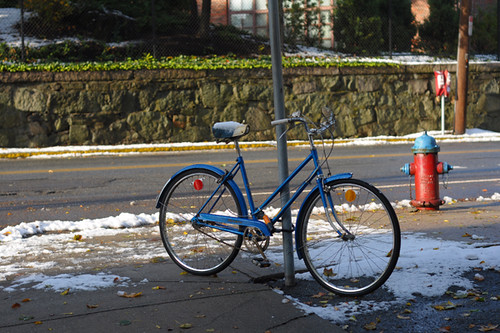
With the snow bound to arrive any week now, I am hearing local cyclists talk about "winter bikes" again. Before my first winter of cycling, the very notion surprised me. You're supposed to ride a different bike in the winter than you do during the rest of the year? why?? But then I understood that not everyone's transportation bicycle is a "tank" that is already winter-proof. Some bikes are more suitable for winter conditions than others. And while there is no one bicycle that is universally considered to be the ideal winter bike, there are certain characteristics most cyclists would probably agree are beneficial for winter commuting in snowy climates:
Stability:One reason the number of cyclists decreases so dramatically in the winter, is that cycling on ice and snow is scary. On the right bike, it is much less so. A winter bicycle should handle well on slippery, snowy, muddy and plow-ravaged winter roads. City bicycles and mountain bikes tend to do best in this respect. Those who commute on aggressive bikes during the warmer months may prefer a more relaxed and more upright bike for winter, with wider tires. If there is a great deal of snow where you live, studded tires could be a good idea, or at least knobby tires. Tame, predictable handling becomes much more important than speed in the winter months. Stepover is another factor to consider. A slippery road surface can make it easier to lose one's balance when mounting and dismounting a bike, and even those who normally ride diamond frames might prefer their winter bike to have a step-though frame or a sloping top tube.
Reliability:Related to the above, it is important that the bicycle's crucial functions - in particular, braking power and shifting ability - are not compromised by winter conditions. Rim brakes and derailleur gears can function poorly (or not at all) if clogged with snow or frozen over, which is why many prefer for their winter commuter to haveenclosed hub brakes and hub (or single speed) gearing.
Durability:Understandably, cyclists may not want to expose their nice bikes to freezing temperatures and road salt, for fear that doing so might damage the frame and components. This is why some recommend getting a "beater bike" for the winter. Personally I am uncomfortable with this advice, because a beater bike is unlikely to be reliable (see above). The approach I prefer is to get a bike that is not vulnerable to the elements in the first place. A tough paintjob, stainless and aluminum components where possible, hub gears and a chaincase should get your bike through the winter relatively unscathed with little maintenance.
Visibility: Not only does it get dark much earlier in the winter months, but snowfall can further decrease visibility - making good lighting more crucial than ever.
Presentability:Just because it's winter, does not mean that we are no longer expected to look presentable at work. With road conditions messier than ever, it is important that a winter bicycle be equipped with features that protect the cyclist's clothing: full fenders, and ideally a chaincase or chainguard.
Taken together, these features suggest a number of candidates that could work especially well as winter bikes. If buying new, fully equipped classic city bikes are worth looking into: They already offer hub gears, hub brakes, a full chaincase, a resilient powdercoated frame, stable handling, generous fenders and reasonably wide tires. Recently I wrote about city bikes with mountain bike heritage, which might be particularly appropriate due to their super-stable handling. For those who prefer to put a bike together from scratch, frames with horizontal dropouts (suitable for hub and single speed conversion) and clearances for reasonably wide tires are now easily available from a number of manufacturers:
Soma,
Surly,
Rawland,
Rivendell,
Salsa and
Velo Orange are just a few that come to mind. For extreme conditions there are even all-terrain models that will fit monstrously wide tires, such as the
Surly Pugsley and Moonlander, and the
Salsa Mukluk. If you prefer to refurbish a used bicycle, an old mountain bike converted to a single speed and fitted with some upright handlebars could work nicely. Same with a vintage 3-speed, fitted with a modern wheelset with hub brakes.
It goes without saying that not everything mentioned here will be applicable to every cyclist who reads this. The kind of winter bike that is ideal for you will depend on everything from the harshness of your winters, to the character of your route, to your bike handling skills, to your bike storage situation, to the amount of time you are willing to devote to bike maintenance, and to the type of clothing you wear when cycling for transportation. Your current bike may already be a winter bike, either as is or with minor modifications. Or you may need to get an additional bike specifically for winter cycling. My own preference gravitates toward classic city bicycles, and those I've owned have made great winter bikes. But I've been increasingly curious to try a mountain bike with knobby tires and see how that compares. What is your idea of a winter bike?

 The Park remains closed until further notice. For updated information, call 360 569 2211 ext 9.
 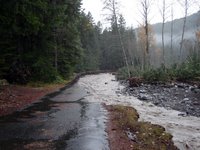 Aside from the rage of the Nisqually River, Longmire is a relatively quiet place. The NPS has closed its offices, and only essential personnel are allowed in through a backroad (which is largely washed out and requires shuttles). See image above, taken near the Eagle Peak Trailhead...
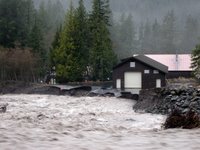 Longmire is isolated by washouts and mudflows, so it feels like a safe little island. Well, "safe" unless you're in the Emergency Operations Center (pictured left) which is being undermined by the Nisqually River... Oh, and some of the electrical and water systems are also damaged, but most of the facilities will probably survive the storm.
  Lassen Peak from the west side of Lake Manzanita on the afternoon of my arrival.
 A closer view of Lassen Peak from the west side of Lake Manzanita.
 On the morning of my second day at Lassen, a prescribed burn was being done by the Park Service on the northwest side of Lake Manzanita. The wind carried the smoke away from the campground area but the acrid smell of the burning brush permeated the air.
 I stopped at the visitors center, which was engulfed in smoke as it was in the direct path of the wind though a safe distance from the burn area, to get a park brochure and some information (it was closed when I arrived the night before). Even though the road through the park was not open, if you wanted to do some driving, you could access all four corners of the park. There were campgrounds on the south side so I could have gone that way and spent the night on that end of the park but it was in the opposite direction I was headed and would have added several more hours onto an already long trip. Instead, I relaxed around the campground and took a few short walks.


 I cut one Iris and took it inside to get a full view of it. From the petals tip-to-tip the flower is a little over 8" across. Several of the plants are "twins" with two blooms at the top of the stalk. There are 12 plants and most of them have 3 to 4 blooms coming on. Absolutely Gorgeous! flowers to feed the soul...

 Copyright © .. by Rebeckah R. Wiseman