Saturday, September 27, 2008

SNAIL OR CORKSCREW?


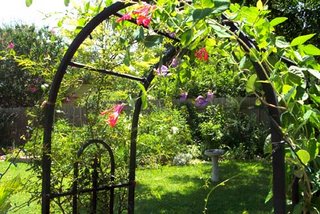
This floral combination on the metal arch is really pleasing me right now, although it sure is not what I’d planned. Earlier in spring, the Lady Banks yellow rose threw her yellow-blooming canes onto the arch from the left side. Now the native coral honeysuckle and what’s probably a Snail vine are growing up from the right side. In March, I was delighted to find the vine, supposed to be annual here, as inexpensive little plants from the Travis County Master Gardeners’ booth at Zilkerfest/Florarama, labeled as Vigna caracalla.

Before the fest, I’d been mining garden sites for information on Corkscrew and/or Snail vine, and found many heated and conflicting opinions. Some insist that Phaseolous caracalla refers only to Snail Vine, a related but separate genus, producing lavender, scentless blooms. They say that Vigna caracalla is the scented plant that is seen at Monticello. Other online experts were just as positive that Phaseolous was an outdated name, that the species was moved into Vigna, and that the scent and color were a result of selection, with both the fragrant and non-scented versions sharing the same name.

Naturally, I was hoping that mine would turn out to be the fragrant white one with blushes of yellow & purple, and thought it would look wonderful with the honeysuckle.

Just as naturally, both of mine turned out to be the lavender one with no fragrance. And the ants adore it. Although this snail vine may not have the scent and color of the corkscrew vine, growing it on the arch lets me see its intricate shape at eyelevel.

Thursday, September 25, 2008

Wild Flowers in the Mountains

I hope I am correct on these names. Purple is Bee Balm, then a type of ragweed, cat tails both a new green one and a dryed one, black-eyed-susans on the fence and later with grasshopper on it, small white is Queen Anne's Lace, larger white is bind weed (wild morning glory),

purple thisle (a new one and one that is fully open), milk weed seedpot, and a cone flower.


Wednesday, September 24, 2008

Devils Claw Wild Flower


Each summer I get a couple of these Devils Claw Wild Flowers. They are more common in other areas of the Southwest states than here, so I try to keep some of the seeds to replant. This is the leaves and blossom on one.

Sunday, September 21, 2008

Greek To Me

My cousin George Alec Cokinos made a copy of this photograph for me. It was taken in 1926 on Macomb Street near the corner of Wisconsin Avenue. The man in the picture is my grandfather, Peter George Cokinos. (That guy in the chair is actually our great grandmother from Greece.) My grandfather built and lived in the building to their left which is now Cactus Cantina.

Wednesday, September 17, 2008

Local Give-Away: Basil Tour Panniers


I've received an extra set of sample panniers from the Dutch bicycle accessory manufacturer Basil, to give away locally as I see fit. Can't decide who to give them to, so will use the blog and pick randomly. Local readers, this one's for you:


Basil Tour Panniers

silver and black

32cm x 12cm x 32cm

26L capacity


Reinforced construction in durable water-repellent 600D polyester; zipper side pockets, double reflective stripes on all sides, bands for LED/ straps/ child's seat. The panniers are a unit, connecting over the top of a rear rack. Inner edges are tapered to prevent heel strike on bikes with shorter chainstays. Good for commuting or touring.


Give-away terms:


1. You must be reasonably local, as defined by coming to claim the panniers in person from Broadway Bicycle in Cambridge MA.


2. You must have ridden your bike at least once since February 8th, of which you must supply photographic or verbally descriptive evidence in the comments here.


Otherwise, that's it. Hopefully, this will be a little pick me up for someone braving the snowy weather! If you'd like the panniers, leave a comment between now and 11:59pm tomorrow night (February 20th, ), and don't forget to include your email address. I will pick from eligible entries at random.


Basil is making an effort to streamline their North American distribution and we should be seeing more of their products in local bike shops soon. Many thanks to them for the sample panniers, and I hope the recipient enjoys them.

Monday, September 15, 2008

Achielle Oma: Handmade in Belgium

Achielle at Hudson Urban Bicycles

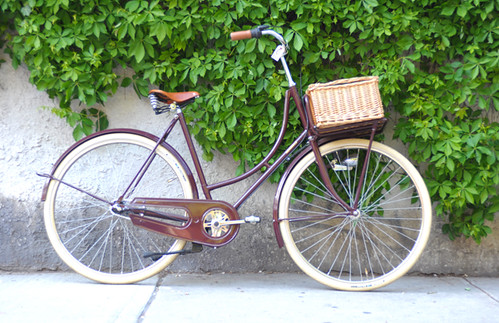
When I learned about Achielle Bicycles from a Belgian friend three years ago, I immediately wanted one - so much so that I contacted the manufacturer and considered buying one direct when I learned there was no American distributor. However shipping a single bike was expensive, and so Achielle did not end up being my first transportaion bicycle. But I remained interested in the manufacturer. Eventually they gained US distribution, but still I never heard of any bike shop that sold them. It was therefore entirely unexpected when I literally bumped into a wine-coloured Achielle Oma at Hudson Urban Bicycles in New York last week. I did not know they sold them, but there it was - the elusive bicycle I'd been admiring from afar all this time, just standing there and waiting for me to try it.


New Amsterdam Bicycle Fashion Show
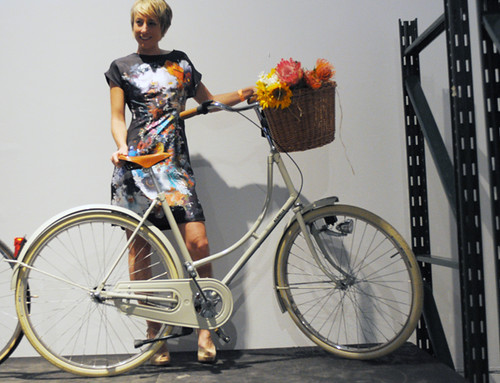
There was also a grayish-cream one in stock, being prepared for theNew Amsterdam Fashion Show.


The owner of HUB had no idea who I was, but knew I had no intention of buying the bike and just wanted to write about it on some blog.The shop was hectic, with everyone running around getting ready for the New Amsterdam Show, and it was almost closing time. Still, he got the bicycle ready for me and was very helpful - much appreciated. Many thanks also to Nona Varnado, who introduced me to HUB and vouched that I was not a bicycle thief. I test rode the Achielle and just barely managed to snap some pictures before the light faded.


Achielle at Hudson Urban Bicycles

So what makes Achielle bicycles such a big deal? Well, it is this: As far as I know they are the only production Dutch bikes that are still handmade locally from the frame up. Even the tubing is produced locally, according to the manufacturer. Does local production mean a bike is better made than had it been outsourced to the Far East? Not necessarily. Quality depends on skill, method and tools, not on a factory's location. But there is something to be said for bicycles that are produced 100% in-house, from frame to paint to assembly. Pashley does it in the UK with English Roadsters and Achielle does it on the continent with Dutch bikes. They are part of the special remaining few and they keep local manufacturing traditions alive.


Achielle has been making bicycles in the Flemish region of Belgium since 1946 and you can read a summary of their history here. The paint is by Dija-Oostcolor - Achielle's parent company. Because pretty much every aspect of production and assembly takes place in-house, a great deal of customisation is possible. But plenty of stock production models are available as well.


Achielle at Hudson Urban Bicycles
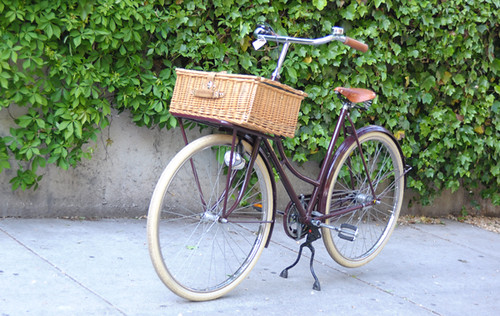
The model I rode is the Craighton Pick-Up Oma -a steel loop frame with 28" wheels, body colour fenders, chainguard and large front carrier. This bike was a 57cm frame, 3-speed with coaster brake only, fitted with cream tires, bottle dynamo lighting, double-legged kickstand, leather saddle and grips, and large wicker basket in front.


Achielle at Hudson Urban Bicycles

The Achielle Oma frame has all the features I value when it comes to craftsmanship. It is fully lugged, including the seat cluster, fork crown and even the loop connector. It also has the bolted rear triangle and the track ends in the rear that I prefer on a bike of this style. The frame is utilitarian and the lugwork is simple, there are no flourishes. But everything that I like to be there is there, and the quality of the finish looked excellent, with precise joints and no sloppiness or bulges anywhere along the frame.


Achielle at Hudson Urban Bicycles

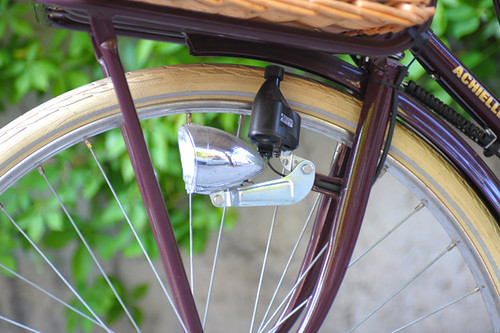
On a bicycle like this, I actually prefer to have a modern bottle dynamo to a hub generator, and Achielle has the option of a braze-on "arm" on the fork for this purpose. Both the bottle and the headlight attach there, making it possible to use a front carrier system without obscuring the headlight.


Achielle at Hudson Urban Bicycles

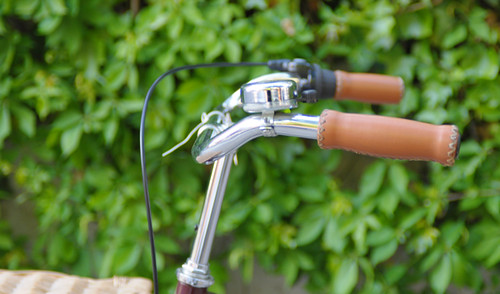
The classically high and swept back Dutch handlebars are near-identical to the set-up on my formerly owned 90s Gazelle.


Achielle at Hudson Urban Bicycles
Although this particular model has a one-sided chainguard and not a full chaincase, models with full chaincases are available also. A tail light is mysteriously absent here, but it is pictured on the Achielle website.


I rode the Oma briefly along the quiet streets of the West Village. It was exceptionally smooth and, by Dutch bike standards, fast. I did not feel that the weight of the front carrier and basket (with my jacket and camera inside) affected handling. However, the lack of front brake was a problem for me and kept me from testing the bike's speed limits to the extent I would have liked. For those considering the bike, a front caliper can be easily retro-fitted and there are options for a hub brake as well, but obviously this could not be done in the short amount of time I spent with the bike. I would love to do a long-term review of this bicycle with better pictures and more nuanced observations.


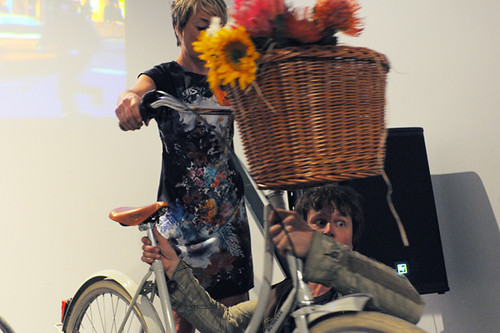
New Amsterdam Bicycle Fashion Show

The Achielle Oma is a classic Dutch bike in every respect, including weight savings not being a priority. It was funny to watch the model who posed with the bicycle at the New Amsterdam Bike Fashion Show "hand" the Achielle to the assistant whose job was to carry it off stage. This big-boned beauty can weigh upward of 45lb, depending on size and what accessories it is fitted with.Like all Dutch bikes, the Achielle Oma was designed to be stored outdoors or in sheds, not carried. And it is certainly durable enough for outdoor storage, as well as suitable as a winter bike.


Achielle at Hudson Urban Bicycles

Priced at $1,450 for the model shown, the Achielle is not inexpensive. But it is handmade in Belgium from scratch, it looks well-constructed and it handles well. The price simply reflects how much it costs to do that, with only modest profits being made by the manufacturer, distributor and retailer. For me, it is worth it. For others, maybe not. It is good to have options. Were I in the market for a Dutch bike today, Achielle would be the one.

Sunday, September 14, 2008

Souvenirs

While writing my post for the 45th edition of the Carnival of Genealogy, I looked for a picture of this car but couldn't find it then. In the background is our 1956 Nash Rambler Super Sedan, like the one pictured at Old Car and Truck Pictures, about halfway down the page.

My parents had just returned from a fishing trip to northern Minnesota with Dad's sister, Fern, and her husband and daughter. Doug, Jack, Terry and I are showing off the souvenirs they brought us. It was August 1957.

In July that year, Doug, Jack and I had gone on a trip to the Wisconsin Dells with Grandpa Vic and Aunt Shirley. It was the first time that we had been away from our parents and little sister. We were only gone for a few days but we still got homesick, or at least, that is what I've been told - many times!

When Mom and Dad were planning their trip to Minnesota they decided to split up us kids and parcel us out to several aunts and uncles. Doug went to Columbia City to stay with Aunt Phyllis and Uncle Walt. Jack and I were sent to Pierceton to stay with Aunt Jessie and Uncle Toby. Terry went to Goshen to stay with Aunt Leah and Uncle Shocky. I don't remember how long Mom and Dad were gone, probably a week. But at some point during that time someone decided that we kids needed to see each other. So Doug and Terry were brought to Pierceton since that was somewhat the "middle" distance between Goshen and Columbia City.

When the time came for Doug and Terry to go back to their respective temporary homes, apparently we all started crying and quite simply couldn't be separated. Each time one of them would get into the car the crying would resume. I'm sure there is some exaggeration on the part of the adults regarding the extent of the hugging and crying ;-) at least there are no pictures of that! Bottom line, we all ended up staying with Aunt Phyllis in Columbia City for the few remaining days until our parents returned. Hers was a full house with her own four children and the four of us, but comfy. And we were together. And it didn't matter that we had to sleep on the floor!

Saturday, September 13, 2008

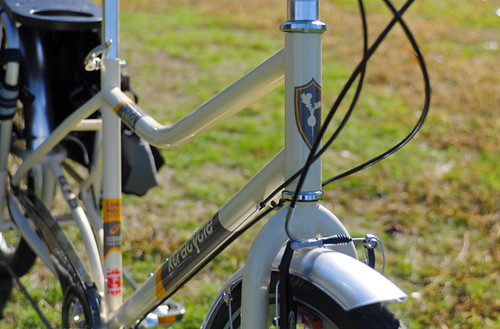
New Old Moser: a 400 Mile Assessment

Moser 2.0 New Lens
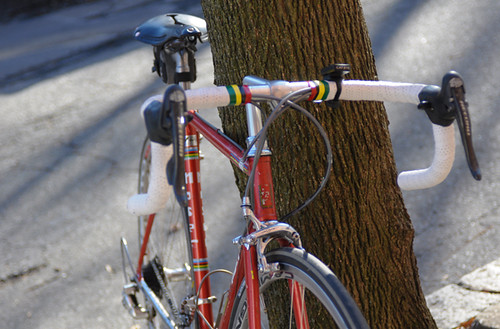
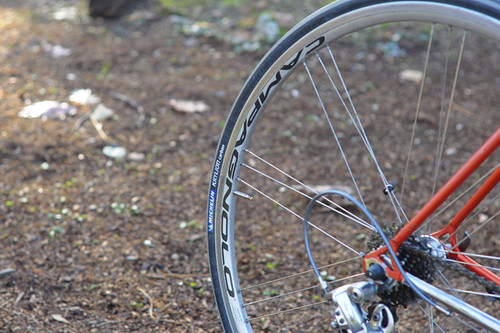
Having now ridden Moser 2.0 for about 400 miles, I think it is time for a report. For those who do not feel like reading about the bike's entire history, this is a lugged steel racing frame circa 1978 fitted with niceCampagnolocomponents circa 1999. The Columbus"tretubi" frame is 52x53cm, with an 11cm stem, handlebars 1cm below saddle level (I would like to set them lower, but the stem won't go down any further), 700Cx23mm tires, and 175mm cranks. Gearing is 52/39t in the front and 12-26t (9-speed)in the rear.The complete bike weighs 22lb without the waterbottle. I have been riding it since the end of November, and the individual rides have ranged from 30 to 60 miles. Mostly these have been group and club types of rides, and mostly with riders stronger and faster than me.


I know that people are interested in whether building up an older steel racing frame is feasible for "serious" roadcycling, and based on my experience with the Moser I do not see why not. As far as weight, 22lb is not bad at all for a complete bike - I have picked up new bikes with aluminum frames and carbon forks and they felt heavier. If I want to shave even more weight off, it could be done with some strategic component upgrades, but honestly I did not feel that the weight was an issue for someone at my level of ability.


Francesco Moser 2.0
As far as speed, I was able to ride with strong cycliststhe likes of which I did not think I'd be good enough to ride with,at what they call a social pace (15-18mph on average, depending on the ride), while also feeling some reserve. At no point did I feel "if only I had a faster bike!" while riding the Moser.


When climbing, the bike itself feels "eager" to ascend, and the only limitations I felt were my own and also the high gearing. I would need to get lower gearing in the long run, no question. But the bike itself was fine climbing. When I ran out of gears, I would simply "heave" us uphill. Sadly my legs no longer fit into my jeans as a result of this practice, but we can't have it all.


The ride quality on bad roads has no harshness to it despite the 23mm tires, I am very happy with this aspect. The frame's tubing feels wonderful and just right; perfect amount of flex and all that.


At slow speeds (and I mean very slow - like less than 10mph, when stalling in traffic) the Moser is a little twitchy (compared to my fond memories of the Seven at least, which remained stable even at a crawl), but I do not mind and can still easily control the bike.


The one and only inherent aspect of the handling that is a problem - and the more I ride, the more I realise it is a problem - is descending. I do not entirely understand what is going on and why. But basically at high speeds, the bike is extremely resistant to turning and this was rather scary to discover. At first I thought that I just needed to get used to being on a racy bike again, and that I was holding myself back because I was nervous. But nope, something odd is definitely happening with the high speed turns - not just 90° turns, but even following the curvature of a winding road on a descent. I cannot make the same turns that I know I had no trouble making on the Seven over the summer. So while the bike is capable of great speed, this handling issueultimately makes me slower, since I hold myself back on descents when I do not feel in full control of the bike. I've been trying to understand what is causing this, and what I can do to counteract it, but my instincts are failing me. Naturally I try to take wider turns, but it isn't always possible, and I am just never at a point where I can let myself go on descents.


Moser 2.0 New Lens
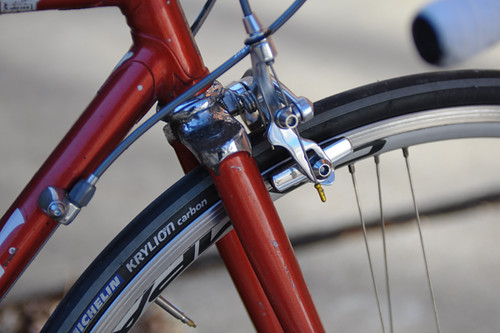
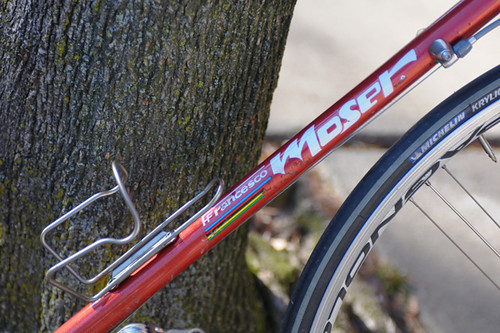
Exacerbating the descent problem is that I am not entirely happy with the braking power. I did not have a brakeset that would fit this bike, so I bought some CampagnoloVeloce calipers. While I realise that Veloce is not top of the line, I still expected it to be fully functional. I guess with my weak hands, not so much. We have adjusted the brakes this way and that, but coming to a complete stop (like at a stoplight or traffic light at the bottom of a hill) after a high speed descent is problematic.


Moser 2.0 New Lens
There are other issues that have surfaced in the course of riding the bike. For instance, there are only braze-ons for one bottle cage, and during longer rides I needed more water. I could get a second bolt-on bottle cage, but it seems a shame to do that to this frame. As mentioned before, there is also quite a bit of rust on the frame that is not visible in pictures (like along the underside of the top tube). It might make sense to get the frame stripped, the rust cleaned up, a second set bottle cage bosses brazed on, and then the frame repainted.


Moser 2.0 New Lens
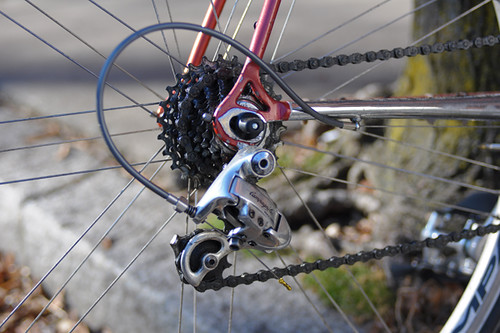
In addition, the rear wheel does not want to stay put in the chromed horizontal dropouts unless the skewer is tightened with a death grip. When initially the skewer was closed with reasonable force, it became misaligned and jammed against the chainstays the first time I rode the bike. It is now tightened as tighteningly as can be and this has not happened since. But it means that I cannot remove the wheels on my own despite them being quick-release; I am not strong enough to budge the skewers.


Moser 2.0 New Lens
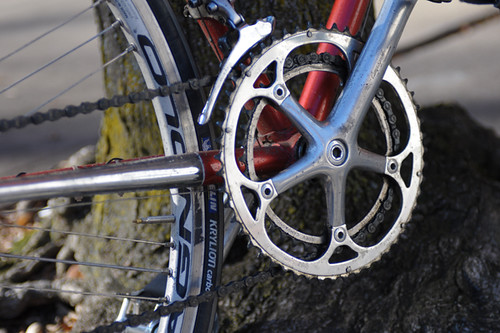
On top of the too-high gearing, the pedal strike from the 175mm cranks, and the too-tall stem, all in all that adds up to a lot of stuff I would have to replace on the bike (the crankset, the cassette, the brakes, and the stem at least)even without the re-paint and second bottle cage question. I would be willing to make this investment for sure if I was 100% comfortable with the bicycle's handling, but this problem with descents now has me concerned.


And that is where I am right now with my assessment of the bike. More than anything, this experiment has convinced me that I do very much need a fast road bike. Despite the issues mentioned here, I just wanted to ride-ride-ride it all the time, even in the winter. No time to ride? I found the time. Too cold? I got over it. Too early in the morning? Nonsense, the Moser beckons. Tamer, more sensible bikes are wonderful, but for whatever reason they do not have the same effect on me as this bicycle does and as the Seven did over the summer. I want a bicycle that is fast enough for club and paceline rides, comfortable over bad roads, and handles well for a ballance-challenged person like me. Is the Moser it? I love it and I hoped so, but I honestly don't know at this stage. Holding back on descents is a problem; I need to feel in full control of the bike if I am going to improve, not to mention for reasons of safety.
Tuesday, September 9, 2008

So, What was in that Box?

Well, it's been nearly 5 weeks since Denise Levenick issued a Treasure Hunt! A Challenge for Genea Bloggers so I should have had plenty of time to open and explore the contents of the box! But, as always it seems, time has gotten away from me and the box was still sitting in the same spot, unopened. Until last night.

I didn't really expect to find any valuable treasures within, but I'll admit I was a little surprised. It's been a little over two years since the box was packed up, and memory can be a funny thing. Just get my mother and her four siblings together telling family stories and you'll get five different versions of the same event! But I digress. Back to the box.

After cutting the tape and pulling out the crumpled newspaper that was used as a filler, the discoveries began. On top, several magazines, from the 1960s and 70s, in very good condition by the way, especially considering that they would have traveled with me to every duty station while I was in the Navy.

  • Kennedy And His Family in Pictures by the editors of Look. No date on the cover but one of the inside pages has a copyright date of 1963. It probably came out the week after his funeral. I was a sophomore in high school. Inside the pages was a "First Day Cover" envelope issued by the post office on May 29, 1964.
  • Flying Saucers was another special edition by the editors of Look, copyright 1967.
  • Apollo 11: On the Moon was a Look special edition that came out in late 1969. Sunday, July 20th, 1969 10:56:20 P.M. Neil Armstrong declared "That's one small step for a man, one giant leap for mankind." My youngest brother was graduating from Navy Basic Training at Great Lakes that weekend. Mom, my sister and I were there to visit him and spent some time glued to the television screen in the motel room.
  • There is life on the Moon. . . was a publication of Pace magazine in August 1969 and includes essays from Arthur C. Clarke, Wernher von Braun, Ray Bradbury and eight other scientists and science fiction writers. It was billed as a "down-to-earth" look at space.
  • Prizewinning Pictures from Life's photography contest was published on December 25, 1970. I was stationed at Norfolk, Virginia and pilfered this copy from the station library, where I was working at the time. I was hoping to get into the Navy's photography school.
Next up was a mess of cards, letters, photographs, and travel pamphlets. Just tossed in the box haphazardly. Most of the cards and letters are still in their envelopes. Birthday cards (predominantly that 50th milestone), along with notes from cousins and aunts. I haven't sorted through them yet to determine whether I want or need to keep them. They will temporarily go into another box for sorting at a later date. With the travel pamphlets were post cards and souvenir brochures, all from our trip to Mississippi and Louisiana the end of June and into July of ... Pascagoula, New Orleans, Monroe, Shiloh Battlefield in Tennessee.

Beneath that mess was a sheet of cardboard. At first I thought I had reached the bottom of the box but then realized I'd only gotten halfway down. Lifting the cardboard revealed, what else, but another box! Measuring 9x12 and 4" deep.

I totally do not remember this box! It may have been packed up when we sold the farm house in 1997, but I'm thinking it may have been earlier, back when I quit my job in Fort Wayne in 1986 and put all my belongings in storage for a year. Regardless, these are my treasures, rediscovered!
  • My birth certificate, issued in 1969 to prove my age for joining the Navy. Why is it a treasure? It includes my mother's maiden name. Current birth certificates issued by the state of Indiana no longer have that, they just have the mother's first name.
  • Several "at a glance" calendars from 1972, 1978, 1979. With sparse notes but enough to jog the old memory about certain events.
  • Letters. Letters that I thought had been lost. In a way, I guess they were. Being boxed up for 10 or maybe 20 years. Most appear to be from my time in Japan (May 1977-May 1979) and through school (Indiana State 1979-1982). From family, and from friends long relegated to the back recesses of my mind. I opened several, but they are all going back into the box for now. I'm just not sure I'm ready for the flood of emotions they are bringing back. Long lost, found again. These letters won't be making it into the pages of this blog!
Personal treasures partially revealed, to be put back for yet another day. I can only wonder what will happen to them after I'm gone. Who will be the one to re-discover them then and what will they think? The question becomes, for me, is this: Do I really want someone else to find some of the letters? Taken out of the context of my life their true meaning is lost. And, as with most discoveries more questions will arise than will be answered.

So, there you have it. Are my treasures valuable? Intrinsically, yes. Monetarily, no. But as a family researcher, where does their real value lie?

A Taste of the Radish

Xtracycle Radish

As anticipated after our meeting at Interbike,Xtracyclehas sent over a demo model of their Radish long tail cargo bike for me to test ride. I will be picking it up from Harris Cyclery next week, and after trying it for the first time a few days ago, I have a feeling we will get on nicely.Pioneers of the long tail concept, Xtracycle makes two main categories of products: the Free Radical, which is an extender kit that can turn almost any standard bike into a long tail, and a line of integrated longtail bikes. The step-through Radish model has been around since and is available in multiple configurations.The Radish pictured here is the Classic - designed to carry "groceries, cargo of all shapes and sizes, and adult passengers."


Xtracycle Radish

As the term "long-tail" suggests, the Radish sports an extended rear end: The back wheel is set back considerably, allowing space for a massive deck to extend along the chainstays. Other than that, the Radish looks like a fairly normal transportation bicycle: lowered stepover, swept-back handlebars, fenders, flat pedals and a chain guard. All it is missing is lights. Current retail prices for the Radish start at $1,220 for a complete bike, bags included.


Xtracycle Radish

California-designed and Taiwan built, the frame is welded cromoly steel. The complete bike weighs 43lb.


Xtracycle Radish

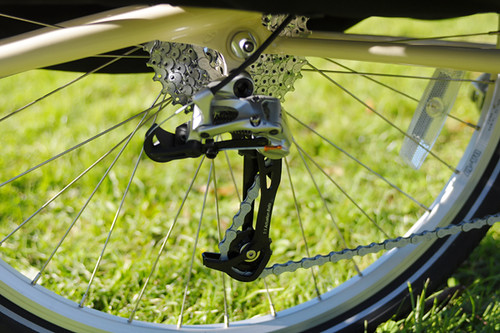
The 1x9 speed derailleur drivetrain is geared to provide a nice and useful range, including a low 1:1 gear.


Xtracycle Radish

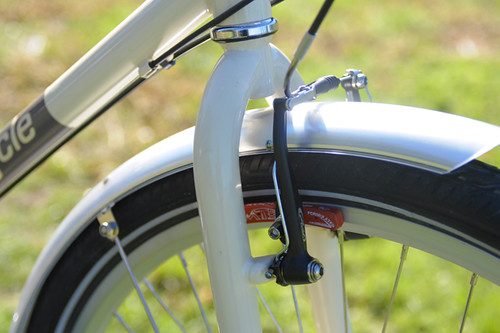
V-brakes front and rear.


Xtracycle Radish

The cargo deck can serve as a carrying platform for large objects and passengers. It also integrates with XtraCycle's expandable FreeLoader bags, as well as with the optional WideLoader side platforms (not pictured). I am going to experiment while the bike is in my possession and see how well this system accommodates the sort of cargo I am likely to carry.


Xtracycle Radish

My initial ride on the Radish was modest. First I rode it completely unloaded, just to see how it would handle in that state. Then I added some photo equipment, my laptop bag, and an armload of random heavy-ish items from Harris Cyclery for extra weight. Here are my first impression notes based on the (4 mile) test ride:


. The unloaded Radish felt surprisingly light to pick up, something the shop staff noticed as well.


. The Radishhandles like a normal, faster-than-average upright bike. There was no learning curve involved in riding it. I would wager that if you can ride an upright bike, you can handle the Radish.


. I could not feel the long-tailness of the bike, even when cornering.


. I could not sense a difference in handling or speed between the Radish unloaded vs lightly loaded. Apparently it will take a lot more than the equivalent of a week's worth of groceries, plus camera equipment, plus laptop bag, for me to feel anything back there.


. Ride quality over potholes was great (26" x 2" tires).


. I like the quick and efficient feel of the derailleur drivetrain.


. The geometry makes full leg extension possible when pedaling, while still allowing me to put a toe down at stops without dismounting.


Xtracycle Radish


. The quick release seatpost makes sharing the Radish easy.


. The stepover is pretty low, but still requires leaning the bike toward me in order to step over the top tube. It is not quite as low as a full-on step-through or loop frame.


. The size of the Radish makes it impractical for me to store it indoors (we have a tiny place). I wonder how it will fare when stored outside.


. While my impulse is to say that if the Radish were mine, I'd want a box permanently affixed to the rear, I will give the standard setup a fair chance before jumping to conclusions.


. Aesthetically, I have to admit that I like the Radish a lot; it just looks so darn friendly and adorable.


All of this combined leaves me in eager anticipation of truly putting this bike through its paces and experimenting with various types of cargo. If you are local and interested in taking it for a spin, the Radish remains for a few more days atHarris Cycleryin West Newton, MA, and will return there after my review.

Monday, September 8, 2008

Badlands :: Rolling in the Dust

Wednesday, August 24th - - The gravel road continued on for a few miles but I turned around and headed back to the main road. As I passed Sage Creek Basin Overlook the bison that had surrounded me a few minutes earlier had made their way off into the prairie. To my right another small band of buffalo were coming across the road. Traffic was stopped until long after they had passed.


Prairie Dogs provide a service to the buffalo by giving them a place to roll in the dirt! At the entrance to the burrows there is always a large pile of dirt that has been thrown up by the Prairie Dogs digging the tunnels. Hopefully, when a bison decides to roll in that dirt, the little fellows have made it safely underground!


Going down....


Really getting into it!


Ah, that felt good.


Giving it another go.


Shaking off the dust.


Feeling better, I'm sure!