Sunday, November 30, 2008

The Bobbin Birdie Flies to Iowa!


I hope that everyone is having a nice Valentine's Day - either celebrating it, ignoring it, or doing something delightfully un-Valentinesy, whatever your persuasion.


But what will thered Bobbin Birdiebe doing, you might ask? She will be spending the evening packing her bags, for soon she will fly to her new human friend in the Midwest. I would like to announce that the winner of the Valentine's Day Give-Away and the recipient of the Birdie is Audrey W., whose submission I repost below:


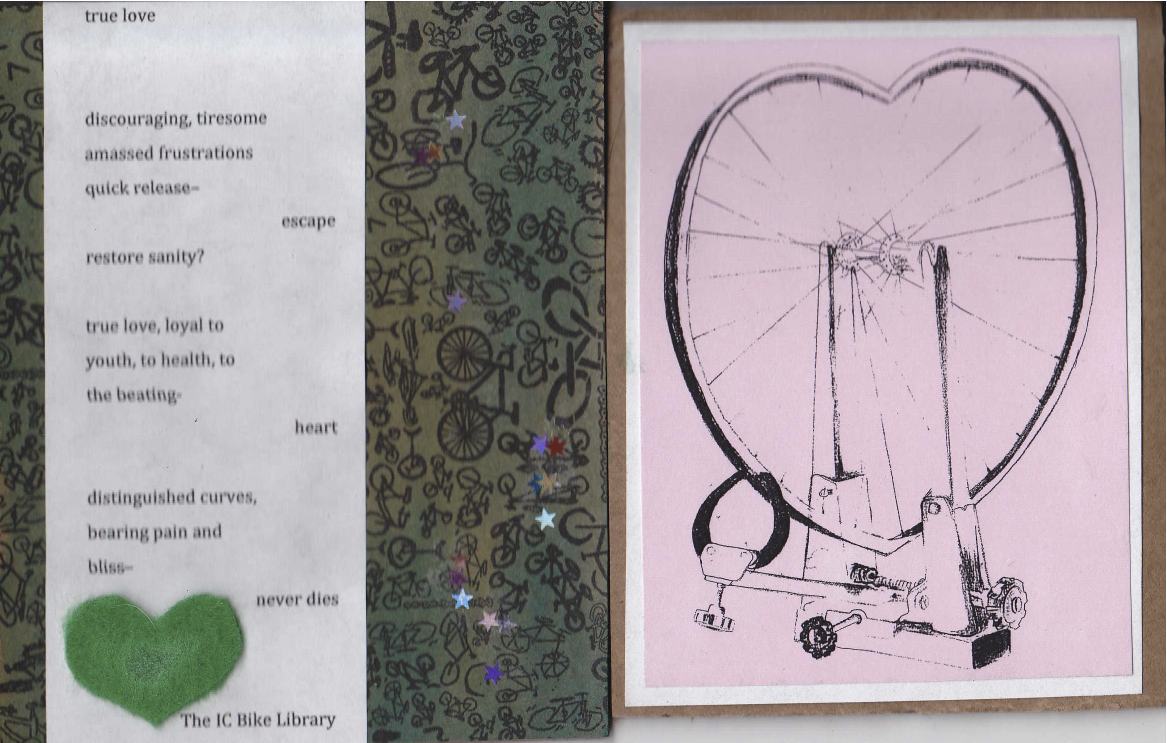
The photo is a little fuzzy, but a close look reveals details that struck me as both sweet and meaningful. On the right is a picture of a heart shaped wheel in a truing stand. And the poem on the left reads:


"true love

discouraging, tiresome
amassed frustrations
quick release–
escape
restore sanity?

true love, loyal to
youth, to health, to
the beating-
heart

celebrating curves,
bearing pain and
bliss–
eternal"


Though not as sleek in presentation as some of the other entries, the impact of Audrey's card stayed with me, and many readers reported the same effect in their feedback.


Audrey is involved inthe Bike Library in Iowa City, where she and the Birdie should feel right at home as a couple.Please join me in congratulating Audrey on her new bicycle!


I would like to thank everyone who submitted their poetry and art for this give-away (see the 15 finalists here). Your work brought joy to lots of readers, and I hope there is some satisfaction in that. Thank you also to those who gave feedback about their favourite entries; I read all the comments and they definitely influenced my decision. Finally, I would like to express my appreciation to the fellows atForth Floor - the North American distributor of Bobbin Bicycles -for sponsoring this give-away with no stipulations or strings attached. As always, thank you everyone for reading, and a lovely evening to all!

Friday, November 28, 2008

Fun in the Summertime!

Another picture of my grandmother (on the right) and her sister Jane. This time they are sharing a piece of watermelon. I don't recognize the background scenery so don't know where it was taken, but it was probably the summer of 1954.

And speaking of summertime fun, Jasia has published the Carnival of Genealogy, 49th Edition which "kicks-off" the 3rd year of the COG as well as summertime itself. Congratulations, Jasia, for starting the COG and keeping it going! I sure enjoyed seeing the variety of swimming attire displayed for all to see. What fun!


Jasia also announced the topic for the next edition of the Carnival of Genealogy: Family Pets! "Bring out those old photos of Snoopy, Garfield, Rex and Bob! Tell us the funny, charming, and cute stories about the pets you remember or remember hearing about. Introduce us to the furry, feathered, and scaly members who have a place on your family tree! The deadline for the next edition is June 15, .. and it will be hosted by none other than the flutaphone master himself, Bill West!" Submit your blog article to the next edition of the Carnival of Genealogy using the carnival submission form. Past posts and future hosts can be found on the blog carnival index page.The pooch pictured above is Buster who was a loveable, loyal, fierce protector of the family for many years. Photo taken about 1985.

Thursday, November 27, 2008

Warmington circular

With Barry, Eddie and Maureen. 8 miles. It stayed fine, though some of the ground was muddy. Rain began on the drive home.


We took a footpath opposite the small cemetery in Warmington, heading north and then east,

following field boundaries to begin with, then crossing a couple of fields to meet the road near Davey's Lodge. We turned left and after a longish half mile we turned right ( south-east) behind America Farm, and past some more farm buildings. We crossed another footpath and worked our way round the paths and footbridges marked Cold Harbour on the map, to head southwest, towards Lodge Farm. The building has a large kitchen garden, and some outbuildings. The route continues along a rough road towards and past Papley Cottages to the remains of a moat and the site of Papley medieval village.


Pond at site of medieval village of Papley

The sun came out as we had our coffee break.


Maureen and the blasted willow

We retraced our steps to the point where a path went off to the left (northwest). After a couple of fields another path crossed ours and we turned left [though we missed it at first and had to turn back!].


Hope they can read.


This path headed south west and emerged on to the road by a small wood.

We followed the road to the right past Toll Bar Gate, where it swings left and later right by Miriam's Cover. At the end of the wood there is a crossroads - we went straight over and after a few hundred yards, just past a large farm (Tansor Wold Farm) the path went off to the right.

At this point there was quite a trek through rape fields, and some grass fields.


Warmington was in sight when we got through the gap


The last lap.

And back to Warmington.


I Like Coffee, I Like Tea...

Tea on a Bike

It's hard not to notice that many cyclists are also avid coffee drinkers. I guess I am too, in the sense that I am thoroughly addicted and must drink several cups a day in order to function. But I am not a coffee connoisseur. I am okay with most espresso blends. I keep it simple with a French press. I add a bit of milk. And I prefer a nice big mug over a dainty cup. After more than two decades of drinking the stuff, I have never felt compelled to explore the world of coffee beyond this.


Tea, on the other hand, has always been a danger zone - something that I sensed could plunge me into yet another crazy hobby. Perhaps that is why I've mostly played it safe and stuck to grocery-store tea bags. I did not want to cross that line.


That is, until recently. There has been a lot of tea drinking at my house this winter and at some point I was gifted a teapot and some loose tea. Long story short, I now have a small collection of delicious teas, about the properties and history of which I know more than I care to admit. It wasn't long before I began to develop my own masala chai recipe, andpurchased a dedicated Tokoname kyusu for green tea. Right...


Well, at least playing around with this stuff has kept me sane over the past couple of months - althoughI use the term "sane" loosely. Earlier today I was debating the idea of a Mobile Tea Party. Inspired by conversations with Jacquie Phelan and by memories of theXtracycle displayat the last Interbike, I had the idea to install a samovar on the back of a bike and turn it into a neighbourhood Tea Chariot. Say a driver is cranky sitting in traffic - I can offer them some tea. A passing cyclist looks thirsty? Cuppa tea. Pedestrian in need of refreshment? Tea! Heck, I can even drink some myself at red lights.


Sadly, I don't think it is feasible to boil water via pedal power while cycling around the neighbourhood. According to this video, it took11 cyclists on bike generators to boil 1 cup of water with a 1kW kettle! But it's a nice idea. And probably a sign that I should put down the tea (it's Darjeeling tonight) and get out of the house more.


So: coffee or tea? What's you preference and how into it are you?

Wednesday, November 26, 2008

Chiricahua Revisited

As I drove south the morning of April 22nd the weather was nice. I was even greeted by a few wild flowers blooming along the side of the highway.


But you see those clouds in the distance. Not a good sign. Nope, not at all... Stopping briefly in Willcox, I continued on to Chiricahua. I got to the turn off to the park, saw the dark clouds hanging low over the mountains four miles away and quickly turned around and went back to Willcox. I knew that the campground was in a canyon beneath a canopy of trees that provided a good deal of shade. Seeing that layer of dark clouds overhead, I also knew that there would be no sun penetrating into the valley.

I ventured a few miles to the west, over the next range of mountains, to the town of Benson where I knew there was a State Park (Kartchner Caverns). When I got there, the weather looked good. It was relatively warm and the sun was shining. However, before long that changed. The dark clouds moved in as did the rain – the campground host said there was a possibility of snow that night!

The view from the van, near dusk. It was getting cold.

And this is the next morning, after I had cleared off the windows, which were caked with heavy, wet snow. It was just cold enough to make it uncomfortable. I left Kartchner Caverns a few minutes after this picture was taken. I stopped to use the internet and checked the weather....with the forecast in hand, I returned to Chiricahua National Monument.

The mountains along the highway to Chiricahua were topped by a layer of clouds, but blue sky was starting to make an appearance, as was the sun!

The view from Faraway Ranch in Bonita Canyon at the entrance to Chiricahua National Monument, taken in early afternoon of April 23rd. As I set up my tent, there was a brief sprinkling of a rain-snow mix but not enough to cover the ground. Within two hours the clouds had nearly cleared up and the sun was shining. It turned into a beautiful day!

By evening, the clouds had moved back in, making for a dramatic sunset with the distant mountains as a backdrop.

Morning at Monahans Sandhills

Wednesday, April 6th - - It was a beautiful morning! Cool temperatures required a sweatshirt but it was quite comfortable. There was barely even a breeze!


Yesterday, I mentioned that the traffic couldn't be heard on the Interstate here in the campground. Today was a different day. You could clearly hear the hum/buzz/roar of the cars and trucks passing by. From the top of the sandhill that I was on you could even see the highway. Nevertheless, it was still quite pleasant.


I may be “off the grid” for a few days and no posts have been scheduled so things will be quiet here for a while...


Monday, November 24, 2008

Mt. Adams


Mt. Adams from the Southwest.


Carbo-loading at the Cold Springs base camp.


High camp at Lunch Counter.


Climbers on the South face.


A beautiful day on the summit.


The 2,000' glissade down to Lunch Counter.


videoDani glissading.


videoWipeout!

Saturday, November 22, 2008

Blue Snake


The first time my husband and I saw a blue snake, it took us forever to figure out what it was.

"There's no picture in this book of a blue snake. Argh!"

"The internet shows no blue snakes in Alabama. Arrrgh!"

"There's no such thing as a blue snake. Arrrrrrrgh!"

Only by reading the fine print did we realize that the Rough Green Snake (Opheodrys aestivus) turns blue after death.

The Smooth Green Snake (Opheodrys [Liochlorophis] vernalis) does the same thing, but they're a more northerly or westerly snake and are not in Alabama.

The snake's green color is made up of blue and yellow pigments in its skin. When it dies, the yellow fades more quickly, so the snake looks blue.

This one looks like he had a little run-in with the postal service. They've also been known to come out on the wrong end of duels with lawnmowers.

(And talk about holding your breath until you turn blue!)

---

This site sugguests that the snakes can also turn blue when excited.

Here's another cool pic of the snakes.

Tuesday, November 18, 2008

The Children of Sophia Hazlett and James Dunfee

I thought that before going further back in time, I'd provide a brief synopsis of what is known of the (presumed) children of James and Sophia (Hazlett) Dunfee. If you are a descendant and you see this, you will contact me, won't you? Please leave a comment or send me an email at kinexxions “at” gmail “dot” com. Especially if you can provide additional clues on the parents of James Dunfee and Sophia Hazlett. Future posts will provide details on these families.


This chart, created by my grandmother in the 1960s, shows what she knew of the family of James and Sophia (Hazlett) Dunfee and was the starting point for my research.


In the 1882 biography of Jonathan S. Dunfee it stated that he was one of 13 children. I am fairly confident that the 10 listed below are the children of James and Sophia (Hazlett) Dunfee though I have found no substantiating “proof” for several of them. I am "missing" 3 children. If anyone knows who they are or where they lived, I'd appreciate hearing from you ;-)


A letter, written in 1849 by Sophia (Hazlett) Dunfee to William and Catherine Dunfee mentions six family members, presumed to be their children: George, Mary, Jonathan, Henry, Lucy, and Sarah. And of course, the letter confirms that William is their son, giving us the names of seven probable children. The letter also states that William's baby was their 21st grandchild. I have found 16 of those 21 grandchildren who were born by the time the letter was written. In all, I have found 58 grandchildren of James and Sophia, born 1837-1879!

  • Eliza Dunfee. Census records put her year of birth at 1811, 1813, or 1815 and place of birth in Maryland or Pennsylvania. Eliza married Aquilla Hoff on September 4, 1851 in Ashland County, Ohio. They were the parents of one son. A little over a year ago I wrote about a response I received on an 11 year old query posted on Eliza and Aquilla. In the 1850 census of Ashland County, Eliza Dunfee was residing in the household of Jonathan Hazlett. Eliza Hoff died on August 6, 1876 in Lagrange County, Indiana. I have no “proof” that Eliza is a daughter of James and Sophia. The fact that she was living with Jonathan Hazlett in 1850 is really the only connection.

  • George Dunfee was born November 22, 1814 in Pennsylvania and died November 3, 1871 probably in Dekalb County, Indiana. He is buried in Corunna Cemetery, Fairfield Township, Dekalb County, Indiana. His wife's name was Nancy and they were the parents of five children. On February 21, 1848, Jonathan S. Dunfee of the county of Holmes, State of Ohio, sold 160 acres of land in Dekalb county, Indiana to George Dunfee of the county of Ashland, State of Ohio for $600. (NW 1/4 S24 T35N R12E). This land was not far from that of David and Sophia Dunfee McNabb.

  • Mary Dunfee was born March 19, 1816 in Adams County, Pennsylvania. She was first married to Isaac Bonnet on March 25, 1836 in Wayne County, Ohio. He died on February 2, 1846. Two years later she was married to James Hanson Lovett. Mary Dunfee Bonnet Lovett died on March 25, 1900. She is buried in the Pioneer/Old Sixteen Cemetery in Lake Township, Ashland County, Ohio next to her first husband. Mary was the mother of eight children, five with Isaac Bonnett and three with James Lovett.

  • Catharine Jane Dunfee (known as Kitte Jane according to my grandmother's notes) was born April 13, 1818 in Pennsylvania. She married Moses Tryon on December 29, 1836 in Wayne County, Ohio. She died January 5, 1893 in Noble County, Indiana and is buried next to her husband in Allen Chapel Cemetery in Allen Township, Noble County, Indiana. They were the parents of ten children.

  • William Hamilton Dunfee was born April 10, 1822 in Adams County, Pennsylvania. He was married to Catherine B. Jones on March 5, 1848 in Whitley County, Indiana. He died May 29, 1888 in Columbia Township, Whitley County, Indiana. William and Catherine are my 3rd great grandparents. They were the parents of seven children of whom only three survived to adulthood. Their second child was Sophia Elizabeth Dunfee (named after her grandmother, Sophia Elizabeth Hazlett). Sophia Dunfee married William Pythagrus Wise. They are my 2nd great grandparents. They named their fourth and last child Hazlette, turning a surname into a first name - and, my grandmother was also named Hazlette.

  • Sophia Dunfee was born August 13, 1824 in Adams County, Pennsylvania. She married David McNabb on October 18, 1842 somewhere in Ohio (no record has been found in the areas where the family lived). They moved to Dekalb County, Indiana prior to 1850 and were the parents of eight children. Sophia died on December 31, 1905. She and David are buried there in Corunna Cemetery in Fairfield Township. The 1885 biography of David McNabb (History of Dekalb County, Indiana Vol 2, Interstate, p577-578) states that she is “a daughter of James and Sophie (Hazlett) Dunfee who moved from Adams County, Pa., to Ohio in 1833.” In addition, the WPA publication of Dekalb County Death Records 1899-1920, p214 gives her father as James Dunfee, born Pennsylvania, and her mother as Sophia Hazellet, born Pennsylvania.

  • Jonathan Smith Dunfee was born June 9, 1826 in Adams County, Pennsylvania. He was married on October 19, 1848 in Holmes County, Ohio to Mary Ann Quick. They moved to Whitley County, Indiana prior to 1860 where they raised their family of seven children. Jonathan died on April 22, 1900 and he and Mary Ann are buried in Evergreen Cemetery in Jefferson Township. The 1882 biography of Jonathan (Counties of Whitley and Noble, Indiana; Goodspeed, 1882 p394-395) states that he “is a son of James and Sophie (Hazlett) Dunfee.” His death record lists his parents as Jas. Dunfee and Sophia Hazelot.

  • James Henry Dunfee (aka Henry or J. Henry) was born about 1828, probably in Adams County, Pennsylvania. He was married on June 25, 1854 to Elizabeth Moores (Moor in the marriage record) in Ashland County, Ohio. They moved to Whitley County, Indiana shortly after their marriage but at some point moved to Aboite Township, Allen County, Indiana where he died on July 3, 1872. James Henry and Elizabeth are buried in the Masonic Cemetery in Columbia City, Whitley County, Indiana. They were the parents of eight children. A land transaction links James Henry to James and Sophia but does not conclusively prove that he is their son: James H. Dunfee and his wife Elisabeth sold two acres to James Dunfee for $10 on March 15, 1855.

  • Lucy Dunfee was born September 17, 1834 in Ohio. She came with her parents to Whitley County, Indiana about 1855. She died there on December 28, 1870 and is buried near her parents in Evergreen Cemetery, Jefferson Township, Whitley County, Indiana.

  • Sarah Ann Dunfee was born August 27, 1839 in Ohio and also came with her parents to Whitley County, Indiana about 1855. Sarah was married to Charles Henry Gillespie on August 7, 1862 in Whitley County and they had one child. It is not known what happened to Mr. Gillespie but on June 8, 1873 Sarah was married to John Robinette in Whitley County. They were the parents of three children. Sarah died on August 8, 1914 and is buried next to husband John in the Sandbank-Jefferson Chapel Cemetery in Jefferson Township, Whitley County, Indiana. The transcribed Whitley County, Indiana Death Records for Sarah Robinette gives her father as James Denfen and her mother as Sofia Hasht. I viewed the record book but was unable to obtain a copy of the record. The names looked to me like James Dunfee and Sofia Haslet.


For additional information see Dunfee Family :: Index to Posts


Wool/Poly Blends for Cycling?

Sportwool, MerinoPerform

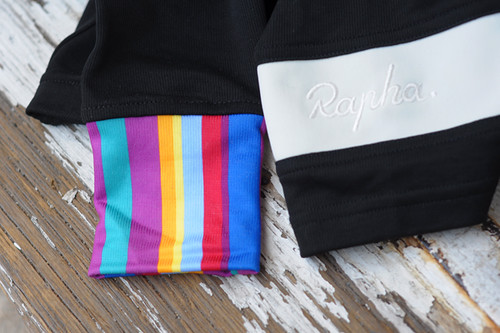
While merino wool has become a popular fabric choice for bicycle clothing, it seems that many manufacturers choose to use wool/polyester blends instead of pure merino, believing that the right combination can deliver the best results. Rapha and Road Holland use a fabric called SportWool. Shutt Velo Rapide usesMerinoPerform. Swobo refers to their blend as Merino 753. I am sure there are other proprietary names, but judging by the descriptions of these fabrics the idea is essentially the same: The blend is formulated to have wool fibers on the inside and polyester fibers on the outside, which the manufacturers believe delivers ideal performance properties.


Sportwool, MerinoPerform

Observing the way these blends have been marketed over the past couple of years, I've noticed an interesting dichotomy. The fiber content shows that merino comprises only 20-40% of it, whereas polyester comprises 60-80%. Yet the names of the blends inevitably feature the words "merino" and "wool," with no mention of the dominant synthetic content. To me this suggests that the manufacturers are eager to promote their use of wool given its current popularity, but in fact do not believe it is possible for wool to be a performance fabric - hence the idea that wool needs to be improved upon (by adding polyester) in order to be used in cycling clothing. All of this has made me highly skeptical about the wool/poly blends. But over the past few months I've had the opportunity to wear several garments made of these fabrics, and gave them an open-minded try. What follows are my impressions.


Sportwool, MerinoPerform

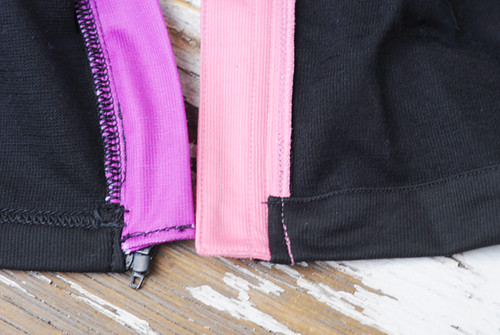
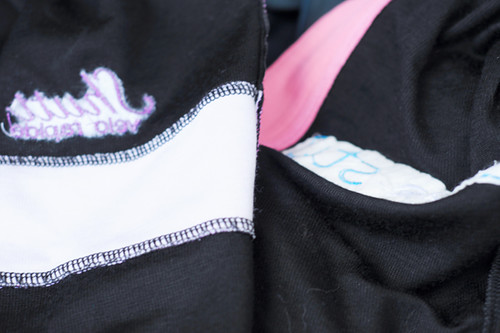
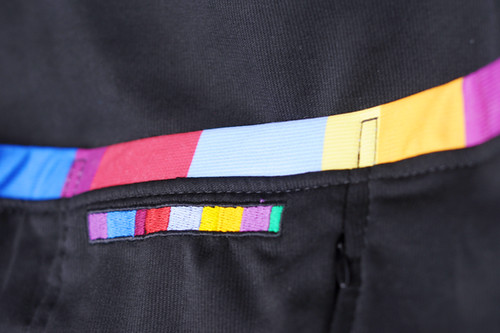
Having joined a local cycling club last December, I receivedtheir club jersey (right), which happens to be made by Rapha out of the aforementioned SportWool. A couple of months later, I received some items for review from Shutt Velo Rapide, including the Women's Training jersey (left), made of MerinoPerform. Both jerseys are 40% wool, 60% polyester. The texture and weight of the fabrics appear to be identical.


Sportwool, MerinoPerform

On the outside, the wool blend fabric is smooth and has a slight sheen to it.On the inside it is matte, soft and slightly textured. To the touch, neither the outside nor the inside feels like true merino, but the inside comes closer.


I have worn both jerseys over a (thin, 100% wool) base layer as well as directly next to my skin. I am sensitive to polyester was was curious whether this blend would engage that sensitivity.


Sportwool
In cooler weather, over a base layer, both jerseys feel pretty good. In fact, as mid/outer layers, I have to admit they regulate temperature better for me than the pure wool equivalents I own. I do not experience any sensitivity wearing either of these jerseys over a wool base layer.


However, worn directly next to skin I found the jerseys inferior to the pure wool alternatives. In warm weather the wool/poly blends do not breathe as well for me, and I feel clammy wearing them. I also find them less versatile for temperature regulation when worn on their own. On one ride I found myself too hot in the jersey at 85°F and too cold at the end of the ride at 65°F. I know that my long sleeve 100% wool jerseys are more versatile over the same temperature range.


MerinoPerform
Rapha, Shutt Velo Rapide and Road Holland each offer lighter weight versions of their wool blend jerseys in an airy eyelet fabric. I've tried the one by Shutt Velo Rapide (above) and it did keep me cool in hot weather. The downside was that as soon as the temperature dropped a bit, I felt chilly. In my experience, pure wool is just more versatile in this respect.


As far as polyester sensitivity, I experienced it with the Rapha jersey when worn directly next to skin, but not with the Shutt Velo Rapide jerseys. I think the reason is simply that the former fits me tighter, so it comes into closer contact with my skin. Either way, after wearing the Rapha jersey in 80°F weather without a base layer underneath, I promptly got a rash under my arms. To be safe, I won't be wearing either of the wool blend jerseys without a base layer again.


MerinoPerform
Finally, some are probably wondering about the BO factor. Wool is well known for its odor-resistant properties, whereas polyester is known for quite the opposite. I found these jerseys to be somewhere in the middle in that respect, but closer to polyester.


In summary, I have learned that for me the wool/polyester blends function extremely well as outer and mid layers in cool to freezing temperatures. However, they do not function well for me when worn directly next to skin in warmer temperatures - both failing to provide the same temperature regulation as pure wool and activating my polyester sensitivity when coming into close contact with my body.


I am curious about others' experiences with wool/polyester blend fabrics from these and any other manufacturers. How do you find them for cycling compared to 100% wool or 100% synthetics?

Monday, November 17, 2008

Gray Sunset over Iceberg Bay


Last night's sunset looked promising for good color right up until the sun went down. Just as the sun was going down the clouds moved in and cancelled the chance of any colorful sky. Still, I found a nice shoreline to photograph and had lots of fun viewing the ice and watching these icebergs roll around in the waves.


Saturday, November 15, 2008

Scaring Away the Cold with a Balaclava

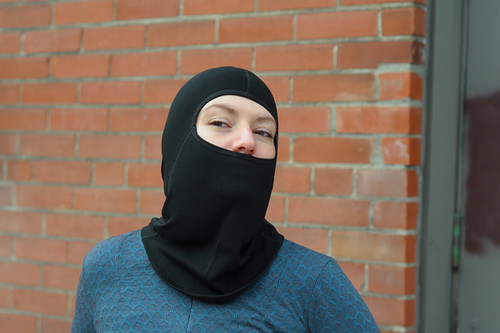
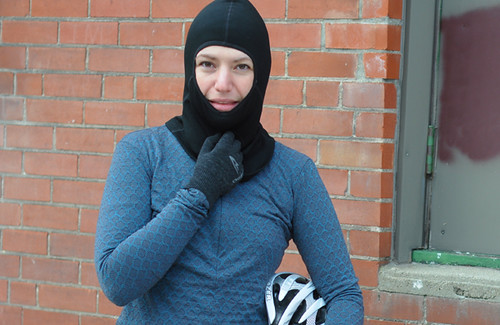
Ibex BalaclavaOf all the winter cycling accessories out there, none can match the formidable powers of the balaclava. I daresay few garments will make a "cycle chic" photographer withdraw his camera faster. And what other article of clothing is capable of striking fear into bank tellers?As universally unflattering as it is terrifying, the balaclava is not an item one would purchase casually. You've got to get to the point where you really, really needit.For me that point came one December morning. As I pedaled my roadbike against a brutal headwind with temperatures in the 30s, I felt ready to give the dreaded balaclava a try. The one you see here is from Ibex, sent to me for review.

Broadly speaking, a balaclava is a garment that covers the entire head and neck in order to protect the wearer from the cold, exposing only small parts of the face. The Ibex balaclava has an opening for the eyes and nose, but covers the mouth completely. It is form-fitting, closely hugging the contours of the back of the skull, browbone and cheekbones. It is made in the USA of soft and lightweight merino wool (18.5 micron) with flat seams, one size fits all.

Ibex BalaclavaMy interest in a balaclava is specific to roadcycling. Going at speeds of over 20mph in a leaned-forward position, my face takes the brunt of the harsh winter wind and this can feel extremely uncomfortable. The close fit of the Ibex balaclava is an advantage here: the opening is so tight that it feels almost elasticised; wind does not enter through it while cycling at high speeds. The thin fabric and close fit also make it comfortable to wear under a road helmet when I don one for organised rides: There is no bunching up or slippage. I would say that Ibex's take on the balaclava is designed for athletic activities, such as skiing and winter cycling, rather than for casual wear. Everything stays in its place, and the technical merino fabric forms a tightly woven layer of protection against the wind that feels feather-light and pleasant against the skin.

Ibex BalaclavaThe inevitable downside of such a precise and form-fitting design, is that there is no versatility in how this garmentcan be worn. While in some balaclavas the lower portion can be stretched down to expose the mouth or pulled up to cover everything but the eyes, this is not possible with the Ibex version. In order to expose my mouth, I have to stretch the opening forcefully and as soon as I let go my mouth is again covered. Likewise, covering the nose would not be possible. For me that is probably a good thing, because covering my nose with fabric in the past felt constricting and uncomfortable. Even having my mouth covered feels somewhat restrictive and will take some getting used to.

Like most balaclavas, this one is profoundly unflattering - particularly to a face like mine, that becomes all nose and eyebrows once the other features are hidden. So if you're going to rock this, you basically have to not give a straw about how you look for the time being. Also, consider that drivers will be seeing less of your facial features and hair, which, in theory, could interfere with them fully processing you as a real, vulnerable human.

I am not sure yet whether I will be keeping the Ibex balaclava. Current retail price is $30, and I consider that a good deal for a US-made 100% merino product. As a roadcycling-specific garment I think it works well, but the sensation of having my mouth covered might just be out of my comfort zone. Have you worn a balaclava for cycling in the winter? Your thoughts, experiences, and recommendations appreciated.

Thursday, November 13, 2008

Las Trampas Leaves


Las Trampas Leaves, originally uploaded by ParsecTraveller.

Although it's not as pronounced as on the East Coast, there is some fall color in California. This tree in Las Trampas was particularly bright.

Anybody else have fall colors nearby?

Sunday, November 9, 2008

Trompe L'Oeil Lugwork

DIY Lugged

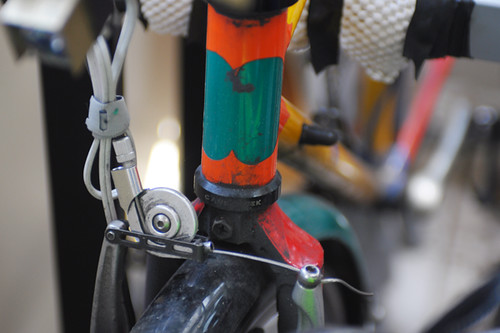
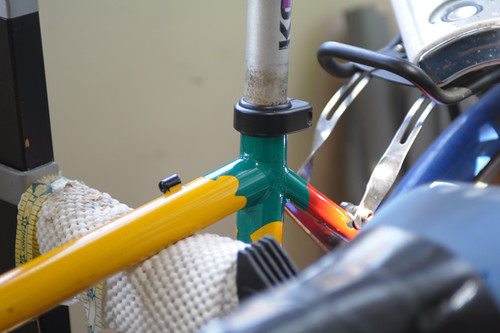
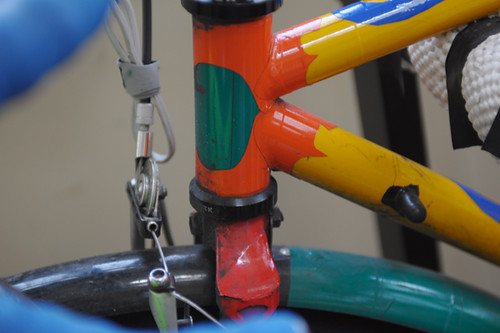
Having mentioned the idea of doing this as a joke some time ago, imagine my delight when I saw it in the wild: trompe l'oeil lugwork! Standing in the parlor of local pickelleur (randonneuring Dill Pickle bag maker) Emily O'Brien, when I first saw the bike across the room the illusion looked quite real. I figured it was an old beater frame, with the lugs spray painted to contrast the tubes. Then I got closer and realised the lugs looked unusually flat, and finally it hit me: They'd been cut out of tape and wrapped around the welded frame joints.


DIY Lugged

And lest you think this project is only about the fabulous looks, it does have practical merit: The tape is reflective. Just imagine the beautiful lugs glowing in the dark... A fun DIY idea to spruce up a boring frame in any event.


DIY Lugged

Apparently I am not the only one to have been fooled from a distance, as cyclists stop Emily all the time to ask about the interesting bike, usually assuming it is something vintage and Italian. Any guess as to what this bike is? Hint 1: It's a ubiquitous modern steel bike. Hint 2: The fork crown is lugged for real.

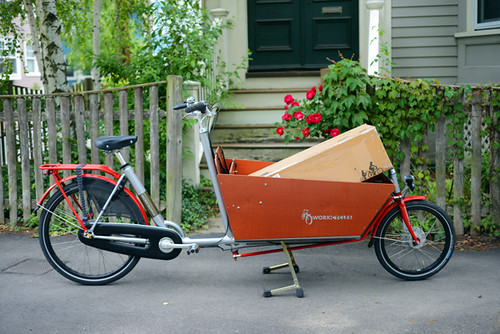
Workcycles Bakfiets Long

Workcycles Bakfiets Long

A year and a half ago I tried a Bakfiets at a friend's bike shop in Vienna. These iconic Dutch cargo bikes are available in two lengths and the one I rode then was the short version. Now a bike-friend in Boston has acquired the Bakfiets Long, and I've had a chance to ride that as well. Aside from the larger size, I was curious how a bike like this would translate locally. Compared to the center of Vienna, our part of Boston is both hillier and less bike-friendly. Would I feel comfortable mixing it up with car traffic on a bike like this? What about cycling up the inclines I regularly encounter even on shorter commutes? These are the aspects of the bike I mostly focused on this time around.
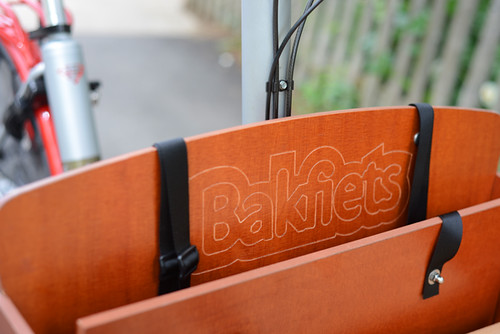


Workcycles Bakfiets Long


To recap: The term bakfiets (plural: bakfietsen) literally translates to "box bike." The modern incarnation of this front-load hauler was designed by Maartin van Andel of bakfiets.nl. Those machines branded with the Workcycles name have been outfitted with upgraded components by the Amsterdam-based concern, but are essentially the same bikes (you can read about the Workcycles version of the bakfiets here). The steel frames are manufactured and powdercoated by Azor. Prices for complete bikes are in the $3,000s range, depending on options.
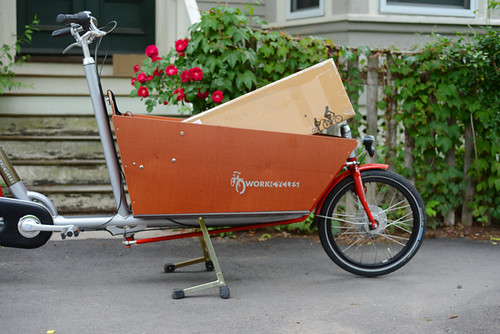


Workcycles Bakfiets Long

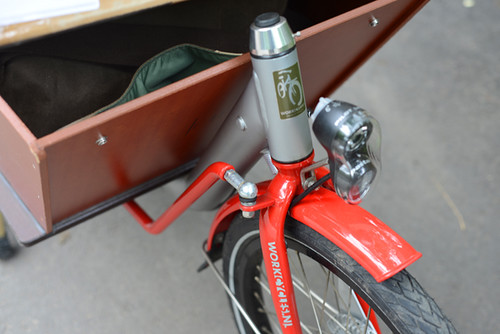
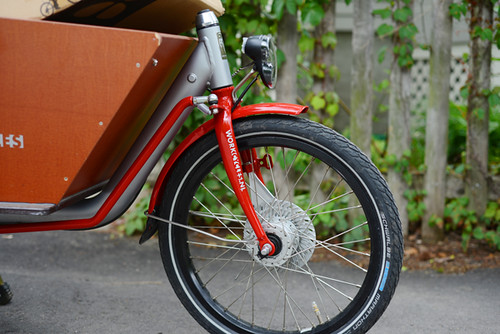
A handsome plywood box sits low upon the extended frame, between the rider and the 20" front wheel (the rear wheel is 26"). There are essentially two head tubes, connected by a linkage system.In my previous write-up readers requested shots of the steering linkage, so I made sure to get them this time.
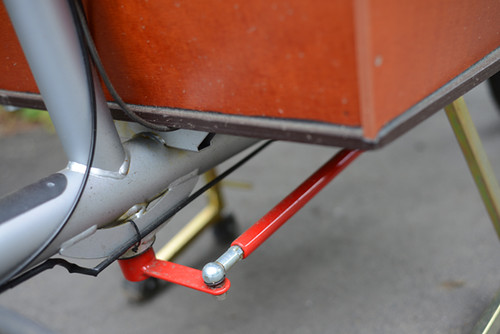


Workcycles Bakfiets Long

Here you go.


Workcycles Bakfiets Long
And here. And here.


Workcycles Bakfiets Long

As the rider turns the handlebars, the steering is activated through the linkage and the front wheel turns.


Workcycles Bakfiets Long

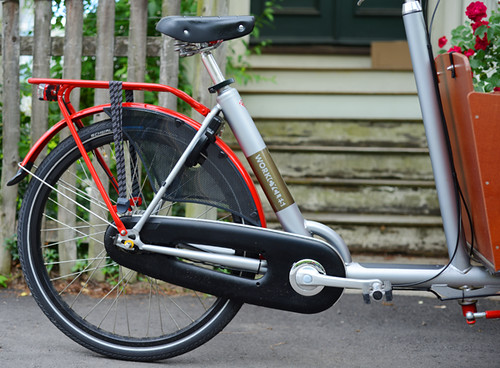
Like most traditional Dutch city bikes, the bakfiets comes equipped with fenders, a full chaincase, dress guards, and a rear rack.


Workcycles Bakfiets Long

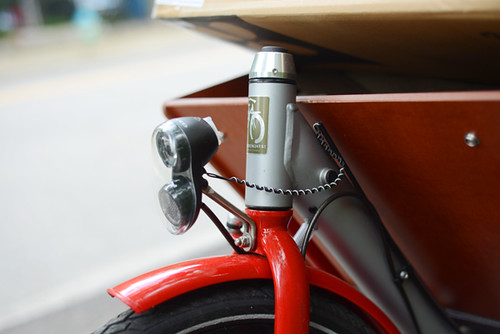
Dynamo lighting with standlights is included, front and rear,


Workcycles Bakfiets Long

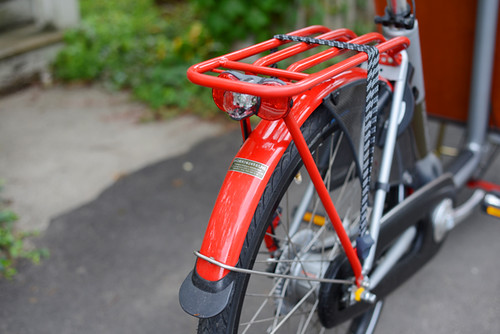
as well as enclosed roller brakes and hub gearing (Shimano Nexus 8-speed with twist shifter).


Workcycles Bakfiets Long
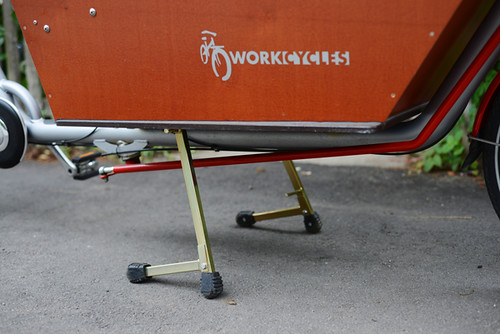
The 4-point Stabilo parking stand supports weight evenly.


Workcycles Bakfiets Long

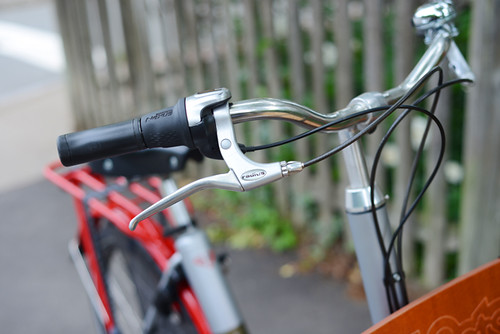
The handlebars are mildly swept back.


Workcycles Bakfiets Long

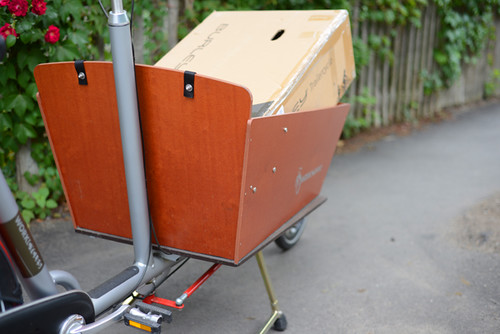
The long cargo box is about 100cm x 60cm at its widest points, tapering from back to front. It is rated for 80kg (176lb), in passengers or cargo.


Workcycles Bakfiets Long

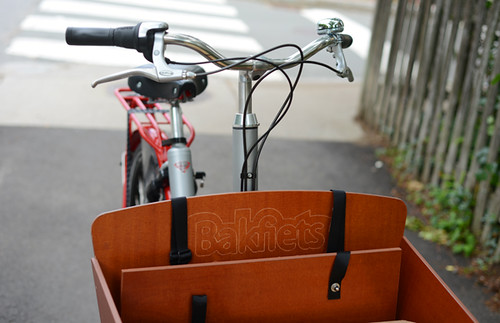
Many of those who purchase these bikes do so to transport small children. There is a little folding bench in the box for this purpose. The bench fits two, though the box itself is rated to fit 4 (I believe a second bench can be installed for those who plan to do this).


Workcycles Bakfiets Long

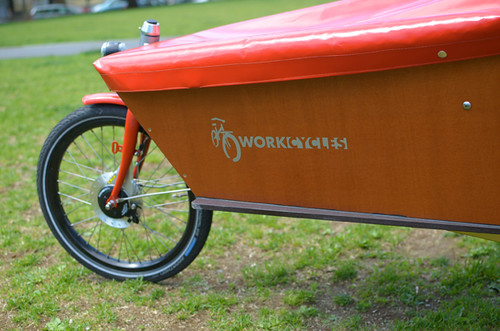
The bakfiets can also function as a work bike, hauling anything from huge loads of groceries, to heavy industrial supplies. In Europe I have seen these in use by professionals such as florists, caterers, construction workers, and sculptors, just to name a few. For those who use the bike in that capacity, a waterproof cargo cover is available. Unlike the structured, canopy cover for transporting children, the cargo cover stretches flush over the box.
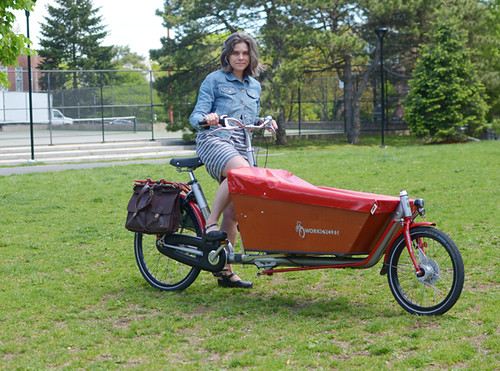


Workcycles Bakfiets Long

The bakfiets owner - known online as "cycler" - has had it for just over two months now and uses it about twice a week as a supplement to her main city bike. On her blog, Biking in Heels, it has been a sort of recurring joke how much stuff she'd often end up carrying on her bike - thinking up various creative, but sometimes precarious ways to secure it all. After years of this, cycler decided to take the plunge and buy a cargo bike. She test rode a few and felt immediately at ease with the Dutch front-load model. So bakfiets it was. She ordered the bike directly from Workcycles in Amsterdam, powdercoated silver and dark orange to her specs. In fact, its purchase is partly to blame for inspiring her to ...drumroll... open up her own local bike shop. But more on that another time.
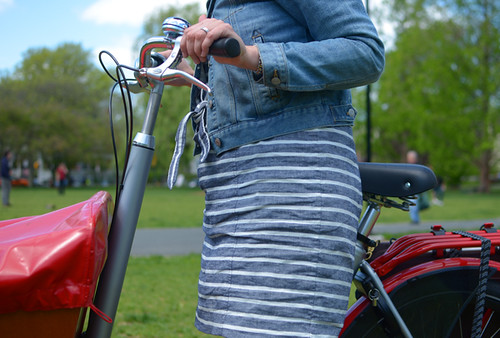


Workcycles Bakfiets Long

I've ridden cycler's long bakfiets twice so far. First in her presence on some neighbourhood MUPs. On a later occasion I took the bakfiets away and rode it on my own along my local commute route, mostly on streets without bike infrastructure.
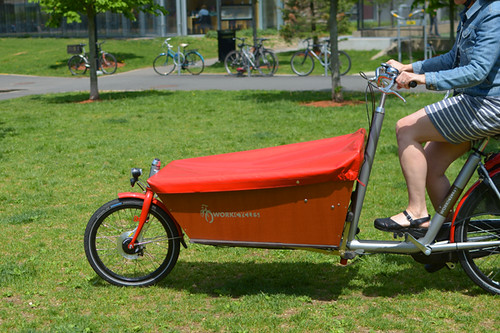


Workcycles Bakfiets Long

On both occasions, I arrived on my Brompton folding bike, which I typically ride front-loaded, like a mini cycle-truck. In a sense, switching to the bakfiets felt like riding a much larger and heavier version of the same bike. Of course in many ways they are wildly different - but the front end handling is not dissimilar. Particularly with less weight in the front, the steering is quick and light, requiring a gentle touch. Once you get used to that, the bike feels natural and intuitive to control. When making turns or adjusting its line of travel, the bakfiets is surprisingly nimble. Having the front wheel so far in front does feel disconcerting at first, but becomes natural once you get used to it. Some riders report that the linked steering takes getting used to, but I did not feel any effects specific to the linkage system. Others have described that the bike does not lean easily on turns, but I find that it leans fine. Overall I suspect that a rider's first reaction to the bakfiets depends on their riding style, inherent sense of balance, and the kinds of bikes they are already accustomed to. Some find it intuitive right away, others need practice.
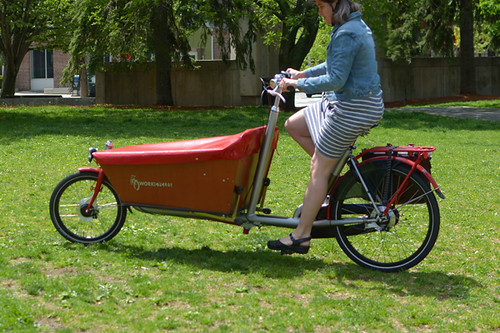


Workcycles Bakfiets Long

The seat tube angle on the bakfiets is quite relaxed and the handlebars high, placing the rider in an upright position. But the "cockpit" is not as tight as it is on some Dutch city bikes (i.e. the handlebars are unlikely to hit your thighs on turns). A low bottom bracket combined with the slack seat tube allows for full leg extension while pedaling and easy toe-town stopping while remaining in the saddle.


One thing that is consistently said about the bakfiets is that it feels weightless in motion even when loaded, and I think that's an accurate assessment. The bike is not fast, but on reasonably flat terrain it is easy to propel forward, without any sensation of pushing or struggling. It just kind of floats as you pedal, boat-like. Henry of Workcycles attributes this quality to weight distribution: Because the box sits behind, rather than over the front wheel and fork, the weight is kept very low to the ground and does not affect steering. With a design like this, the weight is effectively part of the downtube.


Workcycles Bakfiets Long

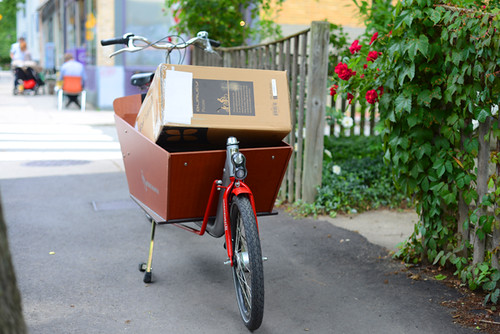
With a large heavy package and some other items thrown into the box, I rode the bakfiets on a 4 mile loop along the Cambridge/ Somerville line, mixing with car traffic most of the way. As far as stability - both in motion and at starts and stops - I did not experience any problems. The bakfiets was very easy to keep upright and, steered with a light touch, it felt downright relaxing to ride. After gaining some confidence, I began to play around with the steering. It felt like the only thing that could make this bike fishtail was the expectation that it would fishtail. But really it wanted to ride where I pointed it, and was very responsive to changes in course. So even if I did make it fishtail intentionally, the wobble was easy to correct. Just a few minutes into the ride I felt like I had excellent control of the bike. Riding with weight in the box does not feel any more challenging than without. And steering the long-box version did not feel any different from my recollections of the short version.


The main difference really between riding the bakfiets and other bikes I am used to, was that I had to be cognisant of its size - mainly the width - when passing cars and making maneuvering decisions. While surprisingly maneuverable, it is simply a big bike with a wider turn radius than what I am used to (including the Xtracycle long tail). For instance, on the same street I can make a U-turn on the longtail easier than on the bakfiets - though possibly with practice I could become more proficient at the latter.


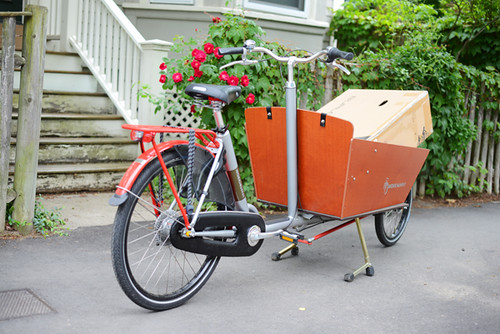
As far as hills... Geared low, the bakfiets handles reasonable inclines well, retaining its momentum and that easy floaty feel. But as soon as I tried it on a real hill (say an 8-10% grade spanning half a mile - Spring Hill for locals) - it just refused to keep going at a certain point, even in 1st gear. I have seen bakfiets owners stand up and mash on the pedals furiously to get over short hills. But on longer hills on the outskirts of town, I imagine this could get exhausting for anyone but the strongest of cyclists. Me, I would need a cargo bike that could go long distance reasonably fast and get me up a 14% grade without standing, so a bakfiets would not be the best choice. But for those whose commutes are limited to flatter, shorter routes this would not be an issue.


Workcycles Bakfiets Long

Over the past couple of years, I have spotted 6 distinct bakfietsen in active use around the greater Boston area. That is actually an impressive number, considering there has been no local dealer. Whenever possible, I've talked to the owners about their bikes. The general feedback is that they love the comfortable ride, the hauling capacity, and how easy it is to dump things into the box without having to secure every item. Those who have children have said their kids prefer sitting on the little bench in front to sitting on the back of a longtail (some families have both types of bikes, or have switched from one to another). On the downside, storing and parking the bakfiets can be a challenge given its size, as is maneuvering it along the sidewalk. And then, of course, the hills: "Not the best bike for hills" is the consensus.


I enjoy the way the bakfiets rides, and I think that it looks adorable. By all accounts it is a tough, all-weather transport machine that holds up well in rough conditions and retains its value well when sold used. For many it is a car replacement, which more than justifies the cost. As far as transporting substantial cargo, the bakfiets is just one of several ways to carry similar amounts of weight - the others popular options being long johns, long tails, and box trikes. Which method a rider finds preferable will depend on their circumstances - including handling preferences, terrain and other factors. As I've mentioned before, I love seeing more cargo bikes in our city, and I welcome cycler's new addition. Full picture set here.