 a few years ago...
Wednesday, February 25, 2009

Tuesday, February 24, 2009
This one's for footnoteMaven...
The footnoteMaven has posted a very special edition of Friday From the Collectors. If you read closely, a heretofore well guarded secret is revealed. . .
In honor of her post I did a quick look through my scanned photos and found these "candid" pictures of several women in my family who wear glasses and who had their picture taken with them on.

My great-grandmother, Susie Yarian Phend, holding two of her grandchildren, Phyllis Phend and Josephine Phend (they are first cousins).

My grandfather (Rolland Victor Phend), his grandmother (Lovina Berlin Yarian) holding his daughter (Phyllis), and his mother (Susie Lula Yarian Phend). About 1923. Grandpa had glasses too but they were not always worn by him, as evidenced in the picture below.

Phyllis Phend, about 1924. Handwritten below the picture was "Dady's Specks"
In honor of her post I did a quick look through my scanned photos and found these "candid" pictures of several women in my family who wear glasses and who had their picture taken with them on.
My great-grandmother, Susie Yarian Phend, holding two of her grandchildren, Phyllis Phend and Josephine Phend (they are first cousins).
My grandfather (Rolland Victor Phend), his grandmother (Lovina Berlin Yarian) holding his daughter (Phyllis), and his mother (Susie Lula Yarian Phend). About 1923. Grandpa had glasses too but they were not always worn by him, as evidenced in the picture below.
Phyllis Phend, about 1924. Handwritten below the picture was "Dady's Specks"
Saturday, February 14, 2009
Tossing Chips

This time of year, wildlife is abundant as many animals are busy preparing for the coming summer season. As is the case with many creatures, this means building a nest in order to raise their young. Today at Grand Portage State Park (which is where I work for my day job) my co-workers told me about a large bird that they had seen climbing out of a hole in a tree. Based on their description I told them it was probably a Pileated Woodpecker. They showed me where they had seen it and sure enough, that's what it was. He was diligently working all afternoon on carving out a nest cavity in a tall aspen tree. When we first got to the tree the bird was nowhere to be seen, but we could hear a muted tapping sound. After a few moments the woodpecker stuck his head out of the hole and promptly threw a mouthful of wood chips to the ground. We watched him do this over and over again.
I knew I had to get some footage of this activity, so after work I went back to the nest and he was still hard at work, tapping inside the tree then throwing the wood chips out. I watched and photographed him for about an hour. Hopefully this means that they will be having babies soon and we will be able to see them being fed by the parents. This is an easily accessible location at the park so it would be neat to share this wildlife encounter with park visitors :-)
Thursday, February 12, 2009
Time Trial Country
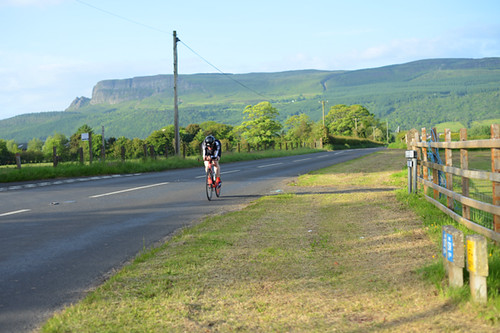
"Mind you, this is only a club time trial," Chris Sharp explains as we set off toward the start on our bikes. But a small club event is exactly what I want to see. The riders in the spirit of competition, but still in their element. The local atmosphere.This is what I think is known as a training racein the US. Staged fairly frequently, it allows riders to test their fitness at different points in the season.
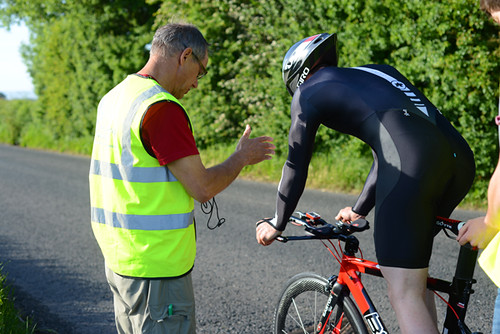
Time trials are a very particular form of racing, and a long standing tradition in the UK and Ireland. In the year 1890 bicycle racing was banned on public roads, permitted only on indoor tracks. This ban brought about a new form of racing, done under the radar of the law. Instead of racing each other outright, cyclists would start at individual intervals and race against the clock. Without drafting or riding in a bunch, there was nothing overtly identifying their activities as a road race. Participants wore no race numbers or club jerseys, adapting instead a style of all-black attire. Races were held in secret, the dates and start times shared through word of mouth. Part secret society, part act of rebellion, the tradition of time trials was born. And although the road racing ban has long since been lifted (I believe in the 1950s), time trials remain popular in the British Isles.
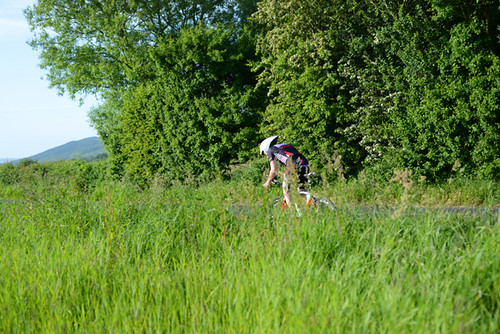
Here in the Roe Valley - a coastal region in the Western part of Northern Ireland - the landscape lends itself to time trials remarkably well. There are long, flat stretches with very little car traffic, where it's possible to pick up some real speed. There are also small, but quite steep mountains for hill climb time trials. Pick whichever you like, or try both.
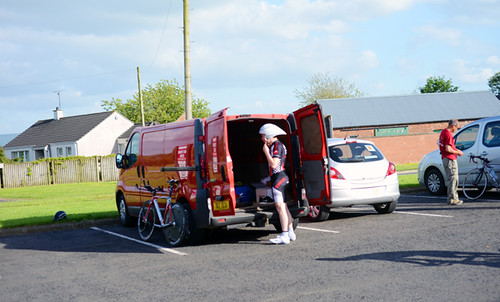
On this particular evening, members of the Roe Valley Cycling Clubgather to compete in a 25 mile time trial: Two loops along the scenic coastal roads, twice crossing the beautiful river Roe. We pull into a parking lot outside of Limavady, just as the riders are assembling their bikes and getting prepared.

For those unaccustomed to modern time trial equipment, both the bikes and the riders are a sight to see.Aero bars, aero tubing, aero wheels, aero helmets...
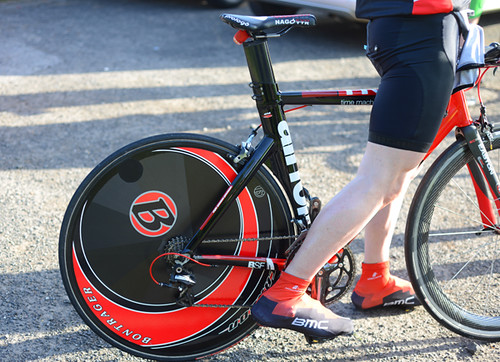
Since drafting is not permitted, much of time trialing is about reducing the individual rider's air resistance. The specialised equipment is designed to facilitate this. The rider's position is quite aggressive, with a steep seat tube and set-forward saddle placing them right over the bottom bracket. In the aero position, they ride with a flat back.
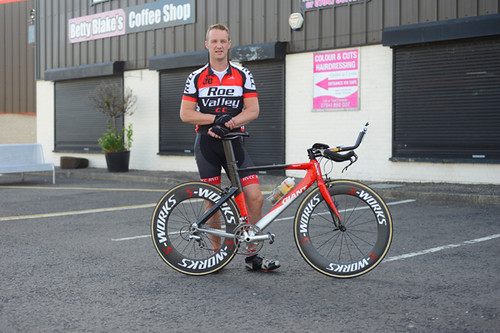
I try not to bother the racers at the start, but they are friendly and relaxed.
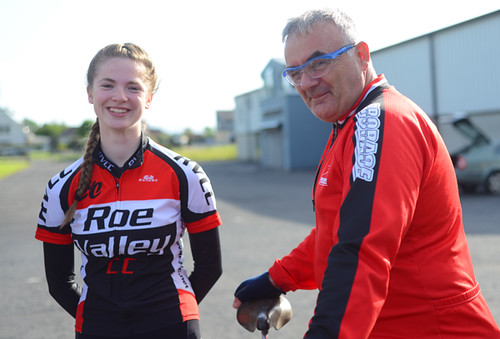
We meet several of them, including Laura Maxwell - Junior Ladies Ulster Hill Climb champion -whom Chris has been coaching for the past 4 years.

Recently turned 17, this is Laura's last year racing as a junior on limited gearing. Having trained for 10 mile time trials so far, the evening's 25 mile course would be a new challenge.She is the only junior and the only female racing today.
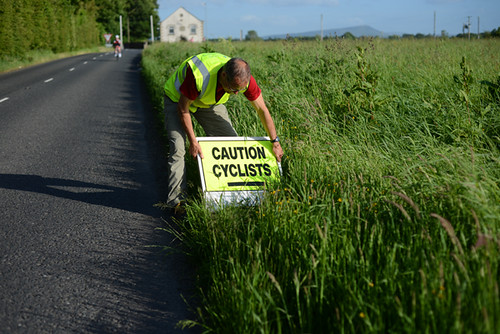
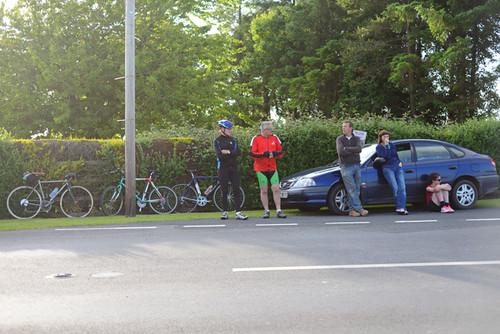
Once the riders' bikes are prepped, all gathered move on from the parking lot to the start of the race - a field along an adjacent road.
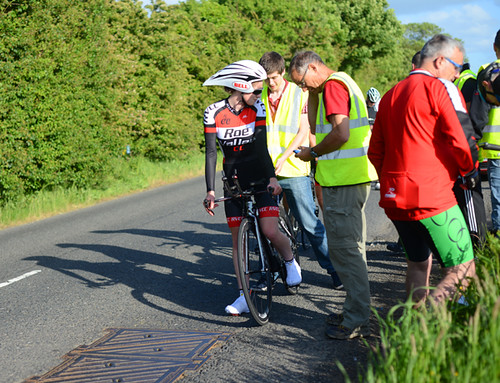
These are race marshals, riders, some family members there as support crews, even a few spectators.

I meet Wallace Donaghy. In the 1950s he raced with theCity ofDerry Wheelmen, time trial and road. No longer racing himself, he comes to watch the local riders. Today Wallace rides a Raleigh Appalachian - a lugged steel mountain bike circa 1989. He also has a carbon race bike. He examines my titanium frame as we discuss frame materials, waiting for the race to start.
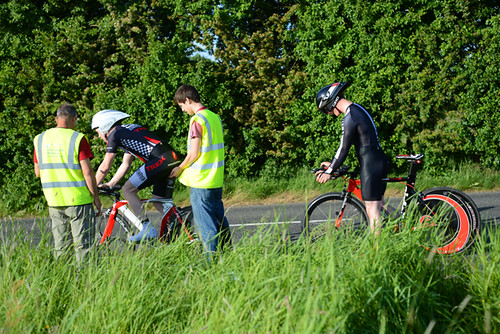
The riders line up for their starts at intervals. Watching this is fascinating.
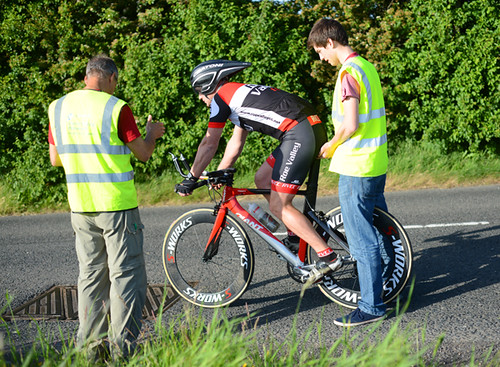
A marshall holds the bike by the saddle as the rider clips in, then continues to hold the bike in place. Another marshall then starts counting back from 15 seconds.
When the sign to go is given, it appears as if the marshall at the back is simply letting go of the saddle and the rider slingshots forward. In fact, it's explained to me, the marshal gives the rider a little push, allowing them to start in a bigger gear that otherwise feasible.
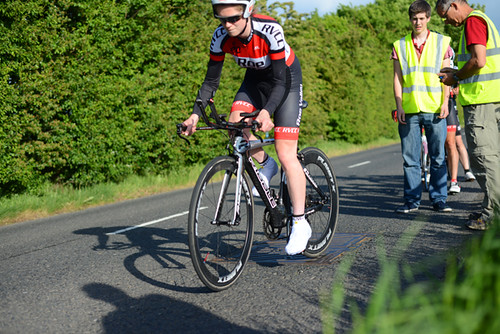
As the rider takes off, they start off holding the wider set of handlebars. These somewhat resemble "bullhorns," and are equipped with inverse brake levers.

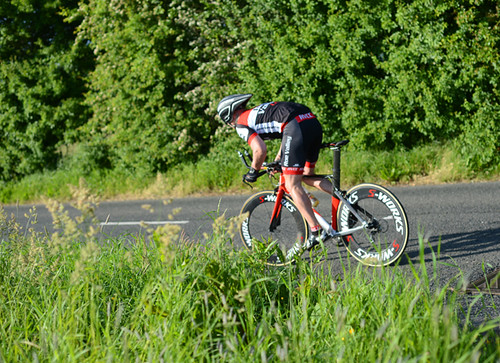
Standing on the pedals and rocking the bike back and forth, the rider quickly gets up to speed and switches to the aero position. This is exciting to watch. They take off in a violent sort of dance, before finally turning smooth as liquid as they disappear into the distance.
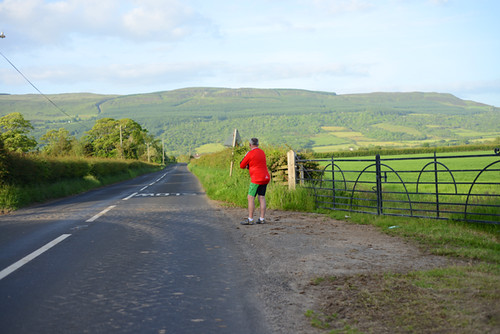
Once all the riders take off, we cycle over to a spot just before the finish line to watch them race at speed. They would be passing us twice, the course consisting of two laps.
Some time passes before we see them, but finally we spot the first rider in the distance. The support crews and spectators cheer for them, then the next and the next.
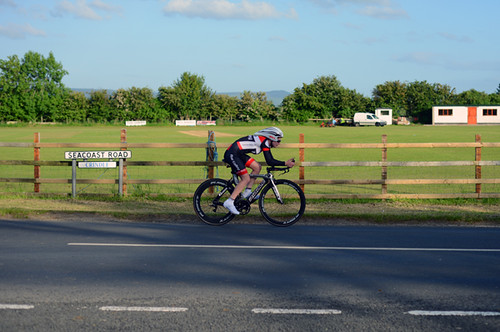
When we spot Laura, the crowd goes wild - her mother, sister and uncle.
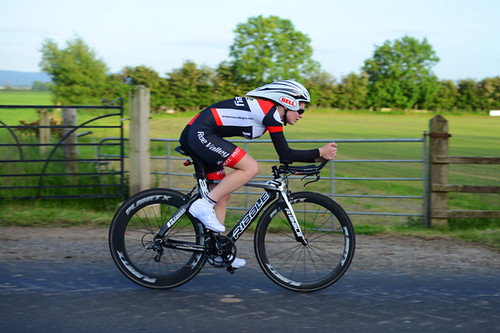
On her second go around the course, I stand closer to get a better look. She is in the zone, head down, eyes forward, a faint smile on her lips as she flies past us. Her posture on the bike is amazing: Her entire body perfectly still, except for the legs going round and round in circles.
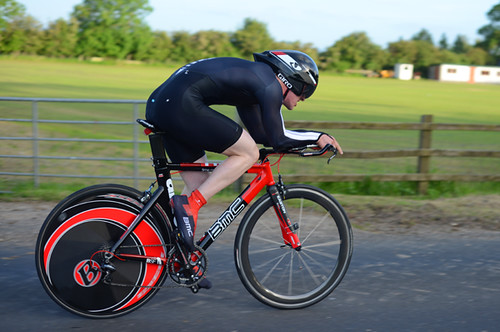
One by one I watch the riders pass. There is an almost coccoon-like stillness around each one, as if each is in their own little world, surrounded by a force field.

On the final lap, I watch one rider pass another. This can be quite challenging in a time trial: The rider must pass immediately, since they are not allowed to draft.
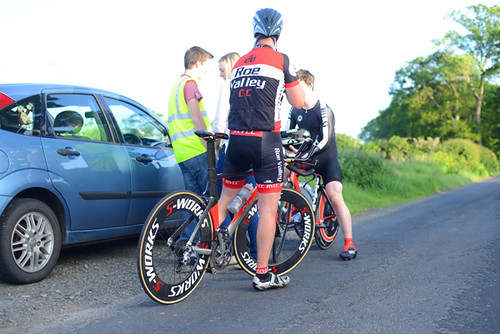
Making our way to the finish, we arrive to the sight of riders cooling down, drinking, chatting with each other about the race. Laura did well, particularly considering the new distance. The numbers don't mean much to me yet, but I am interested nonetheless and listen to the rider's chatter intently.
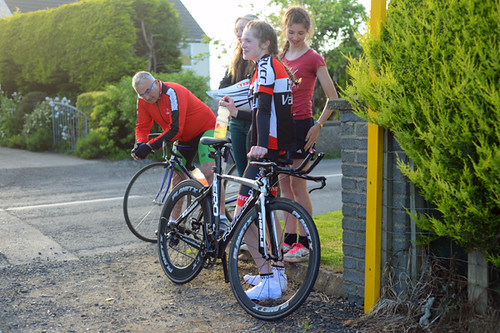
The sun begins to set. This happens slowly here. It will not be dark for hours yet. The riders set off to their homes, in surrounding towns, villages and farms. I put my camera away and get back on my bike. "How did you like that, then?" Chris asks. I shake my head and smile, as we cross the River Roe for the 3rd time that evening. Of all the things I saw, it's the stillness of the riders that is etched in my memory. The absolute stillness against the wind, with only the legs going round in circles.
Sunday, February 8, 2009
Monday Mailbox: What is a High Nelly?
Monday Mailbox is a weekly post dedicated to questions received over email. Here is one, for a nice change of pace:
It's been fun discovering what to call different styles of bikes through your blog... diamond frame, step-through, loop frame, mixte, truss frame, Frascona curve! But what exactly is a High Nelly?
I have wondered about this myself, especially about the term's origin.
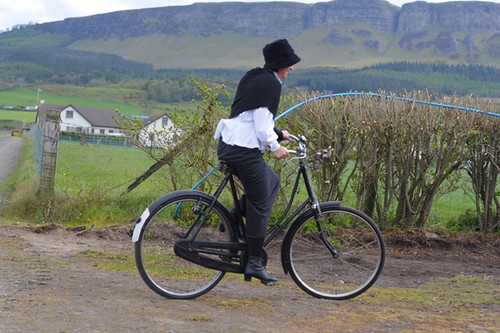
Used predominantly in the UK and Ireland (and not very common anymore), in a general sense "High Nelly" describes upright bikes. More often than not, the term refers specifically to women's bikes, and particularly to vintage ones. So, for instance, an old fashioned loop frame with swept-back handlebars up higher than the saddle might be called a High Nelly - similar to what an omafietsis to the Dutch.
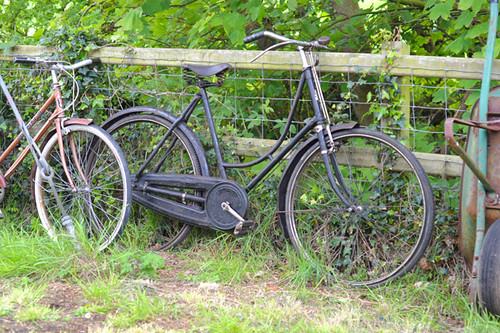
But in Northern Ireland last summer, I was treated to a more detailed explanation. I was told that originally, "high nelly" referred to a specific style of a woman's bicycle frame, where the head tube was extended considerably past the height of the seat tube. This ensured that the handlebars could be set up as high as possible, for a fully upright and ultra-ladylike position. Apparently, only frames thus constructed are true high nellies.
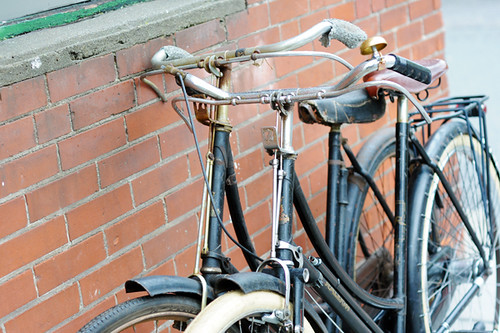
Interestingly, in manufacturing its popular Lady's Tourist model, some time in the 1940s Raleigh switched from the original extended headtube design to one where the headtube was more or less level with the seat tube. The measurements of my 22" 1973 DL-1 frame are almost identical to the measurements of my 22" 1936 Lady's Tourist frame, save for this aspect and the resulting difference in posture.So, going by the explanation above, only the very early Lady's Tourists can be considered high nellies, whereas the later DL-1s (as well as most other post-war English 3-speeds) are not. And according to the same definition, lots of modern bikes can be considered high nellies, since extended headtubes are now quite popular.
Unfortunately, I cannot find any written information about the origins of the term, so I can't cite my sources beyond "conversation with collectors." And sadly, who exactly this Nelly was, for whom I assume the style of bicycle was named, remains a mystery.
Sherpa Peak
 Sherpa Peak is a large bump on the east shoulder of Mt. Stuart. It does not get climbed near as often as Stuart. It was nice to climb something new in the range. Mark and Doug did it as a day hike.
Climbers near the false summit of Mt. Stuart. There was still a lot of snow at the end of June.

Mark leading the way up the West Ridge.

Doug working his way up.

Sherpa Balanced Rock is a feature visible from all over the Stuart Range. It doesn't get climbed very often. It looks like the wind could blow it over, but it is actually pretty well built. We couldn't leave without climbing it. Mark led the way up and Doug followed. It was nice to finally stand on top of that rock we have looked at so many times.

Sherpa Peak is the shaded peak on the right shoulder of Mt. Stuart as seen in this photo from Longs Pass. It was another memorable day spent above treeline!
Saturday, February 7, 2009
Freedom, Peace, Liberty. . .

Wishing everyone a safe and enjoyable Independence Day... (wish I could take credit for the graphic or even give credit, but I don't remember where it came from)
Thursday, February 5, 2009
Bubble Reflection

My reflection in a bubble on Hollow Rock Creek. I was out photographing some small waterfalls on the creek and watching all these bubbles float by. After watching them for a moment I realized that the trees and sky were reflecting in the bubbles. When I stood up and looked straight down on the bubbles, I could see my reflection as well. I decided to have some fun with it :-)
Monday, February 2, 2009
Wistow - Kilby - Foston - Wistow
Wednesday 8 June , with Marta - between 7 and 8 miles. Weather showery, but mainly fine.
Walk taken from the October 1997 issue of Country Walking magazine.
We were so keen to look through the bridge that we missed the footpath by the church and had to turn back to it. Then we failed to take the left turn we should have taken just across a footbridge, and continued to the Grand Union Canal at bridge 78 (I think).
Foston has been a deserted village for about 400 years, but St Bartholomew's church, dating from the tenth century is still in use. People had arrived to prepare for the Flower Festival when we got there.
A pleasant walk - a good lunch at the Dog and Gun in Kilby, but a little too much arable field walking, at low level with no real views, in the middle part of the walk - between Kilby and Foston, and a tad too much road walking - narrow verges and more traffic than I expected. The beginning third and the final third were better.
tbc
For details and map click this link
Walk taken from the October 1997 issue of Country Walking magazine.
 |
| Wistow Hall from the road |
We were so keen to look through the bridge that we missed the footpath by the church and had to turn back to it. Then we failed to take the left turn we should have taken just across a footbridge, and continued to the Grand Union Canal at bridge 78 (I think).
 |
| Lock keepers Cottage |
 |
| Tenth Century church at Foston |
Foston has been a deserted village for about 400 years, but St Bartholomew's church, dating from the tenth century is still in use. People had arrived to prepare for the Flower Festival when we got there.
 |
| Keep on the strai(gh)t and narrow! |
A pleasant walk - a good lunch at the Dog and Gun in Kilby, but a little too much arable field walking, at low level with no real views, in the middle part of the walk - between Kilby and Foston, and a tad too much road walking - narrow verges and more traffic than I expected. The beginning third and the final third were better.
tbc
For details and map click this link
A Bar? What Bar?.Black Diamond crampon connecting bars?
My new BD Stingers may or may not come with a flex bar. They are lighter, but it seems counter productive aswe are talking a new technical crampon. I'd want a rigid bar, a rigid crampon and rigid boots.
So I pulled the bars off my Cyborgs to use on the Stingers. But that left me one pair of bars short if I wanted to trysome crampons side by side. Or like withthe Stingers one with a Flex and one with a solid bar. So locally I run down to REI and buy a spare pairof bars. But these are long bars as there are no reg bars in stock. No worries just wack them off, right?
But then I realise if I want the most rigid crampon I can get from Black Diamond, what I really want is the long bars and wack them off on all my crampons. Well may be I do?Less holes and more rigid if your boot size will allow them for size. Minewill. I use rigid or nearly rigid boots to climb in it shouldn't be a durability issue even in my size 12s. The more rigid the crampon bar is the more rigid the crampon is. And on pure ice the better they will climb. The tighter the bar/crampon inner face is the more rigid the crampon. To keep from breaking connecting bars you add a flexible bar. To allow more flex you loosen the crampon/bar inner face. Reliability? Flexlible things generally don't break unexpectantly?
Know your bar is the answer. Mix and match accordingly but pays to be cautious!
BD stainless crampon connecting bars
Flex bars 1.6mm
Asymmetrical bars 2.6mm
Standardbars 2.6mm
Long bars 2.47mm (1/25th less material strength than the standard bar)
 You get the idea :)
So I pulled the bars off my Cyborgs to use on the Stingers. But that left me one pair of bars short if I wanted to trysome crampons side by side. Or like withthe Stingers one with a Flex and one with a solid bar. So locally I run down to REI and buy a spare pairof bars. But these are long bars as there are no reg bars in stock. No worries just wack them off, right?
But then I realise if I want the most rigid crampon I can get from Black Diamond, what I really want is the long bars and wack them off on all my crampons. Well may be I do?Less holes and more rigid if your boot size will allow them for size. Minewill. I use rigid or nearly rigid boots to climb in it shouldn't be a durability issue even in my size 12s. The more rigid the crampon bar is the more rigid the crampon is. And on pure ice the better they will climb. The tighter the bar/crampon inner face is the more rigid the crampon. To keep from breaking connecting bars you add a flexible bar. To allow more flex you loosen the crampon/bar inner face. Reliability? Flexlible things generally don't break unexpectantly?
Know your bar is the answer. Mix and match accordingly but pays to be cautious!
BD stainless crampon connecting bars
Flex bars 1.6mm
Asymmetrical bars 2.6mm
Standardbars 2.6mm
Long bars 2.47mm (1/25th less material strength than the standard bar)
You get the idea :) Sunday, February 1, 2009
When Do We Need a Cargo Bike?
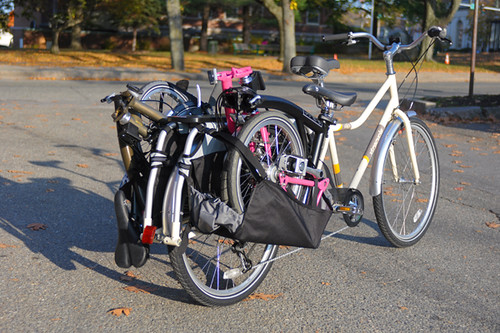
I am thoroughly enjoying test riding the Xtracycle Radish I have on loan for review. What impresses me the most is not so much its hauling capacity (which I take for granted since it is, after all, a cargo bike), as its handling. The Radish is a great ride. It is fast. It is geared for hills. It is easy in stop-and-go traffic, remaining stable when starting and stopping. It is lovely on dirt trails. It likes to keep its line, and I can even ride it no hands - no easy feat for me on most bikes! In other words, I really, really like it.
So now I find myself manufacturing tasks in order to have excuses to ride this cool bike and test its hauling capacity. I should load it up with some Bromptons (done - too easy). I should use it to bring home a Festivus tree. I should borrow some neighbourhood children. I should take the cats skiing. All this brainstorming makes me aware that I don't, strictly speaking, actually need a cargo bike as part of my daily routine. "Don't need a cargo bike?! But you're car free, of course you need a cargo bike!" a friend exclaims. Two years ago, I would have agreed. There are groceries, the hardware store, photo equipment, art supplies, disassembled bikes, large packages. But after all this time, I've adapted to having limited hauling capacity and now only rarely need to transport large or heavy loads. The Radish is a bike I want to need, but in reality would use only occasionally.
On that note, I am curious how often cargo bike owners actually ride theirs cargo bikes. Is it your main ride or a supplementary bike? Do you find yourself riding it more or less frequently the longer you own it? "Soon you'll find all sorts of uses for it, and won't be able to do without," I am told. Yeah, that's exactly what I'm afraid of!
Exploration Day ..
This was a day I was looking forward to since Thursday. Jennifer was sick all week and I was trying not to catch it while saving energy for Monday. The plan was to go climb ice. Steve and I had loosely coordinated on Friday and the initial goal was the North Face of Chair Peak. Temps have been silly cold. (With overnight lows in Seattle in the 20°s.) During the weekend I saw that someone had climbed it on Saturday. We were on. Until it snowed Sunday. Well that wouldn't totally deflate our plans, but being on the dark side of a mountain with the high temp at sea level around freezing sounded really cold to us. That added to the high winds and possible cornices and bombs that would await us at the top of the face. (The wind chill for Monday at Snoqualmie Pass was predicted to be -11°F.) Rather than hike out there and turn around, we decided on Sunday evening to give the South Gully of Guye Peak a try. There was less of a hiking commitment and the route is wind protected.
 Heading up on the road
We had a bit of a late start, and arrived in a parking area on the Oberstrasse. The outside temp was 7°. It took a bit of effort to remove our heavy coats and start moving. At least the sun was out although we were in the woods immediately off the road. Soon we got on a forest road and heading in the general direction of the Southwest Rib. We left the road near the end and headed generally east under the rib. Going was not too difficult with bare boots as the snow pack was firm except for the fresh 5" from the previous day. (Steve and I were regretting not going out to ski instead as conditions were nice for that activity.) We finally arrived at what we believed to be the gully and did some checking to confirm this. However, the gully did not have much snow above our location and we started rethinking our plan. We hiked up to the area where there was less snow (which was in the sun.) The going was not as easy as previous with the increased slope angle we eventually donned crampons. We debated a bit, and then made the decision that climbing snowy rock and a possible loose 3rd class gully didn't sound appealing to us on this day. So we turned around.
 Our high point in the gully
The hike out was uneventful, but we got a good look at Chair Peak and could see cornices and thanked ourselves for the decision not to head there. We made a plan that once we got to the car we would go take a look for ice at Alpental Falls. We made the short drive and hiked up the Snow Lake Trail to the falls. Most of the ice was there, but looked a bit fragile, or had running water behind it. While there, we heard a few icicles falling. It was midday and they were in the heat of the sun. We assumed they would look better in the morning.
 Checking out the ice
We hiked northwest from that location and found a few short solid patches of ice that we would be willing to top rope from trees. (We had only brought three screws for Guye, so we didn't have the capacity to lead.) Steve then searched a gully while I hacked at the ice a bit to see how durable it was. Due to the deep cold, it wasn't as plastic as I would prefer for ice climbing, but it was solid and climbable. We poked around a little more without actually climbing anything and then headed to the parking lot. I took my watch off below the falls (which were no longer in direct sunlight) to gauge the temperature. By the time we reached the parking lot it was a mere 15°. Steve and I got in the car and headed out.
On the way home we checked out some other areas that we knew ice up and investigated their feasibility for later in the week. We will see.
While not the grand goal I had originally planned, it was a fun outing. We now know where to find the gully on Guye Peak and may return when there is better snow cover. For now, I am excited to get out and climb ice while the temps are low and there is no precip in the forecast.
Heading up on the roadWe had a bit of a late start, and arrived in a parking area on the Oberstrasse. The outside temp was 7°. It took a bit of effort to remove our heavy coats and start moving. At least the sun was out although we were in the woods immediately off the road. Soon we got on a forest road and heading in the general direction of the Southwest Rib. We left the road near the end and headed generally east under the rib. Going was not too difficult with bare boots as the snow pack was firm except for the fresh 5" from the previous day. (Steve and I were regretting not going out to ski instead as conditions were nice for that activity.) We finally arrived at what we believed to be the gully and did some checking to confirm this. However, the gully did not have much snow above our location and we started rethinking our plan. We hiked up to the area where there was less snow (which was in the sun.) The going was not as easy as previous with the increased slope angle we eventually donned crampons. We debated a bit, and then made the decision that climbing snowy rock and a possible loose 3rd class gully didn't sound appealing to us on this day. So we turned around.
Our high point in the gullyThe hike out was uneventful, but we got a good look at Chair Peak and could see cornices and thanked ourselves for the decision not to head there. We made a plan that once we got to the car we would go take a look for ice at Alpental Falls. We made the short drive and hiked up the Snow Lake Trail to the falls. Most of the ice was there, but looked a bit fragile, or had running water behind it. While there, we heard a few icicles falling. It was midday and they were in the heat of the sun. We assumed they would look better in the morning.
Checking out the iceWe hiked northwest from that location and found a few short solid patches of ice that we would be willing to top rope from trees. (We had only brought three screws for Guye, so we didn't have the capacity to lead.) Steve then searched a gully while I hacked at the ice a bit to see how durable it was. Due to the deep cold, it wasn't as plastic as I would prefer for ice climbing, but it was solid and climbable. We poked around a little more without actually climbing anything and then headed to the parking lot. I took my watch off below the falls (which were no longer in direct sunlight) to gauge the temperature. By the time we reached the parking lot it was a mere 15°. Steve and I got in the car and headed out.
On the way home we checked out some other areas that we knew ice up and investigated their feasibility for later in the week. We will see.
While not the grand goal I had originally planned, it was a fun outing. We now know where to find the gully on Guye Peak and may return when there is better snow cover. For now, I am excited to get out and climb ice while the temps are low and there is no precip in the forecast.
Subscribe to:
Comments (Atom)