
I get a lot of requests for a comprehensive winter wardrobe post. Since it snowed again today, this seemed like a good time. I won't call this a "guide" and I don't assume that what works for me will necessarily work for others. But in the midst of Winter 4.0, this is the stuff that keeps me comfortable cycling even on the coldest days in greater Boston. For reference, our temperatures are typically in the 20s-30s F range, although it does occasionally get colder.
A few quick disclaimers: I am dividing this into "transport" and "sport" sections, because for me the two rarely intersect, not because I think others must keep them separate. Also, you will find that some things here are female-biased, because, well I am female. Finally, I linked to some companies and products, because readers tend to ask for specifics. As always, none of the product mentions are endorsements or "monetised" in any way; they are just there for your info.
 TRANSPORT
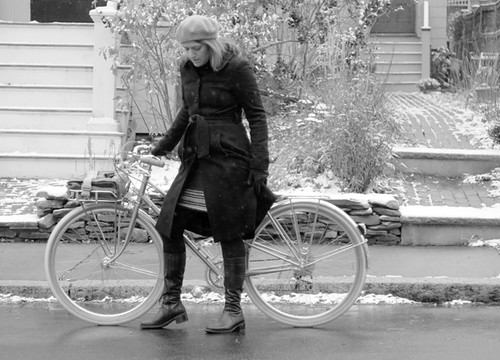
Pictured here is the sort of thing I normally wear when getting around by bike, either for work or errands. I will start from the inside out.
UnderwearWorn closest to the body, underwear plays a crucial role in temperature regulation. So before I worry about bundling up, I make sure to get this part right. In my experience, underwear made of wool, silk, lycra/spandex and some technical polyester-based fabrics, is generally good at regulating body temperature and wicking moisture. Underwear made of cotton or acrylic is not. Out of the fabrics that work I prefer wool and most of my undergarments are from Ibex: I like their modern and stretchy wool/lycra blend. Icebreaker and Smartwool also offer some good options, as does Winter Silksif you're looking for budget-friendly silk.
Everyday OutfitsMy everyday clothing ranges from casual to formal, but, especially in winter, it almost always involves skirts and dresses. This is because I find it easier to add warm layers under a skirt (wool leggings or legwarmers over tights), than to deal with layering under trousers or jeans. Also, if it rains or snows, tights with knee-high boots are a highly effective way to keep dry. After several winters of experimenting, most of my cold-weather outfits are now wool. I knit wool skirts myself in variety of styles. And I wear wool sweaters over wool or silk base layers. 100% merino is harder to find now in mainstream stores than it used to be, but J. Crew remains a good source and they have frequent sales (like right now). I also alternate between several wool dresses, mostly handmade. And I still own a few wool skirt-suits from my suit wearing days.If I want to wear an outfit that is made of a non-temperature regulating fabric, I will wear a wool or silk baselayer under it and it'll be fine. But to me, wooly stuff just feels overall warmer and cozier.
TightsWhen buying cold-weather tights, I look for wool and nylon/ lycra/ spandex content, and I avoid cotton and acrylic content - because, as with baselayers and underwear, the latter does not wick moisture or regulate temperature well. Smartwoolmakes decent all-around winter tights (and socks). Falke is a European favourite, but expensive. Another option is to wear dense nylon tights (such asthese), with wool leggings or legwarmers over them, which can be later removed indoors.
FootwearBoth on the bike and off, I am a fan of waterproof boots rated for freezing temperatures. For years, I have been wearing La Canadienne boots that are exactly that. I have a pair of their ankle boots and a pair of knee-high boots that look reasonably professional and feminine, while being absolutely winter-proof. The soles have excellent traction on snow and ice, which is also useful for when my bike pedals turn slippery. With the knee-high boots, the additional benefit is that they keep my legs extra warm, and protected from slushy splash-back.
CoatsOn the bike, I favour wool 3/4 length coats with an A-line shape, so that the hem does not constrict pedaling. The coat should fit loosely enough to allow layering underneath, and should not in itself be too warm. When I am walking, I will sometimes wear a down-filled coat, but I find it too bulky when cycling. The down-filled coats can also be slippery on the bike saddle, whereas wool coats stay put. My current coat is about 6 years old and I no longer remember where I bought it.
HatsUsually I wear a wool beret or hat that I knit myself. I take care that the stitching is dense enough to be wind-proof, and that the hat covers my ears.
GlovesMy favourite gloves for cycling are wool and grippy. They are perhaps not the most elegant choice, but their functionality has won me over.
ScarvesAfter some experimenting, I have taken to wearing a shawl-like wool scarf which I wrap around my neck once and then tuck the rest into the front of my coat for an extra layer of warmth over the chest. This really helps when cycling against an icy headwind. Beware of long, flowing scarves on the bike,for obvious reasons.
Want more winter wardrobe advice from genuine cycling fashionistas? Dottie of Let's Go Ride a Bike has excellent tips from snowy Chicago. Here is her latest post on the topic and a more general guide for winter dressing. Also, this excellent Bikeyface post will not disappoint.
 SPORT
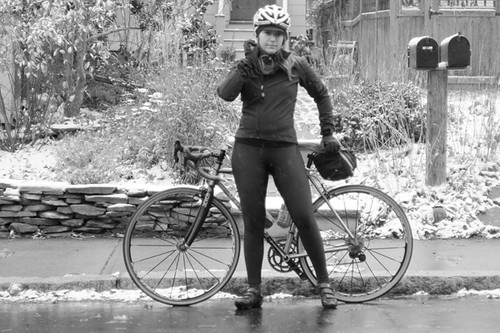
SPORTWith roadcycling, I find getting dressed in the winter easier, simply because there is less creativity required. I can wear the same thing over and over! Here is my formula:
Base LayersI like thin, long sleeve wool base layers. There are many options to choose from now.Rivendell has come out with a nice US-made one recently. I also wear a wool/lycra sportsbra underneath (see "Underwear" earlier).
TightsIn winter temperatures, I wear fleece-lined full length tights. I have triedbib tights, but ultimately I find them too fussy to get in and out of. I prefer the padded winter waist-high tights from Capo, and wear a model from a few seasons ago. In addition to being super warm, these are also somewhat water resistant. I have made do without rain or snow pants so far, and have not felt the need for them.
SocksI love the simplicity and longevity ofDeFeet wool socks. Of all the wool and wool-blend socks I've tried; they have been the most durable. When it gets particularly cold, I wear two pairs.
Mid LayersMy midlayer is a winter-weight long sleeve cycling jersey. As long as I wear a wool baselayer, it does not matter to me what the midlayer jersey is made of, as long as it insulates. I own a few now, but my favourites have become the wool/poly blends from Rapha and Shutt Velo Rapide. These are wool on the inside, with some high-tech poly coating on the outside. I do not like how they feel against the skin, but as midlayers I find that they offer the best temperature regulation.
Outer LayersWinter outer layers are tricky. A windbreaker/shell type jacket is not enough. A jacket that's too warm can be even worse. Last winter I bought a Rapha winter jacket on the recommendation of some of the women I rode with, and it is just right, even for the coldest temps around these parts. This is a painfully expensive jacket, but it does go on sale occasionally and stalking it was worth it.
GlovesDeFeet Duraglove. I have tried fancier and supposedly more weather-proof gloves, but prefer the DeFeets. Gosh, I hope they never discontinue these.
Neck WarmersThese are called various things, depending on the manufacturer, including neck gaiterandcollar. I have a few and find them very useful. For extremely cold rides, I have tried a balaclava, but it is not my cup of tea; I prefer to wear a neck warmer and pull it over my mouth instead.
Hats, Etc.I wear a tightly knit wool winter cycling caps with brims and ear flaps. I buy these instead of knitting them myself, because I can't get the weave tight enough by hand; it has to be machine-made. Several companies offer these hats now. I have one from Bicycle Fixation and another from Ibex. I usually wear a helmet on my roadbike, and find that this adds to the cap's warmth, while also helping to keep it firmly in place.
ShoesI do not own winter cycling shoes at the moment, though I hear there are some wonder-boots from Lake that are pretty good and I might save up for those eventually. I have some overshoes on loan from theRide Studio Cafe, but I have to admit they scare me, so I have yet to try them. Instead I just wear multiple pairs of socks for now. My toes have only frozen a couple of times so far...
Want winter wardrobe advice from more experienced roadies? The Blayleys have an excellent series of posts on this topichere, here and here. As they probably spend more time on the bike in the winter than off, they are the best source I know.
Keep warm and enjoy yourself on the bike this winter, whether in sport or transport!





 The road to Colyer Cemetery, Marion Township, Douglas County, Kansas. Looking to the north.
 The Fisher plot, looking to the northwest. The two barrell-shaped stones are for Lucretia and Samuel.
 LUCRETIA A. FISHER / BORN AUG. 23, 1845 / DIED OCT. 31, 1909
 SAMUEL FISHER / 1840 – 1913 / CO. A. 9 KAS. VOL. CAV.
 FOOTSTONE.
 See detail below.
 OUR MOTHER
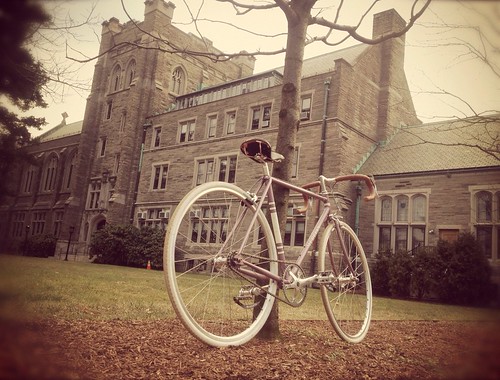 I have been riding fixed gear bicycles for about a year and a half now, and enjoy it so much that it is hard to talk about without getting embarrassed. Here in the Boston area, fixed gear is associated with a distinct cultural attitude and fashion sense, and I do not fit the mold. Seeing me on a bicycle with a fixed drivetrain often seems to surprise people, and I've been told on more than one occasion that I "don't seem like the type." While I suspect this is mostly used as a conversation starter by men, it still succeeds in making me self-conscious. What is it about fixed gear that I like so much and why do I "need" this type of bicycle?
 I first tried a fixed gear bike in June . I was staying in Vienna and pining over the nearby velodrome's summer closure, and a friend offered to teach me to ride a track bike so that I could ride around the velodrome building (this seemed very funny at the time - around the velodrome, get it?). I was afraid to try it at first, but as soon as I got on the bike I didn't want to get off it. It felt so natural and intuitive. My friend ended up leaving the bicycle with me for the duration of my stay in Vienna and I rode it in the park after work every chance I got. Cycling slowly due to the lack of brakes, I must have looked like an idiot, but didn't care. I discovered that on fixed gear, my bicycle handling skills somehow improved. I could make tighter turns, cycle through narrow spaces, control my speed better, and just be more in control. It felt as if I suddenly gained a better understanding of how a bicycle worked. The custom Italian track bike made for a now-retired racer felt unexpectedly comfortable, save for the curvature of the handlebars. I could ride this thing for hours with a silly smile on my face. It became clear during those rides that I needed a fixed gear bike of my own once I returned to the US. A friend of a friend sold me a good road frame for fixed gear conversion, and I mailed it to myself in Boston before leaving Vienna.
 Waiting for the road frame to arrive (it took over 3 weeks!) I couldn't stop talking about my experience with fixed gear, and just for the heck of it one weekend the Co-Habitant and I converted the Motobecane mixte I then owned to a single speed with a fixed/free flip-flop hub. Doing this was easy and inexpensive. We picked up a budget wheelset, modified the existing crankset, shortened the chain and that was pretty much that. I rode this bicycle around the city and out to the countryside, and it was great fun. But I mostly thought of it as a novelty. On an upright bike, I preferred a freewheel. This bicycle was a great hit around the neighbourhood though, especially when I fitted it with some colourful dressguards. The woman who later bought it planned to use it as a freewheel single speed, but liked the idea of having the fixed option by flipping the wheel.
 Finally the vintage road frame I'd bought in Vienna arrived in the mail, and we quickly put it together. You might recognise this as the previous incarnation of theMoser I now ride as a geared roadbike. The tires here look huge, but they are 28mm Panaracer Paselas - the frame had just enough clearance for them if I did not use a rear brake. I rode this bike a lot, and particularly enjoyed it once it began to get cold. There was something about cold and dreary days on a fixed gear that was just magic.But while I loved riding the Moser, it became apparent over time that the frame was not really suitable for fixed gear conversion due to its very low bottom bracket. As my speed on the bike increased I started to get pedal strike when cornering on bumpy or uneven roads, and did not feel that this was safe. Last winter I began to look for another frame, which did not prove to be very easy given my criteria (lugged steel, horizontal dropouts, high bottom bracket, small size,and no toe overlap). I considered getting a frame from Royal H., but could not afford it. I considered the new SimpleOne from Rivendell, but learned that they would not be making one in my size. And that is how I came to be in possession of a Mercian.
 By the time I ordered this bicycle from Mercian, I had a good idea of what I wanted in a fixed gear. I did not want a track bike, but a comfortable and somewhat relaxed roadbike that just happened to have afixed gear drivetrain. I wanted to fit it with 28mm-32mm tires for road and occasional trails. I wanted it to have tame handling without feeling sluggish. All of this was done. When I began to ride this bicycle after we put it together, it was just the feeling I wanted. It is comfortable, intuitive, has no toe overlap or pedal strike, and I can ride it for quite a long time without getting tired.
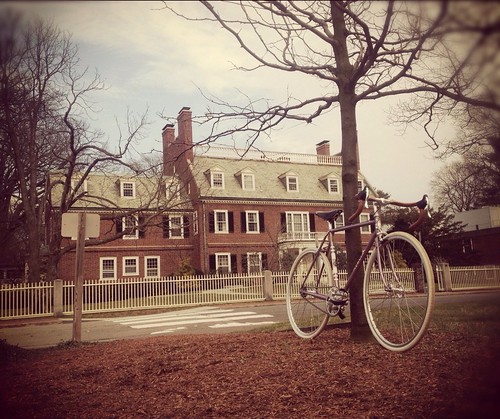 Second, I feel that riding a fixed gear roadbike helps me with technique. My movements feel more elegant and precise, and I can sense that I am developing a more intuitive sense of balance. I play games where I try to keep the bike going at all costs - slowing down to a crawl before a traffic light rather than stop as I wait for it to turn green. I also like to see how fast I can accelerate under different circumstances, and play "sprinting" games until I get out of breath. This is much more interesting to do on a fixed gear than on a freewheel bike, because once you get the drivetrain going it feels as if it "helps" you. All this may sound silly, but somehow I feel that things like this really help. Fixed gear bikes feel playful and very safe, which encourages me to try all this stuff that I would not normally try. Slowly but surely, I can tell that it improves my geared roadcycling skills - including the somewhat "duh" realisation that if I continuously pedal and feather the brakes instead of coasting, then I will feel more in control of my geared roadbike as well.


 Mil Spec version above.
 Mitts "shrink to fit with use".
 Photo courtesy of the "Lou Dawson, Steve Shea, and Michael Kennedy" collection found online.
 Mountain 33 (March 1974.) No photo credit given.More here on that story:http://www.supertopo.com/climbing/thread.php?tn=20&topic_id=395619
