Monday, December 27, 2010

Cycling Destinations


image via chris531


For the past several years, I've had a dream cycling destination that I fantasise about incessantly: the Dark Hedges in the North of Ireland. Oh the Dark Hedges! What are they? Well technically, they are just a short stretch of country road near the coast of Couny Antrim. The road is lined with ancient beach trees, and these trees have grown so crooked and twisted that the overhanging branches have intertwined to form a magnificent canopy. Overgrown with moss, the whole thing has an enchanted, mystical look to it. I fell in love with this unseen piece of landscape the first time I saw a photograph of it, immediately imagining myself under the canopy as sunlight streamed through black branches and everything turned hundreds of shades of green. What happens next? I'm not sure, but something magical. Maybe if one is there at just the right time of day, the trees will talk to you, or the faeries will come out. And if you're there at the wrong time of day, you'll be turned into a tree yourself. With a name like Dark Hedges, an element of danger is to be expected.


As I got into cycling, it was only natural that I began to imagine visiting the Dark Hedges by bicycle. I have family in Ireland, and by this time last year I had developed a grandiose plan that involved visiting them, then taking a train north, disembarking once the "scenic parts" began, and cycling along the coast for hundreds of miles - through rolling green hills overlooking treacherous cliffs, and past the Giant's Causeway - until finally, exhausted and covered in road dust, I would arrive at the Dark Hedges and triumphantly cycle through them as their beauty and magic penetrated every fiber of my being.


I know. Some dream of crossing the Pyrenees and I dream of cycling through a cluster of hedges. Well, it's my fantasy!


While I had hoped my pilgrimage to the Dark Hedges would take place last year, obviously that did not happen. The more I began to look into it practically, the more confused I became as to how to arrange it. There was the question of getting my bike over there - which is so expensive and unpleasant, that at first I thought I'd be better off renting or borrowing a bicycle in Ireland. But on closer examination, it turned out that finding a roadbike to rent would actually be quite difficult, and cycling for hundreds of miles on an upright hybrid was not what I had in mind. And while I have friends there who are willing to lend me a bike, they live in the opposite direction from where I'd be heading, so the logistics would not work out. But the final blow that made me postpone planning this trip came when a couple of local acquaintances expressed skepticism about the idea, telling me that the drivers were awful and that all the good cycling was on the west, not the east coast. Hmm. Of course "awful" should be taken with a grain of salt, as they'd never cycled on the roads in the US and their basis for comparison is limited. Still, all of this taken together made me put the brakes on the idea until I could get a better sense of how to plan a trip like this.


Which brings me to a larger point: How does one go about planning a cycling trip to a place they've never been? There are many beautiful locations that are touted as cycling destinations, but the truth is that we do not really know how comfortable we will be with the terrain and road sharing culture until we are there. Having recently read about two cycling couples' experiences in New Zealand has further highlighted this problem. Localrandonneurs Pamela and John "Blayley" picked up andmoved to New Zealand in 2002, believing (after a great deal of research) that it would be a cyclist's paradise. What they discovered in practice however, was rather different and they ended up moving back to the US just 2 years later. More recently, Russ Roca and Laura Crawford of The Path Less Pedaled embarked on a tour of New Zealand - billed as "The Kiwi Chronicles," documented by the Bicycle Times, and meant to promote new Zealand as a cycling friendly destination. It was therefore a surprise to everyone when several days ago they experienced a road rage incident involving physical violence while cycling single file. The incident has sparked a media frenzy, challenging the portrayal of New Zealand as friendly or safe for bicyclists.


I have a number of acquaintances and colleagues who have gone on trips to their dream cycling destinations, and the feedback has been pretty mixed. Those who go to France and Italy seem to have better experiences overall. This may simply be because those routes are so well traveled that it is possible to do more thorough research and have a better idea of what to expect, and it may also be because both countries have a well developed cycling cultures. While to me, Ireland seems like the perfect place to cycle - with its rolling hills, beautiful scenery and rural roads - I have found comparatively few personal narratives allowing me to gauge what the particular route I am interested in would be like for someone of my skill level, and so I remain conflicted.What is your dream cycling destination, and how would you approach planning a trip to one?

Sunday, December 26, 2010

The Clipless Ambush: a Tale of Failure

Well, my first encounter with clipless pedals occurred sooner than I anticipated. Last week the Co-Habitant decided to update his pedals, and the new set arrived in the mail today... which meant that he could gift me his old ones. I thought that surely this gifting would take place some time in the future - a distant, abstract future. But no. Cheerfully he attached them to one of our vintage roadbikes right then and there, so that I could give them a try. Don't get me wrong, I myself had expressed interest in this. But... I don't know, I just didn't expect it to happen immediately!
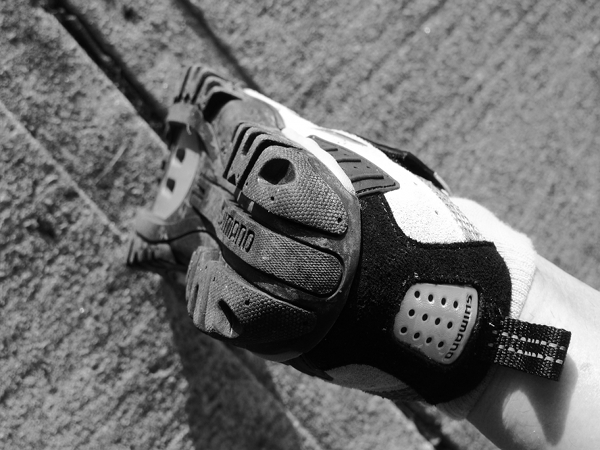


I already owned a pair of compatible shoes, having bought them on clearance last summer "just in case." With apprehension I watched him attach the cleats to the soles, trying to gauge the correct position. I then put them on and dragged the bike over to the kitchen sink, so that I could hold on to the edge with one hand as I tried to figure out how the contraptions worked.


I expected that clipping in would be relatively easy, but clipping out difficult. It was the opposite. At first I could not to clip in. I tried and tried, but my foot stayed on top of the pedal and the mechanism would not engage no matter how hard I pressed. I struggled to figure out what I was doing wrong, but the explanation turned out to be simple: I am a weakling. We had to loosen the tension almost to the max for my foot to engage the mechanism. Even after that, I still had trouble pressing down with enough force and in the exact position necessary for the cleat to catch. Clipping out, on the other hand, was intuitive: the sideways twist of the foot is exactly the same motion required to get out of Power Grips, so I found it natural.Transitioning from the kitchen sink to the trainer, I practiced for some time, clipping in and out successfully. I then decided it was time to go outside. I felt pretty confident at this point. Nothing to this.

It was around 10 pm and the small side street behind our house was well lit and empty of cars. Confidently, I carried the bike outdoors, swung my leg over the top tube, and clipped in my right foot. Now all I had to do was push off, coast for a bit, then put my left foot back down on the ground. That would be such an easy first step. No different from Power Grips. Just need to do it. Now. Go! But... it was not to be. Like some malfunctioning marionette, I kept clipping and unclipping my right foot, trying to mentally force myself to push off, but it wasn't working; nothing was happening. The amused Co-Habitant offered to stand at the end of the street and "catch me" if I found myself unable to unclip when I got there. But imagining that just made it worse. It began to feel as if I'd forgotten how to ride a bike entirely.

There is no redeeming ending to this story. After a good ten minutes I gave up and went back inside, my head hung low in shame. Obviously I am just not ready.

Aside from the tale of failure, I have some observations about the shoe and pedal set-up. I can't find the model name of the shoes, but in retrospect getting clipless shoes with laces was silly. Being stiff and unyielding, they are difficult to put on and tighten, and it's a pain to tuck the laces under the velcro. I am also not sure these pedals are right for me. They are Shimano SPD 520s: mountain bike style, double sided and with a very small surface area. I know that many love this type of pedal, but to me it felt like not enough of my foot was connected. Pedaling on the trainer, I had the sensation that there was too much pressure on the spot where the cleat meets the pedal and that a larger contact area would have been better. Maybe these particular shoes are not stiff enough, or maybe I would do better with a different style of pedals. There seems to be a consensus that the mountain bike clipless system is easier than the road system, but I wonder whether I might prefer the latter. Unfortunately, there is no way to try these things out.

Navigating the world of clipless shoes and pedals is complicated, and at the moment it seems best to postpone it... at least until I am brave enough to use the ones I have beyond the confines of my kitchen!

Saturday, December 18, 2010

Winter Afternoon on Picnic Point


On Wednesday of this week Jessica and I took a day trip into Ontario to do a little afternoon hiking and to spend the evening at the movies. We hiked to High Falls on the Pigeon River via the trail at Pigeon River Provincial Park then went a little further up the road and hiked down to Picnic Point, a fantastic spot on the Lake Superior shoreline.


The Canadian shoreline is very different from the Minnesota shoreline. For the most part the Minnesota shore is straight with relatively few islands and bays. Once you cross the border into Canada, however, the shoreline takes on a totally different character. The islands and bays are plentiful, and both can be huge.


This view is looking east towards Thunder Bay with Pie Island sitting on the horizon behind the sunlit island, and Thompson Island running down the horizon along the right side of the photo. Our timing to this location couldn't have been better... when we arrived at the tip of the point the little island in the bay (not sure if it has a name) was bathed in sunlight. We found several fascinating pieces of ice along this shoreline as well. It was a great spot to spend some time on a mild (the temp was in the mid 30's) January afternoon.

Sunday, December 12, 2010

Redwood Canyon

On one of my stops at the Kings Canyon Visitors Center (in the western side, near Grant Grove), I asked the Ranger on duty if he had any favorite day hikes. He suggested Redwood Canyon saying that there was a 2-mile dirt road down to the trailhead without providing any other details besides asking if I had a large RV (and I didn't think to ask either).

So, the next morning I ventured a few miles south to the turnoff to Redwood Canyon. Once beyond the turnoff and around the first curve, there is no turning back! The narrow, steep, winding dirt road was carved out of the side of the canyon. There were several places wide enough for two cars to pass by each other but most of the 2-mile road (using the term loosely) was wide enough for just one vehicle.

I crossed my fingers and said a little prayer that I would not meet any vehicles coming up while I was going down! The dust flew up behind the rear wheels quickly covering the back windshield so that nothing could be seen from the rear. After a 25-minute harrowing drive, I made it safely to the parking lot, which was nearly full (and all of the vehicles had dust covering their rear windows).

The trailhead was easy to find. Going by what the Ranger had told me I took the trail to the right which gradually went up the ridge, through groves of “young” sequoia trees.

I have no idea what kind of pine tree the large cone belongs to but the cone is about 14 inches long. The three small cones belong to the Giant Sequoia. The medium sized cone is about the size of a chicken egg. The largest trees in the world have the smallest cones! But within those cones are hidden several hundred seeds which are released during fires – they require the heat in order to open up. Pretty amazing.

Once on top of the ridge, it was an easy walk through open meadows and pretty vistas. That's Big Baldy across the valley.

Once on top of the ridge, it was an easy walk through open meadows and pretty vistas. That's Big Baldy across the valley.

The trail (a 7 mile loop) went down into the valley via a series of long, somewhat steep, switchbacks. It followed a river for a short distance then went uphill the last two miles to the parking lot. Portions of the hike were somewhat strenuous (especially the last two miles) but it was mostly a nice, easy, pleasant walk through the forest, which I enjoyed immensely. Even though there were a lot of people visiting the area and the parking lot was full, I saw only four people on the trail and that was on the final uphill trek.

Photographs taken June 19, ..

Climbing Muscles? Perhaps

No More Ouch

When I began to do long hilly rides, I acquired a nemesis: the Mysterious Pain. This pain would get me even when my legs were strong and my energy levels were high. It would get me when least expected, ruining countless rides and limiting my progress.


I have never experienced anything quite like it before. It wasn't so much of a pain even, as an alarming sensation of seizing, not so much in my lower back as below it. If you draw an imaginary horizontal line perpendicular to the top of the butt crack, the sensation was along that line, in two distinct spots on the left and right, symmetrical.


The first time I experienced it in earnest was during a 100 mile overnight ride to Maineearly last summer. It came on around mile 70 and was so debilitating I had to stop on the side of the road and stretch every 10 miles to keep going.


Mystery pains are a source of fascination to cyclists, and I talked about mine with a slew of local riders. At the time the consensus was that I had increased my milage too quickly and hadn't the upper body strength to handle it. So I spent the rest of the summer sticking to sub-100K rides, but doing them with more frequency to build up strength and muscle tone. I am not sure this had any effect. It may have worked subtly, but at the time I felt somewhat stagnant and dispirited. I wanted, very badly, to do longer rides. And I felt strong; my legs would seldom get tired on a bike. But this strange pain/ seizing sensation was like a brick wall I kept hitting:No sooner would I attempt a long ride with lots of climbing, it would return.


This Spring I began riding more than ever. Short rides, long rides, paved rides, dirt rides, club rides, brevets... I thought I was riding a lot before, but now I was practically living on my bike. Disappointingly, the mystery pain was still there - though I'd now learned to manage it with strategically timed stops and stretching. On the 200K brevet, I'd pull over on the side of the road every so many miles so that I could bend over backwards and do some quick twists before continuing. That was all it took to stop the discomfort for the next so many miles, so stopping was better than not stopping: If I did nothing about it and continued riding it would only slow me down.


Having witnessed this riding next to me on the 200K, my friend Pamela suggested that the problem could be insufficiently developed "climbing muscles" - something she herself had experienced at one time. Rather than related to distance, the discomfort could be brought on by long stretches of climbing - which are of course more likely to occur on long distance rides.


There were other suggestions from riding companions at this time: That my gears were too high. That my saddle was too hard. That my position on the bike was too aggressive. And that climbing seated was the real issue.


At that point I decided to take an aggressive approach and try everything. The suggestion that my roadbike position was causing the discomfort worried me, because I otherwise found it so comfortable. But a few strategic rides helped me eliminate that as the cause: I was able to bring about the same pain on more upright bikes (even my Brompton) if I used higher gears when climbing for a prolonged period of time. So gearing had a lot more to do with it than position. I now also knew for certain that the source of the problem wasn't the long distance, but the long, repeated climbs. In Ireland I found that I could bring about the pain within as little as 20 miles, if they were "quality miles" with respect to elevation gain.


In short, the climbing muscles diagnosis seemed the most probable. But how to develop them? I was not willing to go to the gym to work on my "core," and so far just continuing to ride the way I'd been wasn't helping.


Staying in Ireland took care of the problem. Here I did not continue to ride the way I'd been, but, with some guidance, began to do more focused riding - both faster and with more climbing - on a more or less daily basis. I learned how to use gears more efficiently. And I also finally learned how to stand out of the saddleand began practicing that every ride.


One result of all this has been a subtle, but significant transformation to my body within a very short time period. The changes to my legs did not surprise me - after all, that is what we expect from cycling. But I did not expect the changes to my midriff. My abdomen has gone flat and there are these weird thin horizontal muscles wrapping around the sides of my torso, front and back - where the "love handles" used to be,if you will. I have never had muscle definition in this area before, and it all looks and feels absolutely bizarre, as if my body isn't really mine.But existential analyses aside, whatever's happened it has solved the mystery pain problem. No more. It's just gone - regardless of whether I climb standing or seated, in a low gear or high. Just to make sure, this past week I've made it a point to do hilly rides without getting out of the saddle at all, like in the old days (meaning entire months ago). But that seizing sensation below the lower back is now just a memory.


So... climbing muscles. What are they exactly? I imagine some combination of abdominal and lower back muscles. For some they might be naturally well developed. For most they are probably average. And for some, like myself, they could be underdeveloped - requiring lots of work to get up to par. Happily, I love riding and doing this "work." And I love it that this limitation is finally gone.

Saturday, December 11, 2010

*Alpine Mentors* and Steve House?

The American alpinist Steve House - © archive Steve House


"Alpine Mentors promotes alpinism by encouraging, coaching and climbing with technically proficient young alpinists who aspire to climb the worldʼs greatest mountains in a lightweight, low-impact style."


http://www.alpinementors.org/


I think this is a GREAT idea!


But it aint a give away either.


This is one of the questions on the application.


"You are climbing the 1938 route on the north face of the Eiger. The first day you manage to get to Death bivouac, half way up the route. That night a storm comes in and you are pinned down for 3 days. You started with three days of food and fuel, but by being careful, you have saved a small amount of both. You have a partner of equal experience, 6 cams, 4 pitons, 6 nuts, 4 ice screws, and 2 60 meter ropes. You have no radio or cell phone and no chance for outside help. It is 10 degrees F and has snowed 12" in the past 24 hours. What is going through your mind and what would you do?"

Wednesday, December 8, 2010

SOUTH PADRE ISLAND

South Padre Island is more ofa tourist spot on line with Myrtle Beach.

Port Isabel Lighthouse just before the Island

Stop and hang out with the Locals at Pirates Landing


Take the bridge over to Padre Island. In summer we are told it can take a couple of hours to cross - and I thought the Sagamore Bridge got backed up in Summer!


Sand Sculpture at the Visitor's Center


Opt to leave the mainstream and drive out to the end of the Island


Till we can drive no further


Time to head home after a day at the Beach!


Solstice!


Soon the longest day of the year will be upon us. For climbers this is significant not only because there are a lot of festivals, parties and music happenings throughout the area, but also because this is the time of the year when the long daylight hours allow us to climb headlamp free for many, many hours.


This year the actual Solstice is on June 20 at 23:09, however its effects will be noticed for a much longer period of time and are in fact currently being observed. Since the 20th is a weekday you can actually make it to the Fremont Fair and the associated parties going on this weekend, get down, recover and STILL get out in the wilderness or wherever else you enjoy being for the actual day of Solstice. (Just assuming wilderness is your thing since this is a blog about climbing Mount Rainier.)


The forecast for the upcoming week looks like a mixed bag with some sun and clouds, but no major storm events are on the horizon. Hopefully we are done with those for a while. Climbers have recently been summitting via all the standard routes, so check out the updates for the DC, Emmons, and Liberty Ridge among others. Don't forget your sunblock and stay hydrated out there!

Tuesday, December 7, 2010

Danny Boy

From Glen to Glen
When we moved to the US in the early '90s, I promptly started junior high school in a small New England town. The first thing I remember about walking into the classroom, was the shock of green cardboard shamrocks strung up all over the walls and a large banner declaring "Erin Go Bragh." (That's not how you spell it, a friend from Cork would later wrinkle her nose. But never mind.) Our teacher was fiercely Irish, as were at least half of the students. Second or third generation mainly, and, truth be told, most of them ethnically mixed. But Irish identities had a way of dominating in those days - when the economic boom had not yet hit the Emerald Isle, when South Boston still had romantic notoriety, and when House of Pain's Jump Around played several times a day on MTV.Most chose to express this identity through visual iconology: shamrocks, leprechauns, bright kelly green, friendship rings, and abundant use of faux-celtic fonts. But soon fate brought the opportunity to also express it musically.


In those days, our school had a rather famousa cappellachoir, led by our passionate and popular music teacher, Mr. McKenna. It wasn't just anyone who could join this elite group. There were limited spots. The annual tryouts involved weeks of preparation from hopefuls and bitter tears from those who did not make it. But those of us who made it... my goodness, we felt special. In the mornings, we went to choir practice instead of home room.We wore beautiful uniforms.We stood side by side, in a tight formation on metal risers. Labeled a strong Soprano, I still remember my place: 3rd row, 5th from the right. Our choir recorded albums. Our choir preformed in competitions and won. Once a year we even travelled to compete in the national finals, inevitably returning with medals.


We were one of the best, Mr. McKenna would tell us, again and again, beaming at our fresh-scrubbed teenage faces, our teary eyes and our chapped lips from hours of singing. And we were one of the best because we worked at it. Because we rehearsed until each piece was perfect. And if it wasn't perfect (his face would turn serious now, almost stormy), we did not perform it. Not at a local Christmas concert, and certainly not at competition. Was that understood by each and every one of us? It was.


The national finals happened in May. Competing choirs would select their performance pieces in September, then spend the entire school year rehearsing them. The year I entered the 8th grade, Mr. McKenna gathered us to announce the competition selection with an air of festivity: For our main piece, we would be singing Danny Boy. As he distributed the sheet music, it was clear that the piece was very, very dear to him.


With tears in his eyes, Mr. McKenna talked about Ireland. How beautiful it was and how special his visit there with his wife and children had been - a place where his great grandfather had once lived and farmed.Later, as we struggled with the song, he talked about visualising the glens and imagining Danny Boy's plight. We tried our best, although most of us did not know what glens were exactly.


It was a beautiful, but complicated piece. Or maybe the arrangement Mr. McKenna had chosen was complicated, his judgment clouded by a reverence for the song's Irishness. Overly nuanced harmonies, notes held too long for our young lungs, sharp transitions from low notes to high. We were a good choir, but we were amateurs. We were a motivated bunch of kids, but we only had so much energy to give, after our classes and homework and turbulent teenage love-lives.


In fairness, we were doing fine with Danny Boy. We were getting there. But for Mr. McKenna's liking, we were not getting there fast enough. So he panicked, and he pushed us. With passionate pep talks and hours of extra rehearsals, he pushed and he pushed. He pushed until the melody of Danny Boy began to sound like nails against a chalkboard to our ears. He pushed until the lyrics lost all meaning and each repetition felt like a seizure-induced loop. He pushed until, instead of inspiring a breakthrough, Mr. McKenna broke our spirits.


Having come down with the flu, I did not join the choir in that year's finals. I did not witness the mass hysteria and weeping after, for the first time in its 12 year history, our choir failed to earn a medal at the competition. I only saw my peers' dejected faces when they returned home empty handed. I only saw the careless wrinkles in their uniforms at our next local performance and the way they slouched on the risers, with Mr. McKenna not bothering to chide us for either transgression.


We never talked about it. But deep down we all connected our choir's fall from grace with this attempt at a perfect rendition of Danny Boy. The piece was simply too personal, too precious for Mr. McKenna; he gave in to the rawness of his emotions and lost perspective. The following year, when I was already in high school, we heard that Mr. McKenna stepped down as music teacher and moved away. We were told he had health problems, and there were whispers of a nervous breakdown. It was not until years later that we learned he divorced his wife of 30 years and married one of his former students (by then a high school graduate, aged 19), which prompted parents to call for his resignation.


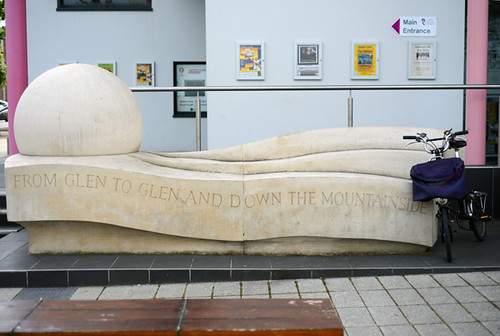
I have not thought about any of this in years. But I think about it now, in the mornings, as I lock up my bike in the town center of Limavady, Northern Ireland. There is a contemporary sculpture next to the cafe where I like to work. It is vaguely glen-shaped, in an abstract sort of way, and engraved with the lyrics to Danny Boy. Across the street is the colourful Corner Bar, its walls painted with murals containing more references to the song. And a helpful inscription explains the connection: "It was in Limavady that the famous melody 'Danny Boy' was noted down by Jane Ross from a tune played by a blind street fiddler named Jimmy McCurry." The original name of the melody was actually Londonderry Air, written byEnglishman Frederic Weatherly. But never mind. It's been 20 years since I sang Danny Boy and I still remember the lyrics.

Monday, December 6, 2010

The shell test is done!

Two days and literally inches of rain fell before it finally turned to wet snow as we climbed into Spray Park. Thenat 2AM Saturday (day 3) morning the moon came out and the temps dropped to 15 degrees F.We were able to get some of our gear dried over night and a short climb in before the nasty NW weather rolled back in late today.


Miserable for the majority of it but very educationaland well worth the effort.But not an experience I (or the rest of the CT test Team) want to repeat any time soon. There is a reason I like climbing in the dead of winter! I like water best in FROZEN form.


More to come once we get all the geardried out and and our field notes into hard copy. Some obvious winners and losers on this one. There is no ignoring ice cold water running down your back in these conditions. Or the specific jackets that we all ended up favoring during the monsoon.


Sunday, December 5, 2010

Balancing Act


The logs were laying every which away. They were huge logs and some would be balanced on top of others. This big one was proped up on a smaller one. Makes you wonder why it doesn't fall, and when will it happen. I just hope on one is under it when it happens.

Thursday, December 2, 2010

The Estate of Dederick Hoffman :: The Sale Bill


Sale Bill, page 1

Estate of Dederick Hoffman (Packet 805) Columbiana County, Ohio

FHL film 2032459 accessed June 8, ..

The cover page shows that the sale bill was filed July 1st 1826.

A List of the property Sold on the 15th day of May 1826 by the Administrators of the Estate of Detrich Hoffman late of Columbiana County Deceased with the amount that the Articles was Sold for to wit


Samuel Hoffman one Shue hammer & chisel - - 20
George Holderreed a hammer wedge & pinchers - - 38
Christian Betz one Square and hog tongs - - 16
John Beevers Mull rings and wedge - - 38
Christian Betz 2 hay forks - - 58
John Hoffman Dung fork & Shovel - - 47
Saml Hoffman Dung hook - - 50
Susanah Hoffman one Spade - - 12 1/2
Jacob Keckly one Matick - - 41
John Hoffman one axe & Bell - - 27
Saml Hoffman one bell - - 75
Thomas Minor on Do 01 00
Saml Hoffman one drawing knife - - 25
David Gearinger a lot of Augurs - - 25 1/2
Christain Betz one inch Augur - - 40
Saml Hoffman one hand Saw - - 50
Abraham Hoffman one axe 01 06 1/4
Jacob Stauffer one mans Saddle 01 01
Saml Hoffman one flax hackel - - 39
Christian Myr a curry comb - - 06 1/2
Thomas Kitch Jr one Grind Stone - - 46
Henry Bricker Jr one pair of hems [?] - - 40
Saml Hoffman one cow chain - - 14
Do Do Do Do - - 28
Do Do Do Do - - 25
Thomas Minor a halter chain & coler - - 94
Wm Baker one lot of traces chains - - 62 1/2


Sale Bill, page 2

Estate of Dederick Hoffman (Packet 805) Columbiana County, Ohio

FHL film 2032459 accessed June 8, ..


D C
Henry Bricker Jr Skillet & lid - - 74
Saml Hoffman one Griddle - - 30
David Gochaneur one pot - - 90
John Hoffman one Dutch oven 01 00
Frederic Betz one Dough tray - - 06 1/4
Abraham Mumert one churn - - 32
John Fry one barrel 00 04
David Gocheneur one Spinning wheel - - 79
Do Do two chairs - - 35
Saml Boots a lot of upper leather 01 02
Wm Baker one chest 01 50
Jacob Stauffer Jr one feed trough - - 26
Henry Miller 2 tow [?] bags - - 63
Saml Hoffman 2 turilled [?] bags - - 56
Abraham Mumertt Do Do - - 72
Frederic Betz one Jack Screw 03 50
Saml Hoffman one half Bushel - - 18 3/4
Jacob Roller one Riddle - - 25
John Hoffman one 12 gallon Kettle 03 12 1/2
Saml Hoffman Do Do Do 02 65
David Gocheneur one meet tub - - 57
George Holterreed one log chain 02 00
Henry Miller a lot of tin ware - - 06 1/4
David Gearinger a lot of Spoons - - 20
Henry Miller a coffee pot dish - - 14
Abraham Mumert one pair of Sheep Shears - - 37 1/2
Abraham Hoffmann a German Sermon book - - 25
Abraham Mumert a pewter Dish - - 22 1/2
Abraham Hoffman 2 German books - - 27
Saml Hoffman a German Bible - - 75


Sale Bill, page 3

Estate of Dederick Hoffman (Packet 805) Columbiana County, Ohio

FHL film 2032459 accessed June 8, ..


D C
Jacob Roller 8 knives - - 30
Henry Miller a tea Kettle - - 27
Christian Meese cups and Saucers - - 12 1/2
Do Do a lot of plates - - 12 1/2
Do Do a tin pan - - 18 3/4
Andrew Altman a lot of pewter - - 59
Henry Bricker Sr 7 yds of Shirting linnen 01 57 1/2
Henry Miller Do Do Do 01 82
Abraham Hoffman 8 Do Do Do 02 40
Isaac Baughman 10 yards of tow 01 82 1/2
John Hoffman 4 yds of Woollen cloth 03 00
Abraham Hoffman one coggshell - - 38
Saml Hoffman one Steelgavel 01 04
Abraham Hoffman one Rifle gun and exutrmer [?] 09 25
John Hoffman a clock and case 05 80
Micheal Frederic a Dresser 02 87 1/2
Saml Hoffman a pot tramel 62 1/2
Abraham Hoffman one mare 40 37 1/2
Christian Halderman one Sow and pigs 03 07
Henry Bricker Sr one Barrow 01 92
David Gocheneur one ew and lamb 01 94
Do Do one Do 01 31
Do Do DoDo 01 45
Samuel Hoffman one cuting Box - - 75
Jacob Keckly one windmill 05 15
George Holterreed one pidea [?] Steer 05 03
Do Do one black Do 05 00
Johnathan Tyler on Cow 10 14
John Hoffman one heiffer calf 03 25
Wm Betz two crocks 00 14


Sale Bill, page 4

Estate of Dederick Hoffman (Packet 805) Columbiana County, Ohio

FHL film 2032459 accessed June 8, ..


D C
Wm Betz two crocks - - 14
Wm Betz two crocks - - 12 1/2
Henry Bricker 6 lbs flax yarn - - 96
Do Do Do Do - - 96
Frederic Swarts one lot of rye 01 80
Jacob Roller Do Do 01 89
Micheal Frederic 3 yr Bushels of buckwheat - - 56
Do Do 2 crocks - - 07
Philip Houtz 10 bushels of wheat 02 60
Joseph Frederic Do Do Do 02 90
Henry Bricker Jr Do Do Do 03 20
Frederic Betz Do Do Do 03 12 1/2
Henry Hoffman Do Do Do 03 12 1/2
Joseph Frederic Do Do Do 03 12 1/2
Christian Meess 3 Do more or less 00 90
Frederic Swarts 10 bushels of oats 01 40
Saml Fox Do Do 01 40
Do Do Do Do 01 40
Do Do Do Do 01 40
Henry Bricker Senr one bed and beding 06 00
Frederic Betz 10 lbs of Sugar - - 75
John Sheets Do Do Do - - 70
Do Do Do Do Do - - 75
Do Do to Sugar - - 12 1/2
Saml Hoffman one cag - - 25
Henry Miller 35 lbs of Becon 01 57 1/2
Do Do 32 lbs Do 01 12 1/2
John Hoffman 22 lbs Do - - 70
Do Do 13 1/4 lbs Do - - 67 1/2


Sale Bill, page 5

Estate of Dederick Hoffman (Packet 805) Columbiana County, Ohio

FHL film 2032459 accessed June 8, ..


D C
John McConner one lot of beef - - 84
Frederic Swarts one gig - - 10
Frederic Betz one Barel - - 12 1/2
Samuel Butz one chisel - - 07
Saml Hoffman one third of a lot of rye in the ground 06 85
Do Do one third of a lot of wheat in the grnd 08 00


I do certify that the above is a correct list and amount of property Sold at the sale before mentioned.


Jacob Roller Clk [crossed out]

John Hoffman

Samuel Hoffman

Wednesday, December 1, 2010

A stroll to the Welland

Just under 3 miles - down to the river and back round the village. The Welland is still in some sort of spate, though nothing like it was last Friday.

I heard the cuckoo again, a little fainter than yesterday. I saw goldfinches flitting about in the hedge, and two hares crossed the road about ten yards in front of me, took a good look, and legged it. By the time I reached the gate to the field they had disappeared. The closest view I've had for some time. Unfortunately, no camera shot!


This may be slightly fuller than yesterday.


Tuesday, November 30, 2010

Vintage French Redux

Unexpected ProjectHere is a bike tinkerer's parlour game for you: Assemble a complete bicycle using whatever wayward frame and spare parts happen to be in your possession at the moment. You can't go out and buy anything - not even cables or bolts. And you have exactly one evening. What would you come up with? The Co-Habitant ended up with something kind of neat. And mostly French. And both of us could ride it!
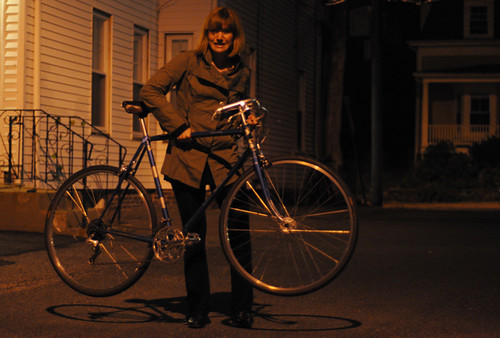
We have thisMotobecane Grand Touring frame that we considered selling, but in the end decided to keep. The frame is too small for him and too large for me, but we were curious about the Vitus tubing and wanted to compare it to other Motobecane models we'd ridden. Maybe some day we'd build it up just for the heck of it, we thought - though not really expecting this to happen. But sometimes, things fall into place. Say you're cleaning, and you notice a box full of stuff you'd forgotten about. And then remember another box, with more stuff. Then out comes the frame and in a matter of hours a bike is born. Vintage touring wheels, Suntour derailleurs and original Belleri Porteur bars were mixed with amodern Sugino Alpina crankset, VO city brake levers, Tektro sidepulls, and Shimano bar-end shifters. We found a sanded-down stem from another French bike, a seatpost that happened to fit, and an old saddle. It was getting too late in the night to mess with fenders and handlebar tape, but we do have some.

Unexpected ProjectThe result so far is unexpectedly lightweight - especially compared to the Super Mirage the Co-Habitant had earlier. We took turns riding the bicycle around the empty neighbourhood in the middle of the night and marveled at how nice it felt. I've ridden lower end Motobecane bikes and have also tried a couple of higher end ones - but this one feels different from either. No toe overlap on the 58cm square frame.

Not sure what we will do with this bicycle, but he may keep it as his fast city bike - especially since he is infamously nervous about leaving his Pashley locked up on the street. I will post daylight pictures once it's fitted with fenders and handlebar tape. Not bad for a neglected frame and a box of spare parts!

Monday, November 29, 2010

_____________________Nick Hall______________________

It's been one long year since we lost you.

We won't ever forget your friendship or your style.

Thanks for the inspiration to do more, do it better.

The mountains are still out there.

We're still climbing.

Miss you a ton.


Sunday, November 28, 2010

Ride Fast or Ride Far?

Covered Bridge Lunch Stop, D2R2
When I first started trying to increase the milage of my rides, I was advised to keep my average speed down on longer distances. "You can ride fast, or you can ride far," I was told. This advice seemed perfectly logical. The faster you ride, the sooner you'll get tired, right?


But my own experience stubbornly contradicted this piece of wisdom. I grew suspicious when, over the past two years, intentionally keeping my speed down only seemed to make me miserableon longer rides. So this summer I experimented. On some long rides I rode at whatever speed felt natural in the moment (whee!). On others I intentionally kept my speed in check. I felt better after the rides where I maintained a higher speed.


At first this discovery confused me. And then all at once, it made sense. The "fast or far" dichotomy fails to account for one crucial factor: time spent on the bike. Let's say you are doing a 100 mile ride. At an average rolling speed of 14mph, you will spend 7.14 hours on the bike. At an average rolling speed of 12mph, you will spend 8.33 hours on the bike. That's more than an hour of extra bike time! An entire extra hour of pedaling, of leaning forward, of gripping the handlebars, of chafing against the saddle. These things can wear you out just as much as the pedaling effort itself.


My point here is not that one should attempt a century ride with the zeal of a racer, but that it helps to look at a situation from multiple angles and to factor in your own strengths and weaknesses. As it turns out, I can ride faster than I've been giving myself credit. And as my body struggles to cope with longer times in the saddle, riding faster is getting me further. YMMV.

Saturday, November 27, 2010

Beta alert.


Look away if you ever plan on on-siting "Spoonman" at Coolum Cave.


Pay attention if you want to see a big Frenchman running out the crux.That's all I have to say. Enjoy.


Need more Antoine? Click here.


jj