 When I posted another photo of these flowers I said I didn't know what they were so I looked them up and they are a type of buttercup.
Sunday, January 31, 2010
Buttercup
When I posted another photo of these flowers I said I didn't know what they were so I looked them up and they are a type of buttercup.
Friday, January 29, 2010
The Speeding Bullitt of Somerville
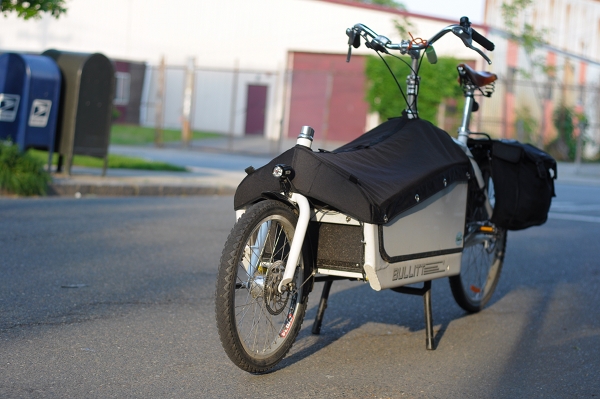 Sometimes Somerville really is a village. On my way home last Friday, I discovered the Co-Habitant, Somervillain and Brian P. engaged in what appeared to be an impromptu bike-testing party, after having crossed paths on their way home from work. The many other cyclists who rode by craned their necks with interest, because of course none of these were "normal" bicycles. Somervillain had his Bike Friday tandem, which he was riding alone. The Co-Habitant had his Pashley. And Brian P. had his Bullitt cargo bike. My own arrival on the swan-frame Pilen complemented the scene nicely.The sun was setting over the Peter Forg Manufacturing Co., bathing the street in that magical golden light. I had wanted to try Brian's cargo bike, and now was my chance.
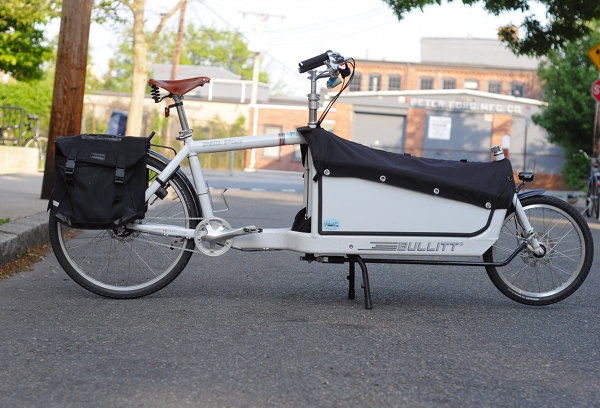 The bike is a Bullitt "Milk Plus" model, made by Larry vs Harry. It is a Danish cargo bike, based on a traditional "long john" design - similar to a Dutch bakfiets, but with a longer and narrower cargo platform. Larry vs Harry market the Bullit as being fast and sporty in comparison to other cargo bikes. The bike is 245cm (96.5") long, 45cm (18.5") wide, and it weighs 24kg (53lb) unloaded. It has a 20" front wheel and a 26" rear wheel. Detailed geometry specs and blueprints are available here.
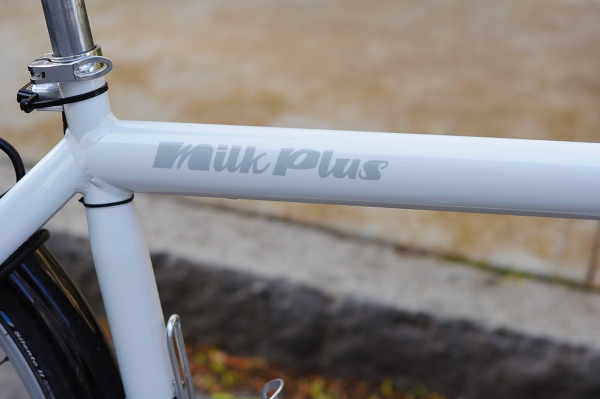 The frame is heavy-duty welded aluminum.
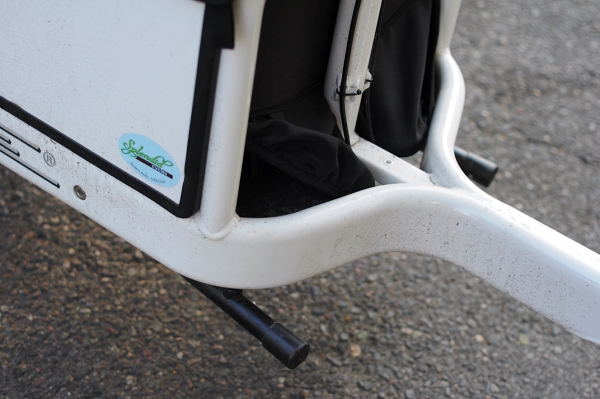 The frame is described byBullittownersas extremely stiff.I like the part where the main tube branches out to form the platform - there is something visually appealing about this junction.
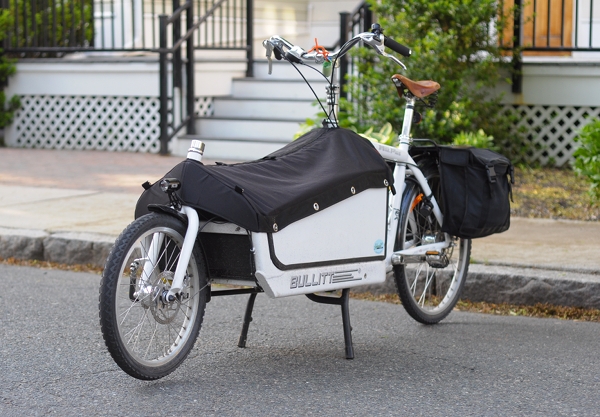 The (optional) cargo box is plywood. It can be used to carry cargo or passengers and comes with a water-resistant cover.
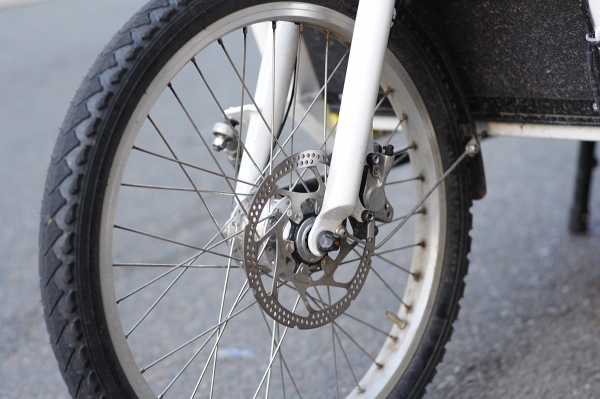 The bike is equipped with disc brakes.
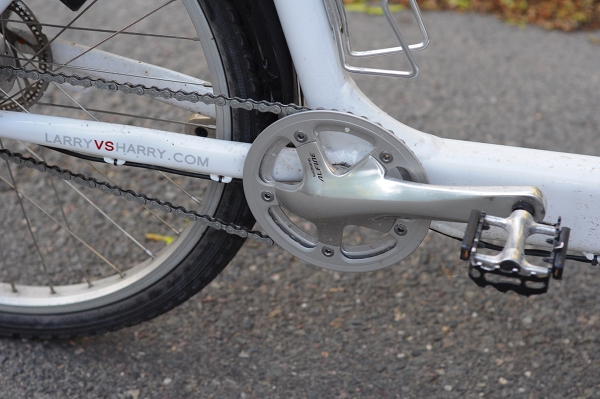 And an 8-speed IGH drivetrain. See here for complete specs.
 The wide double kickstand keeps the bike unquestionably sturdy and is easy to activate.
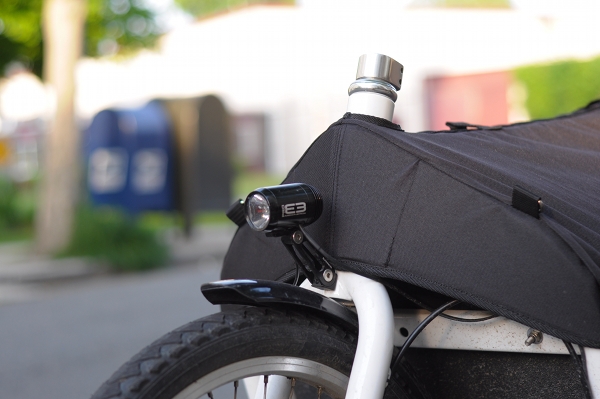 Brian bought this bicycle from Splendid Cycles in Portland, OR, and they installed a dynamo hub with the Supernova E3 headlight and tail light.
 He also replaced the stock racing-style saddle with a Brook Flyer, and he says that that the sprung saddle works well with the stiffness of the frame.
 He replaced the stock mountain bike-style handlebars with North Roads,
 and added a modified Civia rack from Calhoun Cycle with a set of Dutch panniers.
 I found the overall look of the modified Milk Plus Bullitttextremely attractive and was looking forward to trying it. It felt well-balanced as I was walking it, which gave me hope.
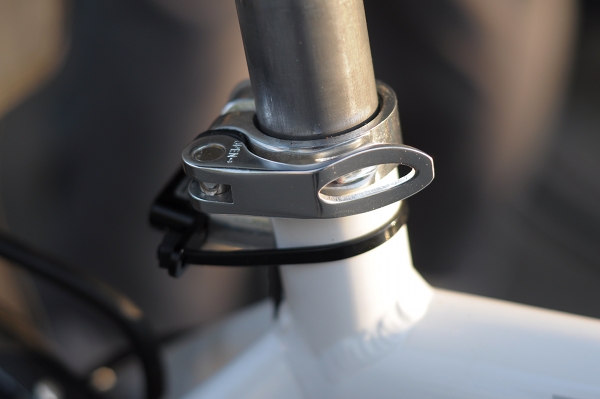 The saddle is quick release and smooth to operate; I was able to adjust the saddle height myself.
 The stem is also quick release, making it possible for different riders to adjust handlebar height to their tastes.
 I was able to step over the Bullitt's top tube while wearing a skirt without having to swing my leg around the back; the standover height is similar to that of a large mixte. I was comfortable and ready to ride the bike... which, unfortunately, was not so easy! The main problem is that the Bullitt needs to gain momentum in order to become stable. When just starting or going slowly, the long front end fishtails wildly and the bike is difficult to control.
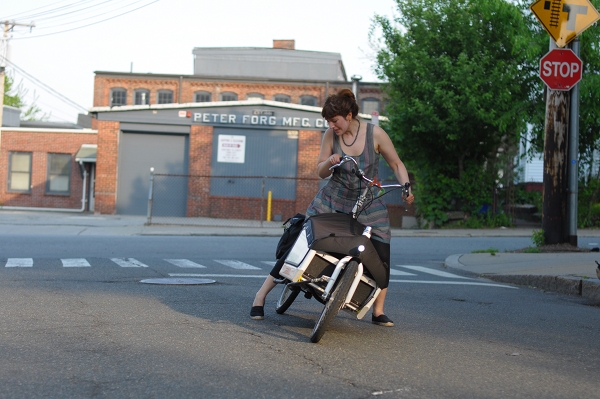 After a few shaky starts, I did manage to ride the Bullitt down the street and pick up some speed, only to falter when attempting to come to a stop. Luckily, the bike was easy to hold up once it started to fall over to the side, so I did not outright crash it into the ground. Not wanting to damage somebody else's shiny bicycle, I did not make further attempts. Not pictured here, but Somervillain tried the Bullitt as well with similar results- false starts, then finally getting it going, then dumping it when attempting to stop at the end of the street. There is a learning curve.
 I understand the concept of having to get the bike up to speed in order to achieve stability. But unless I am missing something, this seems at odds with using it in stop-and-go traffic - which is what I thought cargo bikes are designed for... In any case, some riders may find operating the Bullitt more intuitive than others.
 The Co-Habitant pretty much was able to ride it, though he described the same fishtailing sensation and said that he'd need a lot of practice to feel comfortable with it in traffic.
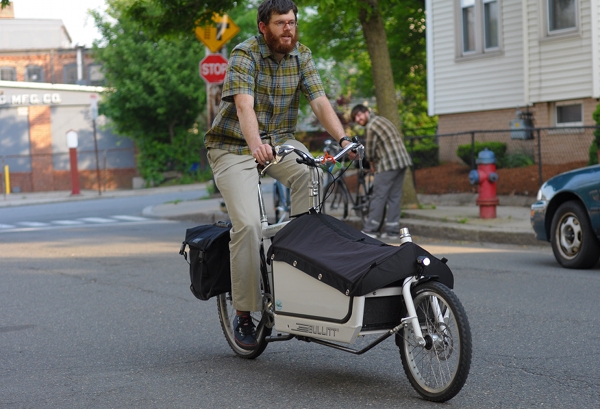 Brian handles the bike like a pro, making it look extremely easy. He reports having been able to ride it pretty much on the day it was assembled - sticking to local streets initially, then venturing into heavier traffic.
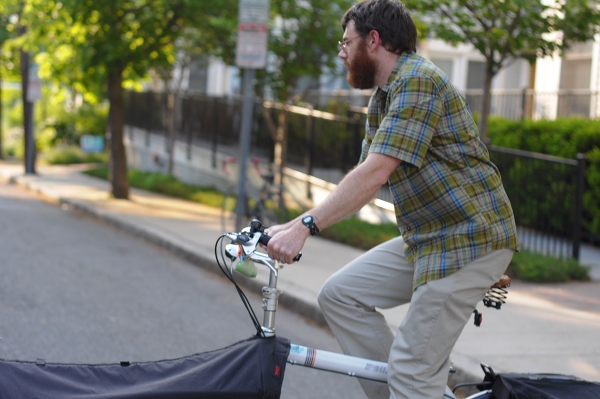 Looking at these pictures, it occurs to me that perhaps people with beards take to the Bullittfaster than people without. Based on our very scientific sample size of n=4 at least, that seems to be the case.
 At this point, Brian has had the Bullitt for just over 2 months and enjoys it tremendously. It is indeed supposed to be faster and more maneuverable than other cargo bikes, once you get the hang of the handling. Brian lives atop of an insane hill that I would hate to tackle every day even on a roadbike. He finds the Bullittmanageable when cycling up it. Typical commuting speed is about 10mph, or faster with no cargo. Normally, Brian uses the Bullitto pick up his son from daycare and for groceries. He has also done a camping trip on it once, which he will soon describe on his website. When I asked Brian for critical feedback, he replied that the size made the bikeunwieldy to walk - for example, when strolling with someone else on the sidewalk. There is also no good way to secure valuable items on the bike, making multi-trip shopping difficult. These issues are of course common to all cargo bikes.
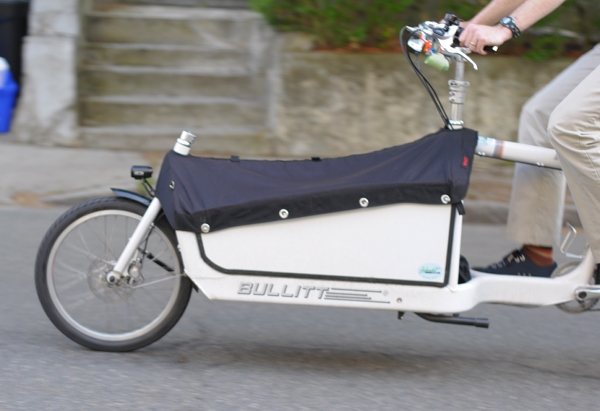 The Bullitt Milk Plus with Brian's modifications is dashingly handsome, and just the right size for the kind of cargo we'd need to carry. If I could ride it, I'd be seriously fantasising about it. But while I can see myself quickly getting used to the Christiania trike I tried earlier, realistically speaking I cannot imagine feeling comfortable enough with the Bullittto ride it in traffic. The slow-speed handling is just too quirky for me.Reactions to theBullittseem to greatly depend on individual bike handling skills and preferences.For those who can handle it, the Bullitt is a unique cargo bike option in the combination of speed, agility and load capacity it offers. But I would strongly recommend test riding this bike before buying.
Thursday, January 28, 2010

Wednesday, January 27, 2010
Saddington - Smeeton - Debdale round
With Maureen, Barry and Gordon. 8.5 miles approx. Three and a half hours including pauses. Weather sunny and warm.
We started from Saddington, and walked along the Smeeton Road to Bridge 72. I intended to take a footpath for part of the way, but we didn't notice it as we passed it. Then along the canal and over Saddington Tunnel,
descending to the tow path on the left of the canal. We left the tow path at Fleckney Bridge, where we used the two hand gates and crossed the bridge, taking the path through Mill Field Wood at right angles to the canal here.
Past the MM stone and across the fields to the Kibworth-Saddington Road, and over into the mud and gravel track which becomes Mill Lane just before entering Smeeton Westerby.
We turned right into the village centre, then left at Debdale Lane. We followed this past Bridge Farm and Bridge 67 cookery school.
Through a farm gate and we followed the track uphill until we reached the canal. Just before the gate and stile we found an inviting patch of shade for a snack and water break.
At the canal we turned left toward Foxton, passing the large narrowboat yard at Debdale Wharf, under a couple of bridges.
We crossed the first footbridge over the canal. We took the path along the right-hand edge of the field, and across another, past some farm buildings and uphill thorugh a field where they may or may not have been a bull - there was certainly a herd of creamy and white cows, along with a lone horse.
The path led uphill with Gumley Wood on our left, across rolling countryside - the hilliest and most scenic part of the walk was saved until the later stages. We crossed the small road from Gumley to Debdale, a little way short of the junction. A brief walk through thistle and butterfly country cut off a corner, and we crossed the road from Gumley to Smeeton.
The path is a track between two hedges, then turns right to follow the edges of fields, clearly marked and climbing gradually, until, just before Smeeton Gorse, the Leicestershire Round path from Gumley joins our path. A short steep climb over grass leads to the highest point, with good views and a strategically placed bench. (To the right of this is HIll Farm, Smeeton Hill, according to the map.) We followed the Leicestershire Round path along the 'ridge' then downhill , crossing two footbridges and going through a number of stiles before climbing to Saddington where we emerged along an enclosed path into the village, directly opposite the well-hidden footpath sign I missed at the start of the walk.
We started from Saddington, and walked along the Smeeton Road to Bridge 72. I intended to take a footpath for part of the way, but we didn't notice it as we passed it. Then along the canal and over Saddington Tunnel,
 |
| North western end of Saddington Tunnel |
descending to the tow path on the left of the canal. We left the tow path at Fleckney Bridge, where we used the two hand gates and crossed the bridge, taking the path through Mill Field Wood at right angles to the canal here.
 |
| By the Mill Field Wood millenium stone |
Past the MM stone and across the fields to the Kibworth-Saddington Road, and over into the mud and gravel track which becomes Mill Lane just before entering Smeeton Westerby.
We turned right into the village centre, then left at Debdale Lane. We followed this past Bridge Farm and Bridge 67 cookery school.
 |
| This ad was on an old container-cum-shed near the cookery school. I googled and it seems it has now gone out of production to the chagrin of many cooks. |
Through a farm gate and we followed the track uphill until we reached the canal. Just before the gate and stile we found an inviting patch of shade for a snack and water break.
At the canal we turned left toward Foxton, passing the large narrowboat yard at Debdale Wharf, under a couple of bridges.
 |
| Fine display in a boat garden. |
We crossed the first footbridge over the canal. We took the path along the right-hand edge of the field, and across another, past some farm buildings and uphill thorugh a field where they may or may not have been a bull - there was certainly a herd of creamy and white cows, along with a lone horse.
The path led uphill with Gumley Wood on our left, across rolling countryside - the hilliest and most scenic part of the walk was saved until the later stages. We crossed the small road from Gumley to Debdale, a little way short of the junction. A brief walk through thistle and butterfly country cut off a corner, and we crossed the road from Gumley to Smeeton.
 |
| Thistle and butterfly country |
The path is a track between two hedges, then turns right to follow the edges of fields, clearly marked and climbing gradually, until, just before Smeeton Gorse, the Leicestershire Round path from Gumley joins our path. A short steep climb over grass leads to the highest point, with good views and a strategically placed bench. (To the right of this is HIll Farm, Smeeton Hill, according to the map.) We followed the Leicestershire Round path along the 'ridge' then downhill , crossing two footbridges and going through a number of stiles before climbing to Saddington where we emerged along an enclosed path into the village, directly opposite the well-hidden footpath sign I missed at the start of the walk.
Sunday, January 24, 2010


Wednesday, January 20, 2010
Moose Meadows, Pigeon River

(Click the photo to view a larger version)
This photograph was made from the Pigeon River Helipad and Overlook on Otter Lake Forest Road in Northeast Minnesota. Ever since the forest service created this helipad and overlook, I've been stopping there whenever I'm in the area in the hopes of seeing a Moose down along the river. Being quite familiar with the river from the seat of a kayak, I knew that this bend in the river was quite popular with the Moose. However, I had never seen one from the overlook until today! I watched through my telephoto lens as the Moose moved throughout the shallows for several minutes. Eventually he turned and gave me a nice profile of his body. It was cool to finally see a Moose from this vantage point! This marks my 18th Moose sighting of this year!
Saturday, January 16, 2010
Is this Fair Use?
This morning I received an email from someone who was asking me for more information about a person they had found on my site at Ancestry.com but the first thing that popped into my feeble brain was that I don't have a website on Ancestry and I knew that what they were referring to was not on my freepages at RootsWeb!
So I went to Ancestry and did a search for "Phend" which brought up the following screen and didn't see anything out of the ordinary (click on any of the images to make them easier to read):

So I elected to view all 229 results:

The "Internet Biographical Collection" jumped out at me. Notice the padlock? I clicked on that link, but this is a "for pay" subscription database, and since I wasn't logged in I couldn't see the detail any more than the listing of pages, all of which, except for the last one, are from my website and they are definitely NOT part of Ancestry.com!!!

After logging in and clicking on "View Record" on one of the listings, what you see is shown below. No indication of where this came from, only a small link to "View Cached Web Page", Okay, so it says it is a cached page. . .

Click on "View Cached Web Page" (click on these images to make them bigger) you'll see a small link at the top of the page to "View Live web page" and it will then take you to the page, maybe.

For this particular page the link works because my site is still live. But when I was investigating all this I had gone to some obituary links. The site where the obituary was retrieved from is even more "hidden" for lack of a better word - many newspapers only keep obituaries online for a short time so the page is no longer live. I wonder if Ancestry.com is paying those sites to "store" their obituaries and make them available to Ancestry subscribers?
Is this legal or moral? How is it right for Ancestry.com to take my website pages, which I've made freely available, and CHARGE people to use them? And if they can legally or morally do this, how can they in turn say that it is illegal for their users (me and you) to use their images (census records, draft cards, etc.) on our websites or in our books or other publications?
The more I think about this, the angrier I am getting. At first I thought, okay, they say it is a cached web page, but it's not overly obvious. But they are charging people for access to my stuff!!! I really don't think it would bother me so much if this wasn't hidden behind a padlock. The more people that can find my data and possibly connect to me or someone else, the better - but they shouldn't have to pay to see it! Now, Ancestry is probably going to say they are simply providing a service for all of us poor webmasters and making it so that more people will see our stuff - but does that make it right? They are profiting from my work, and not just my work but the work of anyone with a genealogy related website. Will my blog pages show up next?
This is different than Google or Yahoo or any other search engine storing cached pages or providing links to websites. This is a company using other peoples work for their own gain - Ancestry is charging for these 'searches'. That is just not right, and not just because this is my work showing up - if you have genealogy pages out there anywhere they will probably show up as part of this new Ancestry database.
*** Update 4:00 PM Tuesday ***
I spent a while this morning and afternoon putting this post together, and while I was doing so, it appears that "all hel* was breaking loose" on this issue, see these posts with some very good commentary on the subject:
So I went to Ancestry and did a search for "Phend" which brought up the following screen and didn't see anything out of the ordinary (click on any of the images to make them easier to read):
So I elected to view all 229 results:
The "Internet Biographical Collection" jumped out at me. Notice the padlock? I clicked on that link, but this is a "for pay" subscription database, and since I wasn't logged in I couldn't see the detail any more than the listing of pages, all of which, except for the last one, are from my website and they are definitely NOT part of Ancestry.com!!!
After logging in and clicking on "View Record" on one of the listings, what you see is shown below. No indication of where this came from, only a small link to "View Cached Web Page", Okay, so it says it is a cached page. . .
Click on "View Cached Web Page" (click on these images to make them bigger) you'll see a small link at the top of the page to "View Live web page" and it will then take you to the page, maybe.
For this particular page the link works because my site is still live. But when I was investigating all this I had gone to some obituary links. The site where the obituary was retrieved from is even more "hidden" for lack of a better word - many newspapers only keep obituaries online for a short time so the page is no longer live. I wonder if Ancestry.com is paying those sites to "store" their obituaries and make them available to Ancestry subscribers?
Is this legal or moral? How is it right for Ancestry.com to take my website pages, which I've made freely available, and CHARGE people to use them? And if they can legally or morally do this, how can they in turn say that it is illegal for their users (me and you) to use their images (census records, draft cards, etc.) on our websites or in our books or other publications?
The more I think about this, the angrier I am getting. At first I thought, okay, they say it is a cached web page, but it's not overly obvious. But they are charging people for access to my stuff!!! I really don't think it would bother me so much if this wasn't hidden behind a padlock. The more people that can find my data and possibly connect to me or someone else, the better - but they shouldn't have to pay to see it! Now, Ancestry is probably going to say they are simply providing a service for all of us poor webmasters and making it so that more people will see our stuff - but does that make it right? They are profiting from my work, and not just my work but the work of anyone with a genealogy related website. Will my blog pages show up next?
This is different than Google or Yahoo or any other search engine storing cached pages or providing links to websites. This is a company using other peoples work for their own gain - Ancestry is charging for these 'searches'. That is just not right, and not just because this is my work showing up - if you have genealogy pages out there anywhere they will probably show up as part of this new Ancestry database.
*** Update 4:00 PM Tuesday ***
I spent a while this morning and afternoon putting this post together, and while I was doing so, it appears that "all hel* was breaking loose" on this issue, see these posts with some very good commentary on the subject:
- Kimberly Powell with Has Ancestry.com Gone to Far?
- Janice Brown with Ancestry.com Hijacks Cow Hampshire
- Randy Seaver with Ancestry.com is Caching some web site data
- Amy Crooks with Ancestry.com Nothing but Theifs
*** Update 4:44 PM Tuesday ***
Ancestry.com has now made the "Internet Biographical Collection" a "free" resource. You have to register to view these free records, which is not the same as signing up for a free trial, but why should you even have to register to view the "Internet Biographical Collection"? Registration is not required to view the Ancestry World Tree entries. To my way of thinking, this step by Ancestry does not entirely resolve the issue.
*** Update 11:30 PM Tuesday ***
Dick Eastman's post yesterday on The Generations Network Receives Patent for Correlating Genealogy Records has a lot of comments dealing with the Internet Biographical Collection, which really had nothing to do with his original topic, so you could say the comments thread got hijacked. As can be expected there is a wide range of opinions on the matter. Some make sense, others don't. Some valid, some not. And Dick is really good at playing the devil's advocate!
Thursday, January 14, 2010
New Visitor Center Sneak Peek
 Being a "Mount Rainier VIP" (did you realize that volunteers are labeled "VIPs" because they are "Volunteers In Parks?") allowed me to recently take a private tour of the new Jackson Visitor Center and remodeled Paradise Inn.
 Both are still under construction (which has consumed the Paradise upper lot for the last 2 summers) but thankfully, that construction is drawing to a close this year. The Paradise Inn will re-open in May and the new Jackson Visitor Center is scheduled to re-open this October.
 Exploring the bowels of a major construction site was a fascinating and educational experience. The first notable surprise was how many people were actually involved in the project, and the variety of different tasks they were all doing.
Project safety manager Derek Burr (my tour guide) says there are about 30-40 people working on the visitor center site on any given day. The various specialists include (but are not limited to!):
- Heavy equipment operators
- Carpenters
- Pipe fitters
- Sprinkler pipe fitters
- Plumbers
- Electricians
- Sheet rock workers
- Earth workers
- HVAC technicians
- Iron workers
- Sheet metal workers
 Another interesting fact about the visitor center construction site is that it features a "Dance Floor." Not your Saturday Night Fever variety, but a giant platform -- nicknamed the Dance Floor -- that is suspended 24 feet in the air. Above that false floor is another 24 more feet of scaffolding that enables workers access to the fifty-foot high pitched ceilings.
Burr notes that working on the high ceiling was one of the most challenging elements of the project. The Dance Floor was created because they couldn't fit a "lift" inside the doorway of the building.
Another cool feature of this project -- designed to address the weather challenges of Paradise -- is a scaffolding that extends beyond the roof-line by 10 feet. "That way that people can work on the outside of the building from the inside, without being killed by snow falling off the roof,” says Burr. There are even more people working at the Paradise Inn-- 40-50, says Burr. The goal is to rehabilitate the 86-year old building so that it retains its rustic feel but can better withstand the ravages of time and weather.
To make the building stronger while keeping the historic atmosphere, many of the original beams, planks, and logs in the walls and floors were taken out, reinforced with concrete and steel, and then put back. The Inn has seen a lot of wear and tear over the years. Earthquakes and large snow-loads have made the floor uneven, pushed on the walls and created gaps and even some trenches throughout the structure.
 One such trench in the corner of the dining room was so big that Burr wondered if “they were gonna dig up some skeletons?” Seriously though, an NPS archaeologist did examine the area and thankfully, no skeletons were found (Remember... Redrum...).
One big challenge for this type of construction project is to keep employees working at Paradise. "It's not an easy job," says Burr. To those of us who visit Paradise for those gorgeous views and hikes, it might be hard to imagine what could be so difficult about working there. (It beats a cubicle, doesn't it?) But the commute is quite long and many of the workers reside in temporary housing. And then of course, there is always the threat of crashing your truck on a slick icy road that is threatened by avalanches, or the joy of digging it out of the snow daily.
Burr, however, has enjoyed the job and his surroundings. "Some people don't even like to look at the view. But I take as many pictures as I can." Photos by Burr, Agiewich and NPS.
Surprise visitors
I looked out the window and couldn't believe what I saw.

Oh! Oh oh oh oh oh!
A wild turkey with four babies! (Meleagris gallopavo.)
I was grinning from ear to ear all afternoon.
Sorry everything's a bit blurry - I never wash the windows. It cuts down on the number of birds that break their necks trying to fly inside. No, really! That's why. Really.
Oh! Oh oh oh oh oh!
A wild turkey with four babies! (Meleagris gallopavo.)
I was grinning from ear to ear all afternoon.
Sorry everything's a bit blurry - I never wash the windows. It cuts down on the number of birds that break their necks trying to fly inside. No, really! That's why. Really.
Wednesday, January 13, 2010
Coming soon - Profile: Big Al Spadijer
 Look out Mt Coolum property prices!Al Spadijer is your new neighbour.
Tuesday, January 12, 2010
Me & Dogs

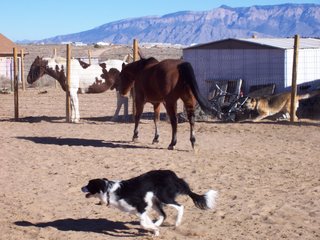
Here is a photo of me, Tuffee, and Codee taking a break while stacking hay for horses. And another shot of Tuffee, and Codee as they think they are herding my bay mare, Nita, and the paint, Sundance.
Subscribe to:
Comments (Atom)