Saturday, February 27, 2010

Buckeye


A Buckeye butterfly on Oleander.

Titanium for Transportation?

Test Riding Van Nicholas AmazonOver the weekend I am test riding a titanium bicycle from the Dutch manufacturer Van Nicholas that was enthusiastically recommended by a reader. I will be posting a review in the future, but for now I have some general thoughts on titanium bicycles as transportation.
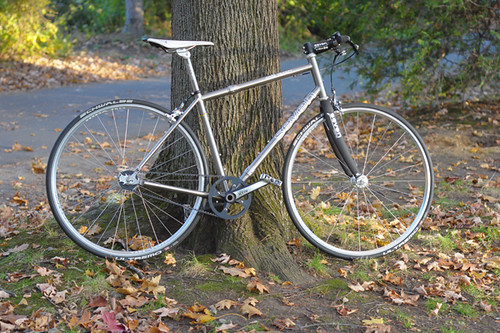
Seven Cafe Racer Belt DriveI've been thinking about this more and more after test riding several Seventransportation bicycles over the past few months, including this belt drive cafe racer.While their idea of how a transportation bicycle should be set up is not quite the same as mine, I have to say the ride quality was divine. I could go over all the roots and bumps I wanted and feel nothing.
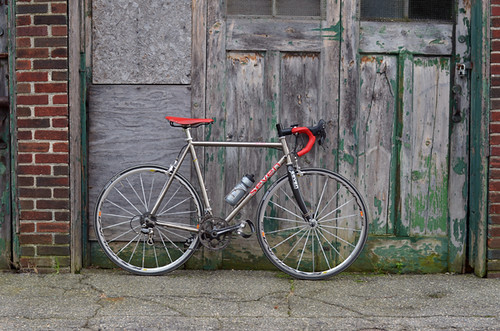


Seven Axiom SThis is the same sensation (or lack thereof) I had reported after many miles on the Sevenracing bike I had on loan over the summer: Riding it with 23mm tires over bumps and potholes, I would feel only an "echo" of going over them, as if it were happening to someone else.At the time I was careful not to attribute this sensation to titanium per se, because I had no experience with other titanium bicycles. But it did make me curious to go out and try some others. This wasn't easy, because titanium bicycles are not exactly common. Still, I managed to briefly ride an older Merlin with 28mm tires. While the ride was completely different from the titanium Sevens, I did experience the same "otherwordly" sensation over bumpy surfaces. Around the same time I also briefly tried a steel and a carbon fiber Seven, and they did not feel like the titanium Sevens.

Brompton P6L-XAnother encounter with titanium took place when I test rode a Brompton over the course of several days. I had heard that bicycles with small wheels tend to have a harsh ride quality, but the Brompton felt just fine. The Co-Habitant pointed out that this could be because the model I'd borrowed was fitted with a titanium fork and rear triangle. "Nonsense," I said, "It can't possibly make a big difference!" But when I returned the Brompton I made it a point to try the all-steel version immediately afterward. Darn, I could feel a difference. The model with the titanium fork and rear tringle had a softer ride quality over bumps. I say "darn," becauseI was biased toward not wanting to feel a difference: that was one factor that prevented me from actually buying a Brompton, as the titanium model is considerably more expensive.
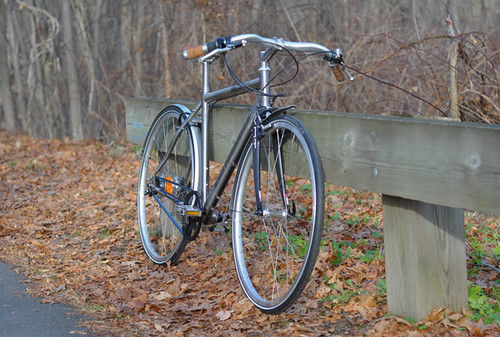


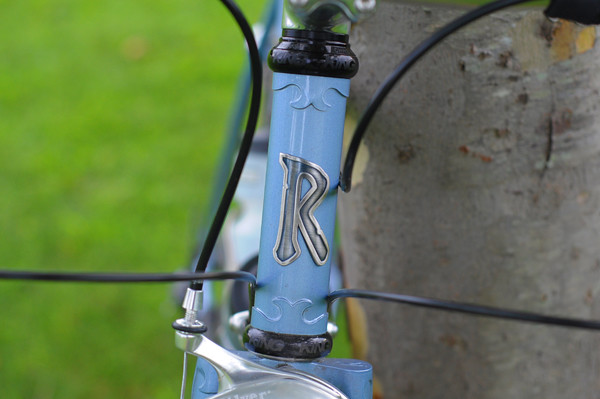
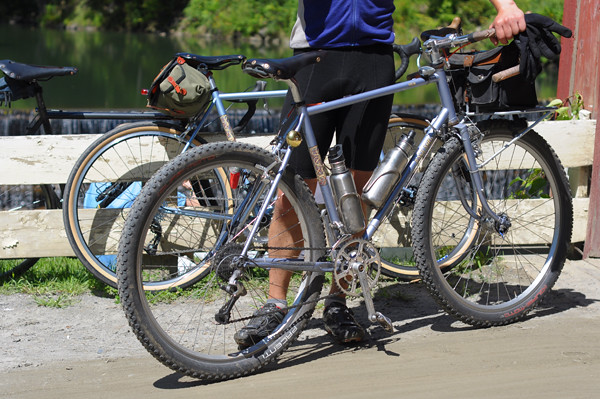
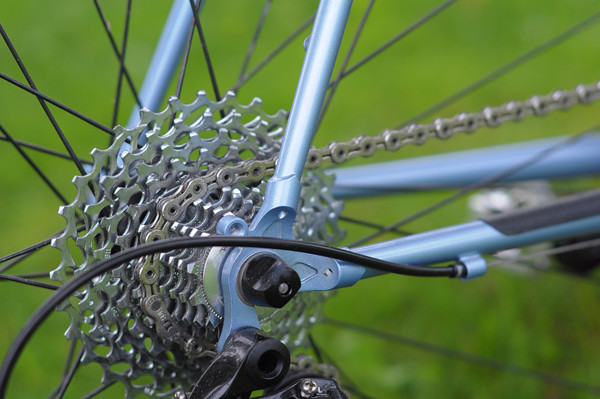
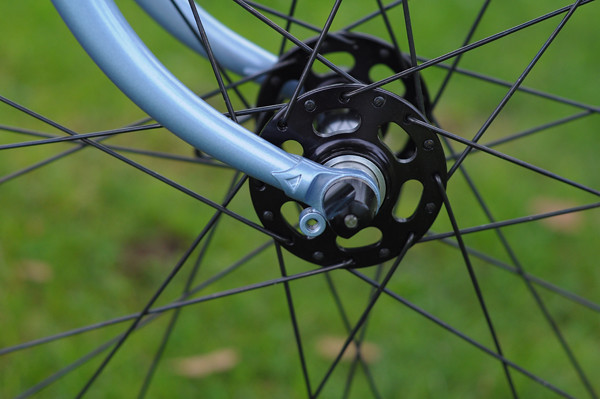
Van Nicholas AmazonAnd now there is the Van Nicholas. This is a touring/commuter model that rides not unlike a titanium version of a Rivendell.At the same time, it has the "echo-like" quality I've noticed in the other titanium bicycles I've tried, and in combination with the 32mm Schwalbe Marathon Supremes I just do not feel the road. It's as if the bike rides on balloon tires, but without the heavy sensation these tires sometimes have.


Test Riding Van Nicholas AmazonHaving tried about half a dozen titanium or partially titanium bicycles at this point, I can say that I do feel a common aspect in their ride quality independent of manufacturer and geometry - namely the manner in which they dampen road vibration. This alone would make titanium a good candidate for a transportation bicycle, simply because it makes for a comfortable ride without the need for super-wide tires. In addition, titanium does not rust and does not require paint. The frame should be absolutely fine in the winter and in the rain with virtually no need for maintenance. Any scratches can simply be buffed off the surface. Combined with an internally geared hub, which would further reduce the need for maintenance, this type of bike could, in theory, be indestructible - lasting for decades with minimal maintenance. And of course the light weight of titanium does not hurt. The downside? Well-made titanium bikes tend to be painfully expensive - if only because they are typically handmade by small builders.
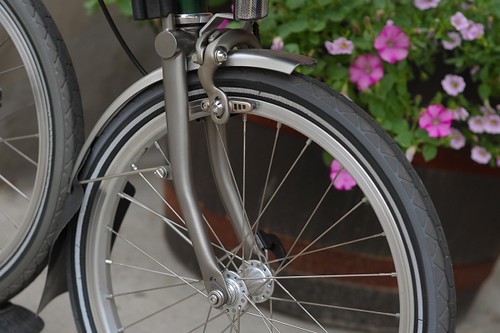


Brompton P6L-X, Ti ForkOne framebuilder in the Netherlands has been making titanium Oma-fietsen(!), which I find completely intriguing and would love to try some day. In the meantime, the only other woman-secific titanium frame I have seen is the ladies' version of the Van Nicholas Amazon, but I don't find the design appealing. I wonder whether there would be demand for elegant titanium loop frames in the US, where weight and hill climbing ability tend to be particularly important. While I am generally not attracted to welded frames, the ride quality and other features of titanium have drawn me into becoming increasingly interested in this material and its applications. What do you think? Does titanium appeal to you and would you consider it for a transportation bicycle if it were more readily available?

Wednesday, February 24, 2010

Cycling Up an Appetite: Women and Food


When I was in graduate school, a friend was conducting a research study that involved interviewing female students with and without eating disorders. This proved to be more difficult than she anticipated. Of the young women she'd recruited though a randomised process, all but one showed signs of disordered eating: She did not have a sufficient control group. So she dismissed her initial participant pool and tried again, only to get a similar result. Eventually this caused her to change the direction of the investigation: Her inability to recruit a group of university women with no history of eating disorders in itself became the theme of her research.


Looking back at this 10 years later, I don't think that she or I would have qualified for the control group of that study either. While neither anorexic nor bulimic, our eating was not what I would now consider normal. We were hyper-aware of our calorie intake.We knew our precise weights.We paid attention to the times of day we ate. After a meal, we would keep a mental note of the amount of exercise we'd have to do to compensate for it. The truth is, eating at that age for many of us was an inherently conflicted experience, the effect of food on our bodies ever-present in the backs of our minds. We were not fashion models and we were not athletes; we were university students. For most of us, it was not about our looks but about maintaining control in a competitive and stressful environment.


It was also a matter of having lostour natural appetite regulation mechanisms. We counted calories because we genuinely had no idea when we were truly hungry and when we were not. Our hunger and satiation signals were so out of whack with reality that we no longer trusted them.At age 12, feeling hungry simply meant I needed to eat something. But by age 22, this connection had become severed. There was nervous hunger, cravings for comfort food during all the endless studying, emotional eating. Lack of appropriate satiation signals could lead to overeating unless we were vigilant. And so we were, and it made us miserable.


How did this become the norm for so many women? Most likely it began with dieting during our teenage years and spiraled from there. We did not see it as abnormal, because we were neither puking up food nor outright starving ourselves. We were simply "eating healthy," watching our weight, making sure we maintained whatever clothing size we saw as being appropriate for our body types. But in truth we were suffering, and did not know how to put an end to it. In retrospect, I cannot believe how normalised this was in my generation of university women. Most of my female friends, acquaintances and colleagues had these issues and hid them with various degrees of success. Countless male friends have told me that they've never had a girlfriend who was not "weird" about food.


I cannot pinpoint exactly when things began to turn around for me. Possibly it was moving to a large city in my late 20s where I was suddenly doing lots of walking - not for exercise, but as a natural part of living and getting around. But riding a bike was what really accelerated the process of getting my appetite instincts back on track, so the connection is a strong one for me. Experiencing my body as a useful machine and not just as a bothersome appendage to my brain was what really did it. Through cycling I began to think of food as fuel. If I wanted to ride, I had to eat. And at age 30, for the first time in what must have been 15 years, I was once again able to eat when hungry and stop when full, just like I did when I was a child.


Since I began writing this blog, I have spoken with many, many women cyclists who describe similar experiences. Regaining trust in their hunger and satiation instincts for the first time since their pre-teens has been a gift more dear than they can express. And while cycling is not the only way to achieve this, it is certainly a great way, both fun and practical. Here's to all the women out there, cycling up an appetite.

Monday, February 22, 2010

Cars


Cars have always been a big part of my father's life. He once bought a house- one half of a duplex with 9 garages. You can still see them on the alley - between Van Ness and Upton Streets. He can tell you about every car he has ever owned starting with the Model T Ford he bought on the sly with the money he earned from picking up golf balls and selling papers. His father thought he was too young to have a car, but that didn’t stop my dad. He lied about his age, forged his father’s name, and got a permit when he was only fifteen. Then his friend, Fred Brown had to hide the car at his house until it was too late for my Papou to stop the deal.

Before he had his own car, my Dad would steal my Papou's car- a maroon Chevrolet with black fenders. Papou kept it in a garage about a block away. Dad swiped the keys to both the garage and the car. He never put gas in it, and Papou never figured out why the car got such bad mileage. He even took it back to the dealer to complain. Later on, my brother would follow unwittingly in his shoes. Not knowing of Dad’s escapades, he’d climb down the tree outside his bedroom window on Davenport Street and “borrow” the car at night. The difference between father and son here was that my brother got caught . Our dad checked the mileage.
My brother’s only recourse was to buy his own car with the money he made from a temp job at the post office. He got a 1939 Buick, shaped like a torpedo. What little paint it had was blue. There was an antenna in the middle of the windshield. No brakes, no insurance, and once again, a forbidden purchase. He’d park it about a block away and walk home. He didn’t get caught until about 9 months later when Dad found a traffic ticket in his wallet.

Anyway after the Model T, my dad upgraded to a 1927 Chevrolet-2 door coupe convertible and from then on it was convertibles all the way. He wanted to modify the Chevy so he went up to the Friendship depot and got a straw bench from a retired streetcar. Then he cut the trunk lid, reversed the hinges, and made his own rumble seat. The next car was a 1932 Desoto with black fenders. He bought that one from a chef from Altoona who was working for Papou at Macomb Cafeteria.

Just before WWII, he got a brand new 1940 Hudson V8 with back windows that buttoned in when the top was down. That was it for new cars for a while. The factories stopped making cars and started making war machines. Those were dark days for my father. During the war, he pre-ordered four cars- and as they started rolling off the assembly line he was right there. The first was a 1947 green convertible Studebaker which he sold when the green convertible Buick came in. Next was the maroon Town and Country Chrysler which he totally loved until the emerald green Cadillac showed up. From then on, it was Cadillacs right on up to the seventies when Cadillac stopped making convertibles. Even then my cousin, Peter Sclavounos, managed to find him a custom made red Eldorado- which turned out to be the last stallion in line, and Dad’s personal favorite with its chrome spoke wheels and big white side walls. But Dad eventually got the fever for a new car again- and it had to be a convertible. That’s when my all American Dad converted to BMW, and it was somewhere around then that he got the bright idea of buying my mother “her car” for their anniversary. My mother didn't learn to drive until her late twenties, and she doesn’t particularly enjoy it, but she wanted her freedom. She avoids the Beltway at all cost, although I have to say she’s a little bit of a lead foot for a supposedly timid driver. She drives to get there, and she does just that. She’s always hated the top down for the unspeakable things that happen to her hair, but she’s always driven a convertible because that’s what Dad loves, and Mom has always "gone along with the program". Even now-just this year- for their 71st anniversary, Dad went out and bought her a bright red Toyota Salera convertible. My mother was totally gracious about it, too. She said she liked the color. And just like when he was a kid, Dad got away with it.

Liberty Hill, where quirky rules


To see the scope of these ponds you really had to be there. While the quirky touches can be seen in the photographs, I can't capture the actual experience of being in the Texas countryside, walking around this engaging creation. All I can do is add one last picture of the miniature Hoover Dam.

My dad traveled to Las Vegas just to see that dam, and we're going to get there some day. Last Sunday the water and sun had me imagining things. I love the romantic comedy Fools Rush In, an admittedly goofy movie in which Hoover Dam plays a role. When I saw a small blue, truck-type vehicle placed on the road atop the model dam, I couldn’t help pretending that it was being driven by Salma Hayek.

Thursday, February 18, 2010

Arlington :: Tomb of the Unknown Soldier

The Changing of the Guard.
Impressive. Meticulous. Solemn. Ceremonial.
Photos taken Sunday October 11, ..


Wednesday, February 17, 2010

Heliconia Success

A few months ago, I collected about twenty seeds of a low-growing tropical heliconia that was, despite frost, thriving outdoors in the open. I brought the seeds home and scattered them in a trough of soil, and now they have germinated. I read that they can take up to ten months to germinate, so it seems to be a miracle that the seeds have grown in the dead of winter. The species is Heliconia psittacorum. The picture on the right shows a flower on the plant from which I collected seed.

Tuesday, February 16, 2010

North Wind, Meet Dirt Roads: the Rawland Nordavinden 650B

Rawland Nordavinden 650B

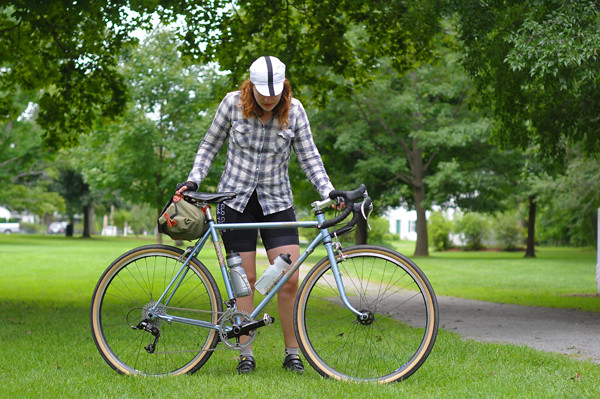
The Nordavinden is a newly released bicycle model from the small West-Coast company Rawland Cycles. Earlier this year I featured a friend's Rawland rSogn, which I could not ride because it was too big. At the time Rawland did not make a bike in my size, but they informed me that one would be coming out later in the year. We talked about a test ride, and as luck would have it, a demo bike was ready just before D2R2. I had it in my possession for a nice long weekend - most of it spent riding local and not so local dirt roads.


Rawland Nordavinden 650B

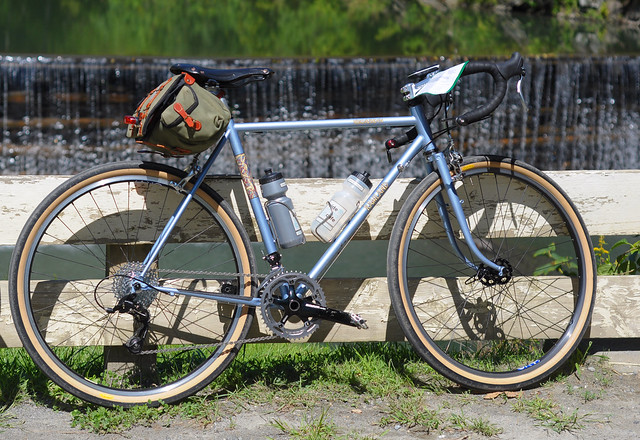
Norwegian for "the north wind," the Nordavinden was designed as a lighter, sportier frameset than its more rugged predecessors: a zippy bike with low trail geometry that accepts fat tires. Full geometry and tubing specs are available here. Like all Rawland models, the Nordavinden is designed in California and handbuilt in Taiwan.


Rawland Nordavinden 650B

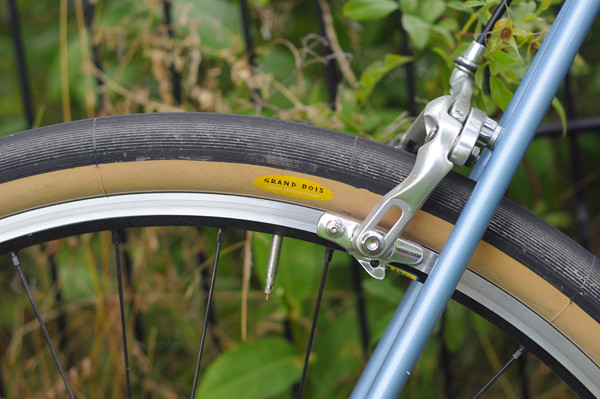
The larger sizes are built for 700C and will fit a tire up to 35mm. The small size is built for 650B and will fit a tire up to 42mm (pictured here with Grand Bois Hetres).


Rawland Nordavinden 650B

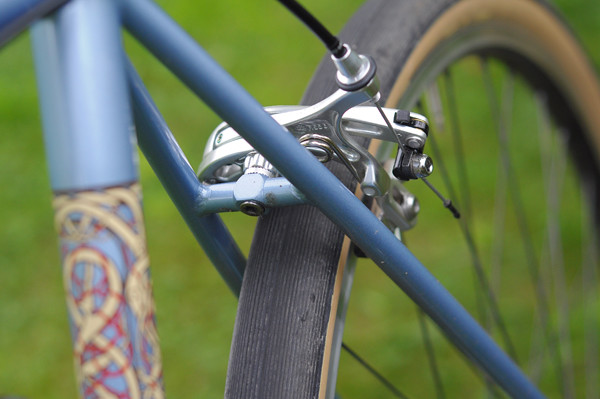
The frame is designed for sidepull or centerpull brakes. The demo bike came fitted with Rivendell's (discontinued) Silver big-mouth sidepulls.


Rawland Nordavinden 650B

The dramatic curvature of the fork is immediately noticeable - prompting lots of low trail questions from those who saw the bike whilst in my possession. The trail is 30mm,with 650Bx42mm tires.


Rawland Nordavinden 650B

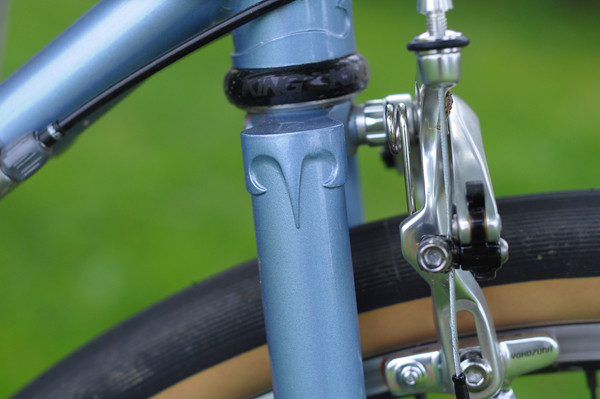
Unlike its predecessor rSogn's double plated crown, the Nordavinden's fork crown is the more minimal Pacenti Artisan II, with lighter fork blades.


Rawland Nordavinden 650B

The "ice blue" paint is a light, shimmery sky-blue. I tried to take some pictures that eliminated the shimmer and showed the true colour underneath. In person, the shimmer makes the blue look lighter. Compared to the (very similar) colour of the rSogn, the Nordavinden is cooler and a bit more saturated.


Rawland Cycles, D2R2

Looking at the Nordavinden next to the rSogn (front), they are similar at first glance, but less so upon closer inspection. The Nordavinden has an almost level top tube (1.5° slope), compared to the rSogn's more prominent slope. The Norvavinden's appearance is sleeker and more roadish - with fewer braze-ons, narrower tire clearances, lower bottom bracket, shorter chainstays.


Rawland Nordavinden 650B
Still, the Nordavinden is sufficiently versatile, with eyelets for fenders and braze-ons for a front rack (on the fork blades; optimised for Rivendell's Nitto Mark's rack).


Rawland Nordavinden 650B

The frame itself is welded cro-moly steel, with some decorative flourishes.


Rawland Nordavinden 650B

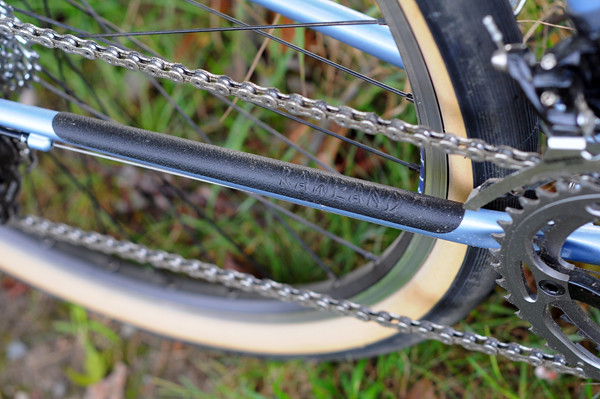
A Rawland chain-slap protector is included with the frame set,


Rawland Nordavinden 650B

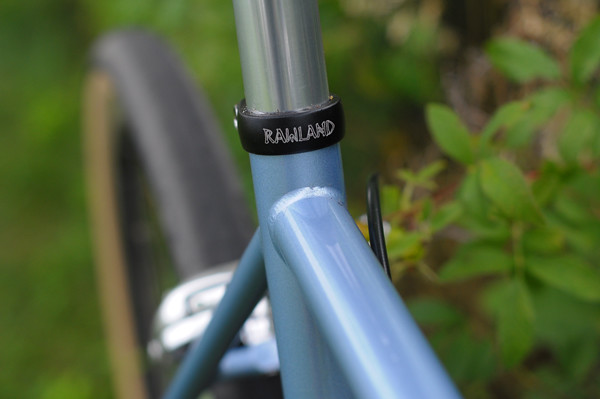
As well as a Rawland seat collar.


Rawland Nordavinden 650B

The size Small is described as a 54cm frame, measured by its top tube. My ideal frame size for a road fit would have a 53cm top tube, but the small Nordavinden worked nicely with a slightly shorter stem.


Rawland Nordavinden Test Ride
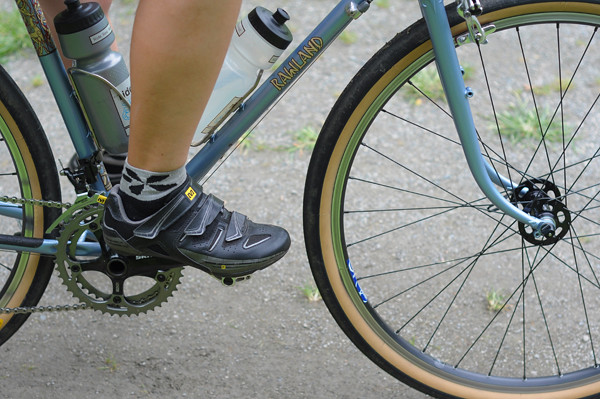
Rawland advertises no toe overlap in any of their frame sizes. This held true for me (in size 38 clipless shoes), with room for a fender.


Rawland Nordavinden 650B

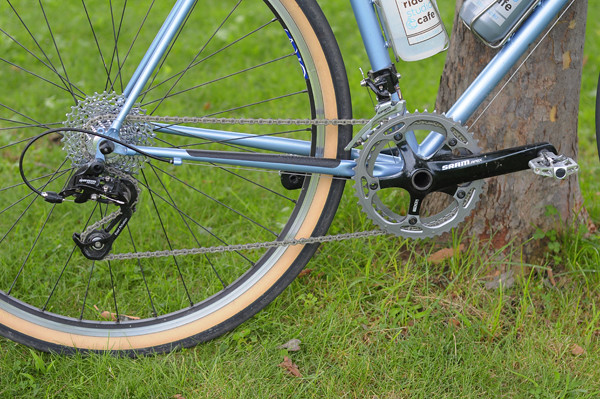
The demo model was built up with Velocity Synergy rims, White Industries hubs, a SRAM Apex drivetrain,


Rawland Nordavinden 650B

Chris King headset, Soma threadless stem and handlebars, Tektro short reach brake levers and bar-end shifters. The build was not done for me specifically, but I did have a say in stem length and handlebar width, to ensure the bike would fit me. Were this my own bicycle, I would do some things differently for sure. But sometimes it can be interesting to use unfamiliar components.


Rawland Nordavinden 650B

For shifters, I had a choice between SRAM brifters and bar-ends, and opted for the latter. Prior to this I had not used bar-end shifters in over a year, and it took me a bit to free my brain from Campagnolo ergo mode. By the end, the SRAM bar-ends grew on me, though I still prefer Campagnolo ergos on my own bike.


Rawland Nordavinden Test Ride

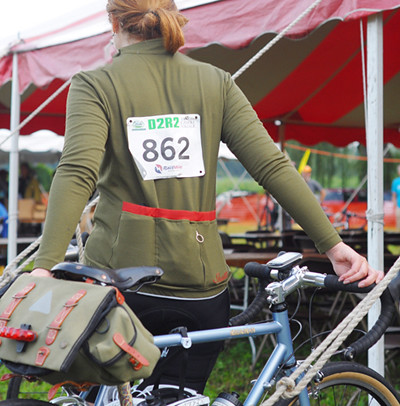
I used my own pedals and saddle, and installed two bottle cages. The bike did not come equipped for carrying a front load, as it was optimised to do, so I used a saddlebag when I needed to carry a camera and other items.The bike - as shown here, but without bag and water bottles - weighed just over 24lb.


Rawland Nordavinden, D2R2

I rode the Rawland Nordavinden for a total of 150 miles over the course of 4 days. First was a 30 mile shake-down ride, which included 12 miles of local dirt roads. The following day, I rode a 50 mile route at the D2R2, over half of which was dirt. The day after, I did a 40 mile local ride that included a paved road, a dirt road, and a rather technical dirt trail. And after that, I did a final 30 mile ride on paved roads - including a couple of hill climbs - before returning the bike.


D2R2, Rawland Nordavinden

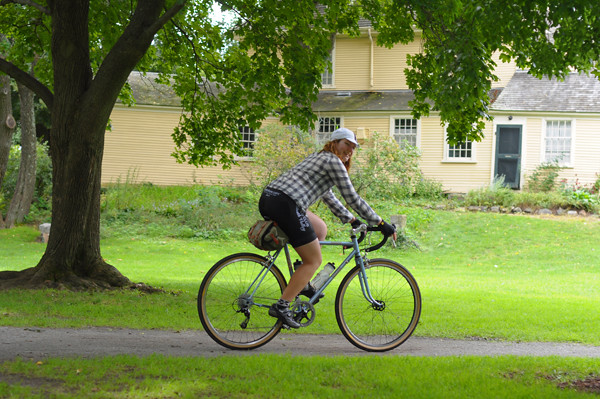
What I noticed about the Rawland immediately, was that my sense of balance was different on it than on other roadbikes I've ridden recently. I found tight cornering easier than it typically is for me, and I found it surprisingly easy to change my position on the bike without disturbing its balance - allowing me the freedom of activities I usually have trouble with, such as drinking from the water bottle while riding. I remember similar handling when riding the Royal H. Randonneur last summer, but this time I think I was able to appreciate it more - particularly on unpaved terrain. At the D2R2, I was able to descend on loose dirt and gravel faster than I was comfortable doing previously, and to drink all the water I wanted without having to stop. It certainly added to my enjoyment of the day. The following morning, I rode unceremoniously on a somewhat challenging local dirt trail that I've never been willing to ride before.


Rawland Nordavinden Test Ride

As far as speed, the Rawland is plenty fast and accelerates with no hesitation. There is a snappy, responsive, roadish feel to it. On pavement it is not quite as fast as my Seven roadbike, and it does not climb quite as effortlessly. But as soon as the pavement ends, the dynamic changes. It's as if the two bikes were made to be friends and supplement each other. The Rawland glides over dirt and gravel, seemingly preferring them to pavement. In part, of course, it is the wide tires - which don't bounce me around the way narrow road tires do. But it's also the handling -again, that peculiar flavour of maneuverability that comes with low trail - that makes it easy for me to pick a line through rutted out areas and to corner on loose sections without reducing speed.On a bike with standard front end handling, I feel less confident riding on winding, unpaved roads and trails - especially descending. This preference might be particular to me, I don't know. But I found the Rawland's handling exceptionally agreeable for riding on dirt.


Rawland Nordavinden, D2R2

Notably, carrying weight in the rear was not a problem despite the bike's low trail design. It did not feel much different than riding without a saddlebag, except on steep climbs (with a full saddlebag, the front end "wandered" a bit). I do not know what the bike feels like to ride with a handlebar bag, but I can only imagine that not worse, considering that it's designed for one. I should also point out that I do not know what the bike feels like to ride long distances; my longest single ride on it was only 50 miles. With its front rack braze-ons, a bike like this just begs to be taken on a long, self-supported ride, and I hope to soon read some reviews from owners who've done that.


Rawland Nordavinden Test Ride

To think of criticisms is not an easy task here. I suppose I would like the bike even better if it were lighter, though I recognise the weight is pretty good for a bike of its kind. Anotherthing I can say is that I am fairly spoiled at this point as far as ride quality, and from that perspective the Rawland is not the cushiest bike I've ever ridden. It isn't a harsh ride by any means, but I feel that much of the cush is due to the fat tires - and that with narrower ones I would feel the bumpy roads more. Finally, as I've mentioned already,on pavementthe Rawland is not as fast as my Seven - but then I don't think it makes sense to pit them against each other; they are not meant for the same kind of riding. I would not mind owning a bike like the Rawland to supplement my skinny tire roadbike.


Rawland Nordavinden 650B

While showing off the demo bike, more than a couple of times I was asked why only the smallest Nordavinden size is offered in 650B. I must say I wonder as well, as it is precisely the combination of the wide 42mm Grand Bois Hetre tires and the handling that draws me to the bike. There is demand out there for lightweight, sporty low trail 650B bikes without having to spend a fortune on custom work. The Rawland Nordavinden retails at $725 for the frameset (available from Rawland Cycles directly). While I cannot vouch for the other sizes, I suspect the 650B Nordavinden is a bike that many would appreciate for road-to-trail riding.


Many thanks to Rawland Cycles for loaning out the demo bike, and thanks to the Ride Studio Cafe for putting it together.
More pictures here.

Monday, February 15, 2010