Thursday, September 29, 2011

Dutch Bike: Impressions After an Absence

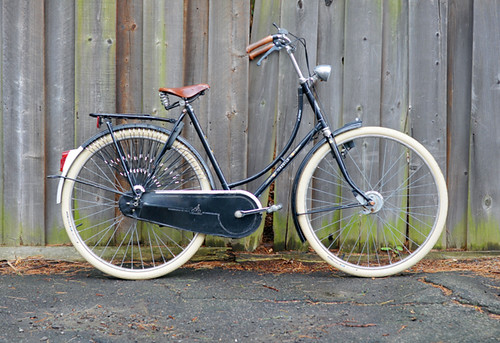
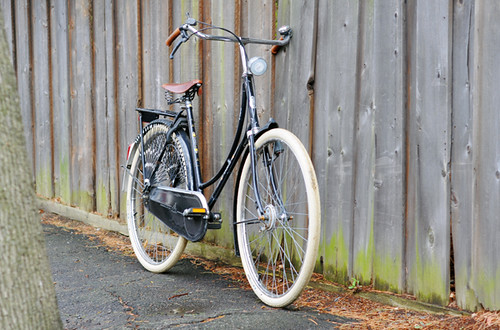
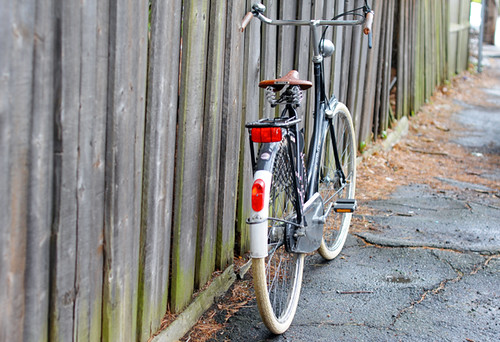
90s Gazelle A-Touren

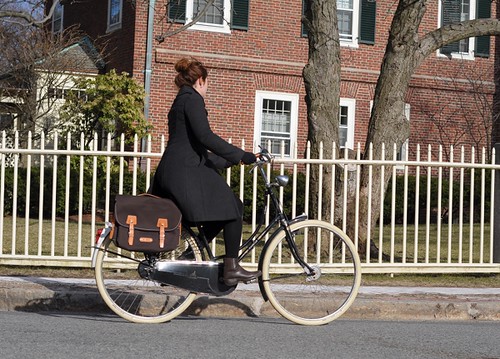
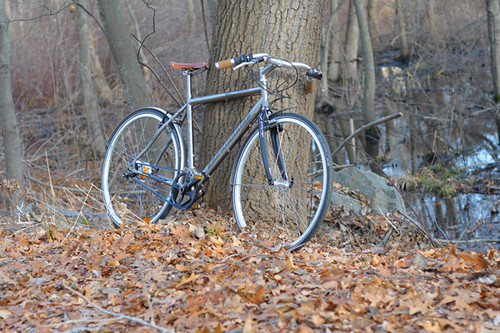
I own a 15 year old Gazelle A-Touren that is pretty much the prototypical Dutch bike. It was my main city bike for a while, until I put it in storage last November. Yesterday I retrieved the Gazelle (I am looking to sell itedited to add: I have now sold this bicycle), dusted it off, and rode it for the first time in 4 months. The nice thing about riding a very distinct type of bicycle after a long absence, is that everything about it seems new again and you notice aspects of the ride quality that didn't stand out when the bike was familiar. So I wanted to take this opportunity to write up my impressions of Dutch bike handling - from the altered perspective of someone who's now also ridden a variety of other bicycles.


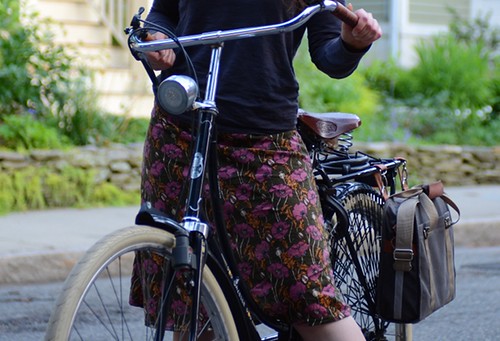
Gazelle, Philosophy Intrans Pannier
My first impression of the Gazelle upon our reunion had to do with the riding position. I forgot that it was even possible to be sitting that upright on a bicycle! I consider my other 3-speed and my mixte to be upright bikes as well, but they are certainly not compared to the Gazelle. The rider's position on this bike is akin to sitting in a chair: back straight, shoulders relaxed, hands holding the bars in much the same manner as one would hold an open newspaper or a tray.


Purple & Green Skirt
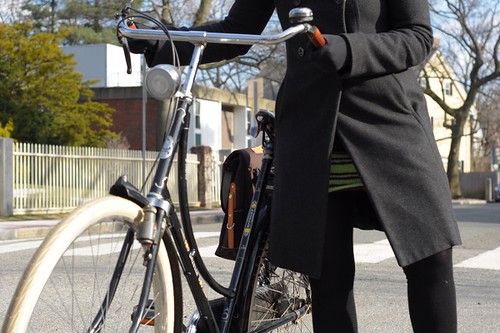
The handlebars are dramatically swept back and very close to the body. There is no feeling of reaching at all - my hands just basically rest on the bars naturally if I simply plop them down, bent at the elbows. This also means that there is very little weight being placed on the handlebars, or on the front end of the bike at all for that matter.


The unweighted front end was a sensation that took getting used to after an absence. However, it was really just a matter of training my body to adjust to it. After circling the block a few times and picking up speed, the handling already began to feel intuitive again. With the handlebars way behind the font hub, this is not a super-responsive bicycle. There is almost a feeling of passivity or detachment in riding it, like being in the back seat of a vehicle instead of the driver's seat.


90s Gazelle A-Touren

These factors combined are what's responsible for the "regal" feeling associated with riding a Dutch bike. The effortlessness, the perfect posture, the ability to observe one's surroundings in a way that cannot be done on other bikes - it all encourages a relaxed and confident attitude. The wide 28" tires create a plush ride quality that further contributes to the luxurious feel. The nuisance of potholes and rough road surfaces need not trouble the rider. As I rode the Gazelle around the neighborhood, it felt as if I were sailing aboard a luxury liner more than riding a bike. I had completely forgotten that sensation.


Of course another thing I'd forgotten was the weight of the bike. At just under 50lb, the Gazelle is an armful to drag up and down even a small set of stairs on a regular basis. Having now gotten used to my "heavy" city bikes being a good 15-20lb lighter, I admit I did not welcome the extra weight.


Vintage Gazelle, Po Campo Pannier

The bike's weight however, does not pose a problem when the Gazelle is in motion. It accelerates easily and retains momentum extremely well. On flats I can fairly quickly get it to 17mph+ in the high gear, which is about as fast as I'd want to go in the city anyhow.


Uphill is of course a different story, though it's not quite as bad as you might think just by looking at the bike. Uphill the Gazelle is slow, but responsive to hard pedaling effort. Unlike some other heavy city bikes, it does not attempt to pull me back, but is willing to advance slowly forward and upward as long as I am willing to push.


90s Gazelle A-Touren

Having had the bike out of sight for so long, it was also nice to see its lovely little details again. Being of mid-90s production, the bike is not exactly "vintage," but still the details were more nuanced on these older models than they are today. Examining all the intricate, albeit now rusty, little embellishments on it is a pleasure. The bike was well used before I got my hands on it, and spent a great portion of its life outdoors as I understand it. In light of that history, the extent to which its functionality and aesthetics have been preserved is impressive.


90s Gazelle A-Touren

While I love and respect the Gazelle, for my current transportation needs I've come to prefer a more active ride and a slightly more aggressive posture. Still, the positive qualities of this bicycle are hard to beat.


The Dutch bike is an excellent choice for a cyclist who wants to be as upright and relaxed as possible, enjoys a plush ride, prefers to do little to no maintenance on their bicycle even in winter, lives in a fairly flat environment, and is undaunted by weight. It will also appeal to those who love vintage elegance: The basic design of the Dutch bike has gone largely unchanged over the past century and remains an icon of transportation cycling.

Wednesday, September 28, 2011

Ecola Park


Looking out across the little bay toward the mountains that hide the town of Seaside which was hit by hard storms this winter. It is kind of a neat sight to see all the rocks sticking up out of the water. No wonder there were so many shipwrecks along the Oregon Coast.

Fun memories.....and the Vuarnet Cateye sun glass


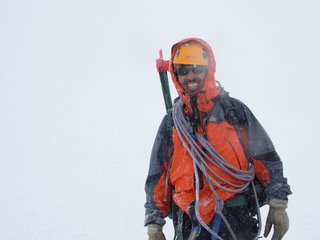
Mugs Stump soloing on Thelay Sagar, 1986. Photoby Micheal Kennedy (courtesy of Patagonia's archives)


I had just returned from the head. There were several tables of us crowded around in the Road House that had just gotten off Denali after a big storm cycle went through. Everyone at the table had beenstuck at 17K for a few days. Mugs and I had dug out each others tents a few times as the clients stayed in doors.We were all happy,hungry and glad to be out of the mountains (at least I was anyway).


I sat back down and found my pork chopmissing along with most of my mashed potatoes. When my jaw dropped opened and my temper started to flare, Mugs and the rest of the table had a deep and well deserved laugh at my expense. Great way to finally relax a bit, get warm and drink a beer or two.


I didn't have enough money in my pocket to buy another dinner.May be an extra beer. Of course they had already ordered and paid for one of both for me. And I quickly realised how much of a dick I was being but not quickly enough. Mugs could be hilarious in a social setting. I eventually had a good laugh as well. Mug's story of the coldon the Moose's Tooth bivy was funny and frightening. He toldus his headwent numb from the cold. Ithad me rolling on the tent floor. "No? Really? Your head hu?"Or maybe it was the whisky. Likely both. Great story either way. I was never sure if he was pulling my leg. But I didn't think so. Damn, that would be really, seriously,COLD ;) Bet he is still laughing about that one! Yep, "my head went numb!" May be it was Bridwell's bivy stash that did that?


Hard for me not to remember Mugs and smile when I see a pair ofVuarnets. Maybe it was the picture above and the Patagonia's Capilinead. It is a picture that still defines alpinism for me even today. And you have to remember Michael Kennedypulled out a camera to get the shot while soloing as well!


We all went over the 'shrund together when Mugs and Paul Aubry did the Moonflower. Brad and I failed on our proposed route. Mugs was wearing Vuarnets in the bright sun that day as well.May, 1981.


Much more about Mugs here:

http://www.thecleanestline.com//02/the-dream-a-journey-of-the-spirit-with-mugs-stump.html


Anyway Vuarnets are a funmemory for me. Mugs and I would see each other on and off in Alaska every season fora few years. He introduced me to Wild Things gearand by example, harder climbingthan I had ever imagined possible.


Now that I think about it, even Doug Klewin had a pair or two of Vuarnets bitd. Doug was wearing blackframed, Cat Eye, Nuatilux lens Vuarnetson the 1st ascent of the North Buttress of Hunter! Hard to believe that tiny bit of important NA mountaineering history (trivia) might have be lost! :)


Doug Klewin racking up mid "Shaft" on the 1st ascent, N. Butt of Hunter, Todd Bilbler photo


Anyway when I was doing the sunglass review earlier two things I found very exciting. The first was my original Vuarnets had lasted 35+ years. They cost$58 at the time, which was a pot full of money for me. My Galibier Mountain glasses had only been $38 a couple of years earlier. So the Vuarnets were a big step up for me. In my mind they were my first pieceof "man jewelry". Gas was .63 centsa gallon in 1978! I havebroken three frames in those 35 years. They are easy enough to replace if you have an oven or even boiling water handy. But my lenses have no scratches and only one tiny pit on one lens from being dropped flat onto fresh pavement from about 6 feet up. They are the only piece of my originalclimbing gear I still use. More importantly one of the few pieces I still really like. They have been "everywhere" with me climbing. I had them on for my first 5.10 lead. And all but one of the walls I did in the Valley. Most every ice climb I had done in Canada up til 1990 as well. And with few limitations theyare as good as any thing available today I think. Fewwould think of a $100 pair of sunglasses as jewelry today.


The second thing I find exciting? I had looked around and saw Vuarnets selling for anywhere between $200+ and $350. Crazy money IMO for a retro pair of glasses no matter how good the lens.

Maybe not so muchcrazy money if I remember how long they have lasted.


But then I found them, where else, but on Ebay. Direct from France in all styles and lenses and at decent prices. Nothing over $150 that I actually wanted and most a few bucks less.


For some reason I kept digging around on the Internet and found a US dealer who specialises in repairing vintage Vuarnets and selling parts as well as complete sunglasses for $105 including the shipping.


On a serious note. The Vaurnet glass lens give excellent sun protection for your eyes. There are multiple lenses available to fit most every one's needs. I can attest thatall theglasslenses are really tough and durable under hard useconditions. The original nylon "cat eye" frames are robust and tough. Most importantly for me is they fold almost flat and are easily carried/stored in a pocket on longmountain trips (like Denali). Same place modern sunglasses can be bulky and hard to pack and fragile while living in the confines of a tent.


"Vuarnet lenses filter out all harmful UVZ, UVB and UVC radiation. Their multi-layered anti-reflective coatings eliminate glare and bounce-back light.


All Vuarnet lenses are made from the finest glass, ground and polished on both sides to ensure distortion free vision, and are heat tempered for impact and scratch resistance.


They meet the most stringent quality control standards and exceed all the performance criteria imposed by European, American and Australian consumer legislation.


Skilynx Brown Silver Gradient Mineral lenses: PX4000, The Original and Legendary Vuarnet Ski Lens. Amber yellow base, brown & anti-reflective coatings.


Double gradient silver exterior filters to absorb white light glare, especially on or around snow and bright light conditions. Eliminates glare and reflection, enhances contrast and depth of field.


The essential lens for mountains activities and at sea. The Skilynx lens blocks nearly all of the violet and blue light, thus reducing glare and eye strain, while allowing more of the yellow-orange-red end of the spectrum to pass through to the eye, enhancing contrast, depth perception and sharpness of vision, making distant objects visually clearer.


This lens benefits from chemical tempering in order to make it secure. Besides the excellent adherence of surface treatments, it benefits from an outstanding longevity.


Each lens is engraved with the letter V, symbol of authenticity Vuarnet."


Here are the links that I found for Vaurnet. I have recentlyordered from both companies and been happy with their service and products. Enjoy!


JMARGIFTS.....a USA based company based in Saint Paul, MN.

Repairs, spare parts, and new sunglasses they can build you to your spec/color/lens on some styles, the Cat Eye in particular. Quick service. $105.00 for a new set of Cat Eye Skilynx (Mugg's choice in the mountains) or Nautiluxincluding the shipping in the US!

http://www.jmargifts.com/index.htm


SHOPEYEWORLD....a French based company in Courbevoie, France

New glasses and spare framesin most every (all?) originalVaurnet styles. Decent prices and free shipping if there are multiple purchases at once. Hit or miss on the speed of delivery though. You'll need to be patient. Typically $150 for the same Cat Eye Skilynx here but frames and some of the other Vuarnet lens tintscan be had cheaper oron sale here occasionally.

http://stores.ebay.com/shopeyeworld


I suspect Mugs would get a laugh out of the fact Vuarnets are still around and that I'm suggesting here they are a good pair of glasses :)But I am not pulling your leg. And I'llremember to hangonto my pork chop!

Sunday, September 25, 2011

Hot, Hot, Hot

The temps are soaring in Washington, and gaining altitude on Mt Rainier is one way to avoid the heat. The last two weeks of July and the first two weeks of August historically mark the highest success rates and most reliable weather for the peak. If you're climbing, leave early, as the freezing level is hovering around 15,000 feet.

Recent mountain achievements include Jason Edwards personal climbing benchmark. Jason successfully made his 300th summit climb of Mt. Rainier on July 12th. Jason joins an elit clan of guides (there are only 6) who have more than 300 summits. The current summit record is held by George Dunn, who has over 480 successful ascents.

In other news, we've updated the route condition reports for the Kautz, DC, and K Spire to name a few. Please keep the updates coming.

Friday, September 23, 2011

From The Western Yearbook


GEORGE PETER COKINOS
Track Team '31. '32, '33; Football '32
IS: Very amusing and talkative
Famous FOR: His stunning "car"
and for his skill at taking cars apart
and putting
them together again.

Thursday, September 22, 2011

The Cyclist and the Roundabout

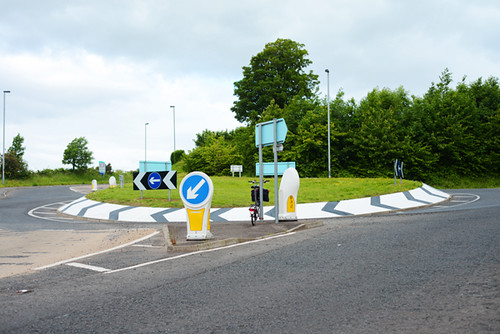
Roundabout, Limavady Northern Ireland

Though not nearly as widespread as in the UK, roundabouts - also known as rotaries and traffic circles - are fairly common back in New England, particularly in the sort of areas that brevets and similar rides tend to take us through.Personally, I don't know anyone in the US - be they cyclist or driver - who actually likes roundabouts, and I am no exception. Over the years my attitude toward them has transitioned from one of pure terror to one of a more manageable, subdued loathing. There are right of way rules to navigating them, but somehow the traffic flow ends up being chaotic despite those rules. Drivers don't always yield to other vehicles correctly, and bikes they sometimes outright ignore. As a cyclist, you can end up waiting your turn forever despite having the right of way. Or worse yet, a driver's failure to yield once you're already moving through the circle can result in a close call or collision.


Now cycling in Northern Ireland, my relationship with roundabouts has moved to an entirely new, downright intimate level. On the North Coast they are everywhere, often used in leu of traffic lights, and I go through at least one - but more typically anywhere between three and six - every day. There are large roundabouts the size of parks. There are smaller ones that might display a modern sculpture or two. And there are tiny ones that are just painted circles on tarmac, easy to miss. There are urban roundabouts through which cars move at a crawl. And there are rural ones, through which lorries fly at top speed.


Most impressive of all are the roundabouts situated along steep hills. One such stunner is just outside of Limavady town, approaching the village of Aghanloo. When I first saw this thing appear in front of me, my jaw dropped. When approached from one direction, this roundabout requires being ready to yield or stop while climbing a 10% grade, from another direction while descending the same. And to be clear, the hill does not start or end with the roundabout; the intersection is half way through the climb. For a cyclist this can be rather ...interesting, requiring precise control of one's bike and brakes.


But one thing I realised about the roundabouts in Northern Ireland over time, is that they are predictable: There is no chaos or confusion, as everyone actually follows the right of way rules. Traveling on the left side of the road, you yield to traffic approaching from the right, and in the same manner other traffic yields to you. Unlike in New England, drivers do actually yield when it is another vehicle's turn - even if that other vehicle is a bike! It took me some time to trust in this, but once I started to all the stress from navigating the roundabouts was removed. When it's my turn, I go and when it's not, I stop: easy, and, admittedly, more efficient than a traffic light. I like it!


What has been your experience with roundabouts as a cyclist in the area where you live?

Lysander and Lydia Robison Joslin

In about two weeks I'll be going to Springfield, Missouri to attend the fourth reunion of the Descendants of Lysander and Lydia Robison Joslin (DLLRJ). Held every two years, the first DLLRJ reunion was in August .. in Springfield, Missouri. The picture at right is my mother and her sister, Pat, standing in front of "the wall" of descendants. Lysander and Lydia are my 3rd great-grandparents.

In July .. the reunion was in Monroe, Louisiana and in August .. it was in Whitley County, Indiana. The gathering is a little late this year because there was so much going on with the various families. That and the fact that families are scattered all across the United States (New York, Virginia, North Carolina, Alabama, Louisiana, Indiana, Wyoming, Missouri, New Mexico and elsewhere) added to the complexity.

Lysander Price Joslin was born May 1, 1825 in Delaware County, Ohio and was the son of James and Abigail Goodrich Joslin. Lydia Robison, the daughter of Henry and Anna McMorron (or McMorrow or McMorran - another of my "roadblocks" to be discussed in a future post) was born October 10, 1825 in Champaign County, Ohio. Lysander and Lydia met up in Whitley County, Indiana where they were married on August 23, 1843 when Lysander was 18 years old and Lydia was 17. Between November 1844 and June 1868, Lydia would give birth to 15 children, 5 of whom would not live beyond their third year. (Photo at right: Lysander and Lydia Joslin, received from Harry Joslin, Jr.)

If you were to go by census records alone, you would think that Lysander and Lydia lived in Whitley County, Indiana continuously from 1850 through 1870, but you would be wrong. Records show that in October 1866 Lysander and Lydia sold their land in Whitley County and headed west with all of their living children. The oldest daughter, Anna Eliza, had married William Klingaman the previous October and records of them were found in Jefferson County, Iowa. The last two children of Lysander and Lydia were born in Iowa in June 1868; they were the twins Elmer and Elmus. Elmer died within a month of his birth and is presumably buried in Iowa.

In March of 1867, Lysander filed a law suit against the man who had purchased the land in Whitley county. Seems the fellow had not made the mortgage payments as promised. A Whitley County deed record of May 25, 1868 shows that the land was sold at auction and purchased by Lysander Joslin. It is not known when Lysander and Lydia returned to Whitley County though it would have been after the birth of the twins and prior to the 1870 Federal Census. All of their children, except for Anna Eliza, returned to Whitley County with them.

On January 8th 1877 Lysander and Lydia once again sold their property in Whitley County. They kept possession until March 1st so it is presumed that the family didn't leave until the spring of 1877. This time they went to Barton County, Kansas. They are found in the 1880 Federal Census in Cheyenne Township. In the 1885 Kansas State Census they are in Odin Township, Barton County.

Of the 10 adult children of Lysander and Lydia, all except Malissa left Whitley County. Some of the children remained in Kansas near their parents, but others moved on to Okalahoma, Colorado, Montana, South Dakota, Washington, South Carolina, and Missouri. One possibly went to California.

Found online in February .. were these two items from "Barton County, Kansas Newspaper Gleanings: Short stories from Barton County newspapers gleaned for your edification and entertainment."

  • Hoisington Dispatch -- Thursday, June 12, 1890: Mr. H. P. JOSLIN, of near Odin, was a caller Saturday and ordered the Hoisington paper sent to his address.
  • Hoisington Dispatch -- Thursday, July 10, 1890: L. P. JOSLIN was in from Odin Friday and reported a very heavy hail storm in his vicinity the night before. Much damage was done to wheat, corn and fruit. Mrs. JOSLIN lost about fifty little chickens and twenty-five turkeys by the storm.

By 1895, Lysander and Lydia had moved to Melvern Township, Osage County, Kansas. The Kansas State Census for that year shows the following summary of statistics relating to their farm:

  • Production of Agriculture: 40 acres, 38 under cultivation. 130 rods of hedge fence and 100 rods of wire fence. Cash Value of farm is $1,000. There are 30 farming implements. Will plant 30 acres of corn in the spring of 1895.
  • Has 100 Bushels of corn on hand 3/1/1895. Cut 3 tons of tame hay in 1894 and 40 tons of prairie cut. Sold $100 worth of poultry and eggs. Made 800 pounds of butter. Has 3 horses, 8 milch cows, 18 other head of cattle, and 80 swine. Sold $500 worth of animals for slaughter.
  • Has 100 apple trees, 30 peach trees and 12 cherry trees. Made 5 gallons of wine in year ending 3/1/1895, has 2 bee stands and 1 dog.

On January 26, 1899, the day after Lydia passed away her obituary was published in the "Current Remark". This newspaper was published in Lyndon, Osage County by James Downey "J.D." Quillen, son-in-law of Lysander and Lydia.

"Lydia R., wife of L.P. Joslin of our neighborhood, died yesterday morning, January 25th, after about a week's illness of pneumonia. The funeral occurred at 11 o'clock to-day at the Baptist church in Lyndon, and the body will be laid to rest in the Lyndon cemetery. Mrs. Joslin was born in Urbana, Ohio, October 10, 1825, and was married to L.P. Joslin in August, 1843. She united with the Methodist church at the age of sixteen and was elected a life member of the North Indiana Conference, but in after years she united with the Baptist people, and at the time of her death was a member of the Lyndon Baptist Church."

After the death of his wife, Lysander sold his farm and moved to Keighly, Butler County, Kansas to live with his daughter, Minerva Knight. Lysander died less than four months after Lydia. His obituary was published in the Columbia City Weekly Commercial, Whitley County, Indiana on May 31st.

"The death of L.P. Joslin occurred last Sunday, May 14th, at the home of his daughter and son-in-law, Mr. and Mrs. William Knight, at Keighly, Butler county, Kansas of heart disease. Accompanied by Mr. and Mrs. Knight, the remains reached here Tuesday afternoon, and after a short service at the grave, were laid to rest beside his wife, whose death occurred the 25th of last January at their home south of this city.

Lysander P. Joslin was born near Columbus, Ohio May 1, 1825. The family moved to Whitley County, Indiana where he grew up, and in August 1843 was married to Lydia Robinson. From this union fifteen children were born, six of whom are now dead.

The family came to Kansas in 1877, and to this county eight years ago, buying the place since occupied as the Joslin home. After the death of Mrs. Joslin, he went to Butler county to make his home with his daughter.

Mr. Joslin was one of those good old fashioned, honest, industrious men whose purpose and aim in life was to do the best he could. But when his life companion, whose love, council and companionship he had enjoyed for over fifty-five years, passed on to that other home, he lost much of his interest in this life and was ready to go where she had gone. In this, his heart's desire is met, and who can say that it is not well? It is. And, while sad hearts mourn them here, there is greater joy on the other side, where two souls re-unite for the life which is all joy, and eternal.

The brothers and sisters of the Joslin family desire to extend their sincere thanks to all those who so kindly assisted them and gave them comfort and sympathy in the trial and bereavement at the death of both mother and father. - Lyndon, Kansas Current Remark May 18, 1899.

Mr. Joslin, the father of Mrs. William Brubaker, of Troy township, is well and favorably remembered by many of our older citizens."

It has taken considerable time and effort on the part of four family researchers, but we have located living descendants of most of the adult children of Lysander and Lydia and made contact with most of them. Some are not interested in the family history and won't be attending the reunion the Friday after Thanksgiving, but I'm sure that we'll have a good time and enjoy the companionship of extended family during the holiday. I'm looking forward to seeing those distant cousins again.

Weather permitting, I'm hoping to take a few days the following week and come home the "long way" through eastern Kansas and parts of Iowa to do research on siblings of some of my other ancestors. I'm in the process of trying to figure out which facilities to go to and determining what information I would like to find.

This is getting to be a rather long post, so see the post "Children of Lysander and Lydia Joslin" for information on their children.

Loon on Elbow Lake


Here is a shot of the loon that we saw during our kayak outing on Elbow Lake. We were paddling very close to shore and almost ran into this loon as it was not moving at all. All of a sudden I looked ahead (I had been looking directly at the shoreline as I paddled) and there was the loon, floating not more than 50 feet in front of me. I stopped paddling and pulled out my camera, snapping pictures as I drifted by. I got to within 20 feet of him/her as my momentum carried me past. After drifting by the loon we turned around and slowly paddled back. The loon stayed where it was for a minute or two, then slowly swam down the shore a short distance before swimming out towards the center of the lake. Encounters with loons are always very special. I treasure the moments when I am able to see these beautiful birds up close!

Wednesday, September 21, 2011

Pedal and Coast

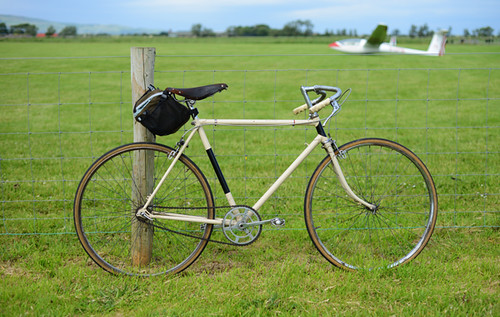
Tyrone Flyer, Ulster Gliding Centre
A friend of a friend flies gliders at the Ulster Gliding Centre down the road. I was encouraged to visit. "He used to race bikes. He restores old planes. The place is amazing, you'll love it."


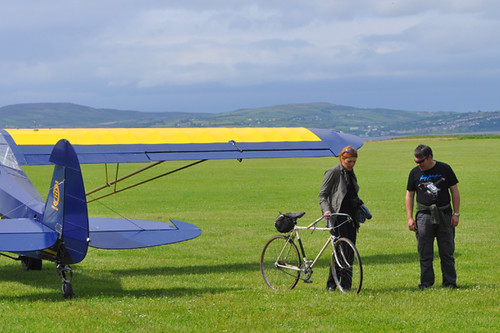
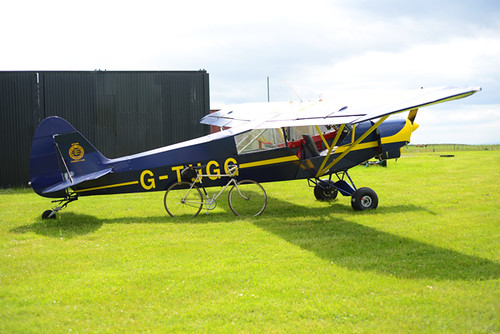
Terrified of flying and armed with only the vaguest notion of what gliders actually are, I nonetheless head over there one evening. The phrase "restores old [fill in the blank]" proves to be excellent bait.In honor of the occasion, I ride a 1938 Tyrone Flyer, handmade in Northern Ireland.


Ulster Gliding Centre
Astride the 75-year old machine, I race down the winding coastal road, at length turning onto a narrow lane toward the Lough Foyle. I ride past pastures, chicken coups, a thatched cottage, and a field of parked caravans, until finally a meadow comes into view - spread out along the water's edge and littered with small aircraft. From a distance the scene resembles a vegetable patch.


Bike and Glide
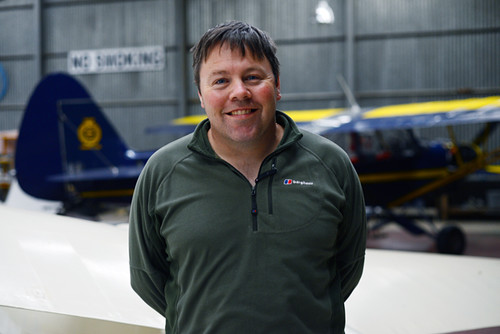
By the hangar, Owen waves me through, bike and all. We exchange greetings and straight away his eyes are on the bike.


Owen
Owen used to race 100 mile time trials. He was good, right up there at the top. Then he stopped. But I can see the cycling has not left him. If he sees a bike, he can't not look at the bike. Then it's my turn to look at the planes.


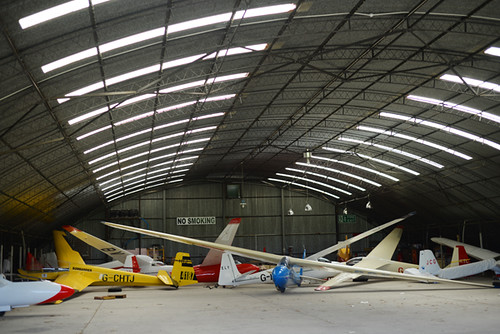
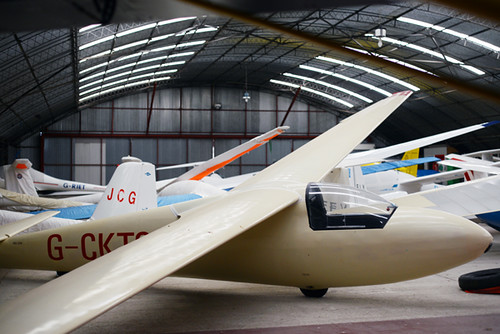
Hangar, Ulster Gliding Centre
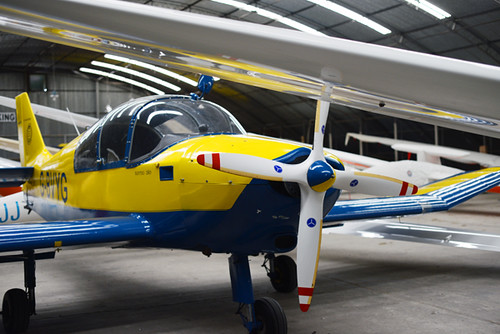
A hangar is basically a garage for aircraft. This one is dome-shaped. The interior is well illuminated. There are little planes everywhere and I wander through them as if through a forest, stepping over tails and wings as if they were felled tree branches. Some planes are colourful and others are white, some fairly new and others quite old. Owen restores the old ones.


Small Vintage Plane, Ulster Gliding Centre

I ask about the materials, the paint, the provenance. Most of the machines are British or German, WWII era. We talk about plastics, and how they've changed over the years (a topic I'm familiar with from my fountain pen collecting days). Then he shows me the cloth used for wings - stretched so tautly and painted over so smoothly, I would never have guessed it was cloth.


Gliders!

The planes are so light and small, they seem toy-like. "I could take you up in one of these if you like?" I shake my head in horror, which I quickly try to disguise as a polite "I wouldn't want to impose."


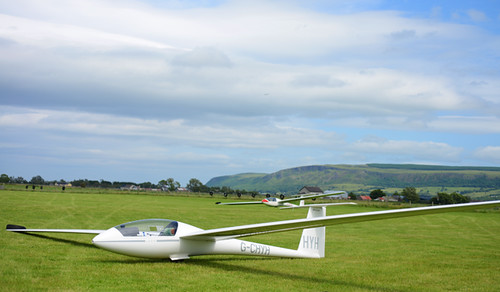
Ulster Gliding Centre

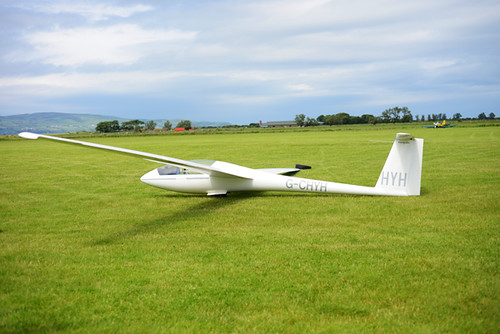
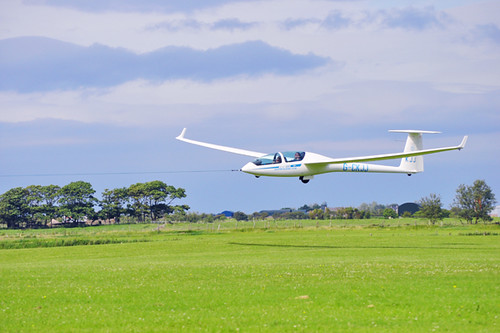
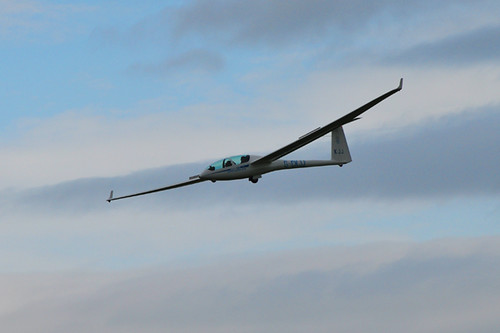
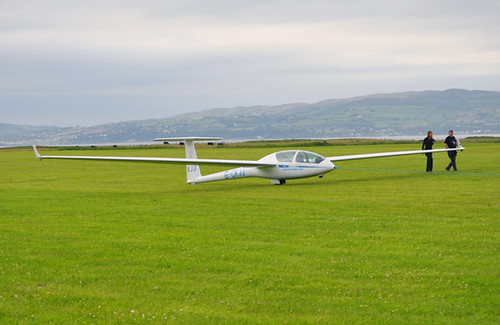
So what exactly is a glider? Put simply, it is a small airplane without an engine. A non-motorised plane. Visually, gliders can be distinguished by their lack of propellers(although there are alsomotorised gliders, which do have propellers)and their unusually long wings.


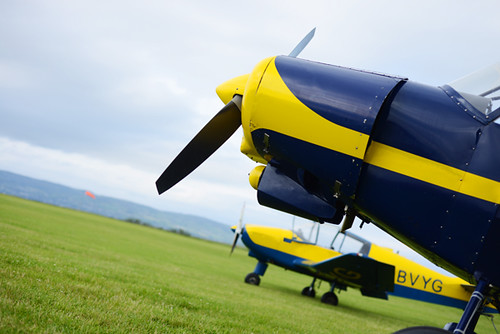
Tug Planes, Ulster Gliding Centre

Because a glider does not have an engine, it cannot take off under its own power and relies on a tow-plane to bring it up to the desired height, then release it.


Ulster Gliding Centre

Once airborne, the glider uses streams of rising air (thermals) to prolong the flight, as the pilot steers it. In this manner, the glider can stay up in the air for hours and even travel cross-country. "Cross country without an engine?" I said, growing interested in the mechanics of the thing.


Ulster Gliding Centre

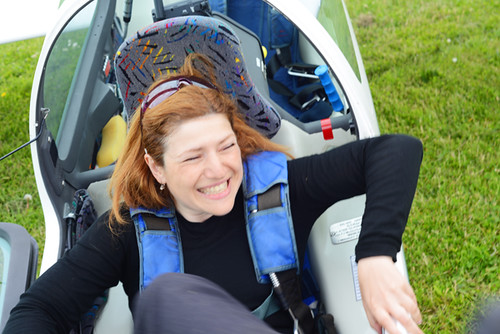
Long story short, I ended up in the glider. Owen - as most of the pilots there - has such a steady, reassuring manner about him, that the more we chatted the more it began to seem like a good idea - just a normal way to spend an afternoon. "There's no engine, so nothing can go wrong, you see. It's a bit like cycling really. Take your camera!" Yes, it would be like cycling.


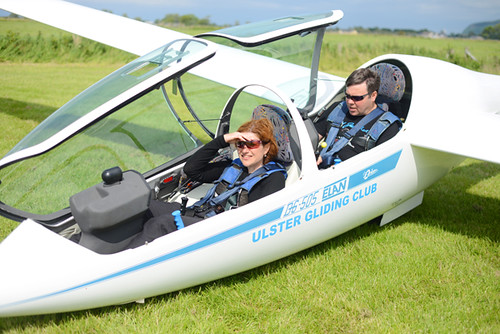
I was feeling pretty good as I approached the glider, until another pilot - Gary - handed me a parachute. "Here, put this on." I must have turned white and begun to inch my way backward (OMG why do I need a parachute??), because Gary sort of held me in place and swiftly began to put the parachute on for me, cheerfully instructing me on its usage while gently nudging me into the glider. "There. It's like getting into the bathtub."


In fact, the thing is sort of canoe-shaped. The pilot/instructor sits behind the student/ passenger. There are duplicate controls. There is very little room, and once the top is down, you feel sealed off from the rest of the world. Once I was in it, my attitude was - If you're gonna do it, do it. Otherwise don't do it. No point being scared now.


Gary, Ulster Gliding Centre

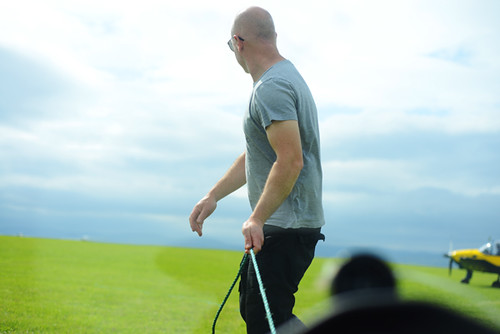
As Owen began to rattle off a series of mysterious control-check messages into the radio, Gary grabbed the rope attached to the glider's nose and connected it to the tow-plane.


Being Towed in a Glider

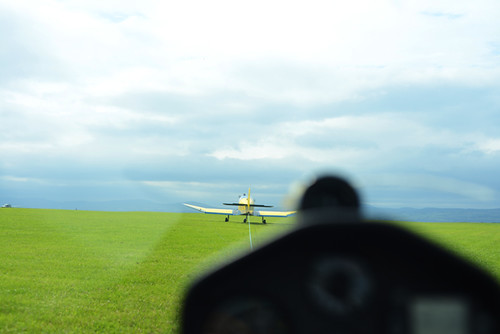
This is what it looks like to be towed along the grass runway. We are taking off toward Lough Foyle.


Glider Being Tugged, Ulster Gliding Centre
Here is the rope.


Being Towed in a Glider
The take-off is quick and painless. Before I know it, we are being towed through the air.


Glider and Tug Plane, Ulster Gliding Centre
View from the ground.


Glider (I am in It), Ulster Gliding Centre
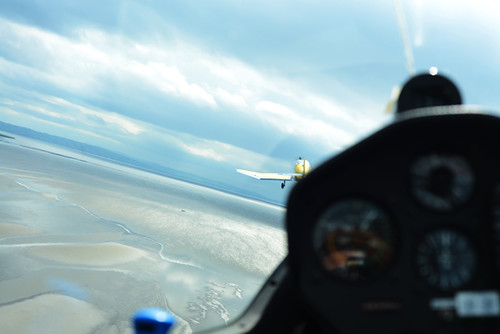
Finally, the rope is released. The tow-plane returns to the ground and the glider - well, it glides. I am in a small plane. Everything is completely silent. We are floating, coasting really. I am feeling fine. Calm, downright serene.


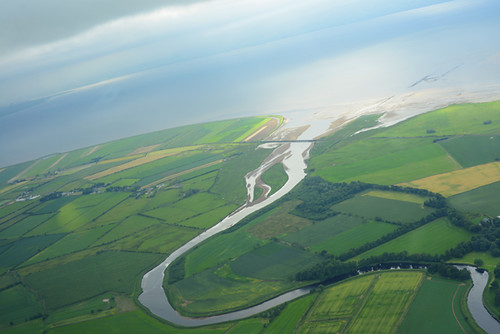
River Roe and Lough Foyle, Glider View
The landscape spreads out beneath. Familiar places from an unfamiliar vantage point. In that sense, it really is a bit like cycling. In an abstract sort of way.


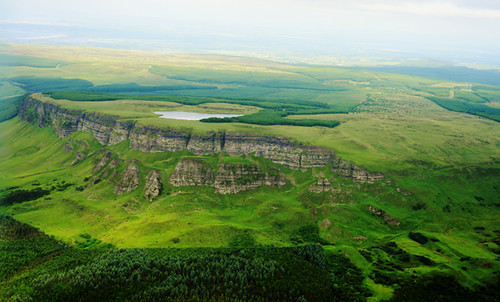
Binevenagh, Glider View
We fly along the coast, then turn inland and head to Binevenagh Mountain. Owen explains how to work the controls to make the plane bank, turning it around. It makes sense and I give it a try. The plane turns. And there is Binevenagh, half submerged in shadow from a low cloud, half illuminated by intense sunshine. It looks quite tame from here, flattened out against the landscape. My heroic climbs and descents hardly seem like an accomplishment now.


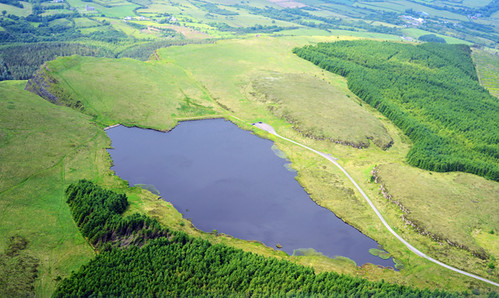
On the very top of Binevenagh is a mysterious lake. It is up a rough gravel road and I've only made it up there once so far. The lake is eerie, prone to mists and unusual growths around its edges. When you're standing next to it, it looks as if it is about to pour off of the edge of the mountain.


Binevenagh Lake, Glider View
But what you don't see from the ground, is that the lake is distinctly heart-shaped. It is also nowhere near the edge of the mountain when viewed from an aerial perspective.


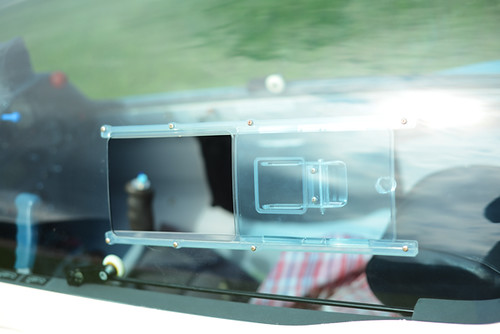
Glider, Observation Window
My camera is with me in the glider. There is a small window that slides open to stick the lens through. I've no experience composing aerial photos, and my 50mm lens is all wrong for the task. Even as I take them, I know that my pictures will look generic, uninteresting. But they are mine and I take them with the same genuine enthusiasm as anyone would.


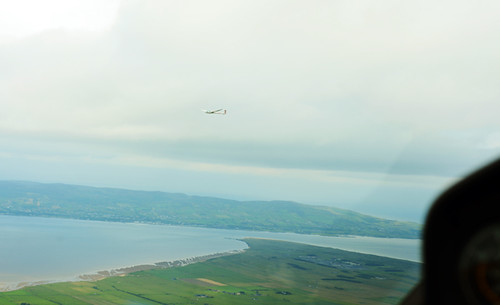
Magilligan Point, Glider View
The sun fades gently in the silence.Over Magilligan Point, we see another glider in the distance and wave to them.Everything is beautiful. "You all right?" Owen asks. Yes! This is wonderful. "Want to try a Chandelle?" he says. "Oh. What's that?" It's a maneuver. A bit of fun. Not quite aerobatics, but almost. "All right!"


The glider does something that is part spin, part freefall and part loop. I see clouds. I am not sure which way is up. I feel pressure in my temples and my vision starts to go dark. A split second later, I am drenched in a cold sweat and hit with a wave of nausea. I sit very still and take deep breaths. "How was that?" Owen asks from the back seat."Mmm hhmm hhmm!" I reply, mouth closed, worried I will puke all over the nice glider if I try to form sentences. Point taken. No more aerobatics. As the sun sets, we descend.


"Like Getting Out of a Bathtub," Ulster Gliding Centre

On the ground, I am soaking wet - hair, clothes, everything. Weird, the physical reactions we have. I don't remember feeling scared, but my body must have decided otherwise. We have a laugh about it. Then we steer the plane down the grass runway toward its next tow.


Ulster Gliding Centre

Is gliding anything like cycling? Hmm, I don't know. Maybe the feeling of landing is similar to that of a long descent. The view can be similar too. But on a bicycle everything feels open, whereas in a glider you are closed in, closed off - a bit claustrophobic for me. Not that I don't want to do it again. But perhaps no Chandelles just yet. It could be a useful skill, knowing how to fly light aircraft.


Tyrone Flyer, Ulster Gliding Centre

Some day. But for now I get back on the Tyrone Flyer. I pedal uphill, coast downhill. That is more my style of gliding.

Monday, September 19, 2011

Van Nicholas: 'Dutch Bike' Redefined

Van Nicholas Amazon Rohloff, Lexington MA

Over the winter holidays I hosted a rather unusual guest from overseas - a titanium Dutch bike. Van Nicholas is a small Netherlands-based manufacturer of titanium road, touring, mountain and cyclocross bicycles. A reader suggested I try a Van Nicholas after I reported enjoying other Ti bikes, and thanks to him a test ride was soon arranged. What made Van Nicholas particularly noteworthy, I was told, is that one of their models - the Amazon - made for a uniquely comfortable transportation bicycle, combining aspects of the workhorse utility bikes Holland is known for with the special properties of titanium. Add to that a couple of fancy features afforded by modern technology (a 14-speed Rohloff hub and a belt drive), and the Van Nicholas Amazon seemed very interesting indeed.


Based on my understanding of the sizing, I asked for a 54cm bike. The bikes are customizable, and so I also asked for it to be fitted with swept back handlebars, a leather saddle and flat pedals. The American distributor (EU Cycling Imports) sent the demo model to the Ride Studio Cafe in Lexington MA, and they put the bicycle together for me. I took it home to test ride and brought it back two weeks later, after which the bike was returned to the distributor. It should be noted that the Ride Studio Cafe carries a certain local brand of titanium bicycles, which is technically a competitor of Van Nicholas. But this did not seem to bother anyone and the RSC displayed the Van Nicholas right on the sales floor along with the Seven bikes for customers to admire. It was a treat to see two different titanium brands side by side.


Van Nicholas Headbadge
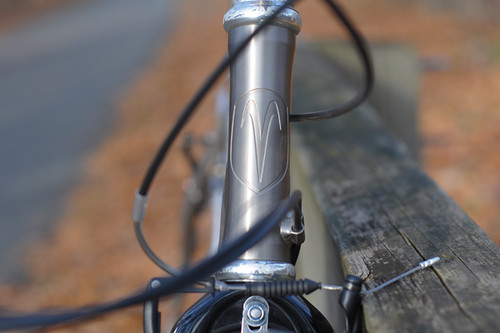
Van Nicholascame into existence 12 years ago and was founded as a brand in 2006. The frames are designed in Numansdorp, Netherlands, built in the Far East (I was not told which country), then finished, assembled and tested back in the Netherlands. The titanium tubing differs in thickness and composition based on the frame model and size. The Amazon is made with stout tubing, designed for touring and for supporting heavy loads. The frame is unpainted, with a brushed matte finish. The headbadge is chemically etched into the frame. Components that come standard with the build are high quality. The stem, seatpost and seat collar are also titanium, branded with Van Nicholas insignia.


Van Nicholas Ti Bell
The tiny titanium bell is pretty impressive. I forgot to ask whether they sell some of these Ti parts separately, because I certainly would not mind a titanium seatpost and bell.


Van Nicholas Amazon

The manybraze-ons for cable routing keep the cables very neat, which is a good thing because there are lots of them thanks to the Rohloff hub. There are also braze-ons for racks, water bottle cage bosses, and everything else one would expect from a touring frame.


Van Nicholas Amazon, Carbon Fiber Fork with Canti Mounts
The fork that comes with the bike is carbon fiber, labeled "VNT Elements" - a house brand I think.There are cantilever/v-brake bosses on it, which sort of horrifies me even though I know this is not uncommon nowadays (but how does the carbon fork withstand the force of the mighty v-brake?..).


Van Nicholas Amazon Rohloff, Gates Belt Drive
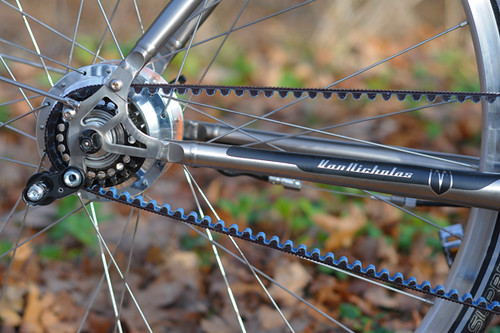
Special dropouts that can be split apart for the belt drive and also accommodate the massive Rohloff hub, with a built-in mount for the "belt keeper" that prevents the belt from slipping in snowy and muddy conditions.


Van Nicholas Amazon
Brooks Swallow saddle with titanium rails, FSA Metropolis handlebars,Rohloff twist shifter and Brooks leather washer grips. The brown leather accessories warmed up the titanium frame and I found the combination appealing. The handlebars are a modern take on the classic upside down North Roads and this added a touch of an almost vintage look to the whole thing.


Van Nicholas Amazon Rohloff, Lexington MA
When I first saw the bike, more than anything I was overwhelmed by all its bells and whistles. A titanium frame, a carbon fork with canti mounts, a Rohloff hub and a belt drive all on the same bike? It was a lot to wrap my head around. I am glad that at this point I'd ridden several other titanium bikes, and also another bike with a belt drive - so that at least all of these elements were not simultaneously new to me.


Van Nicholas Amazon Rohloff
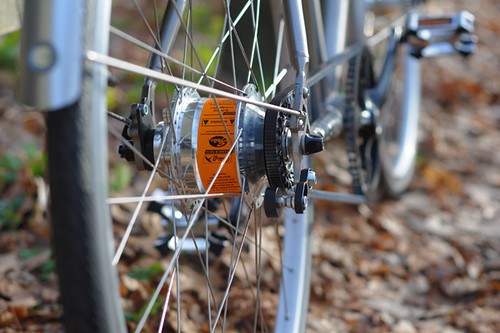
The Rohloff hub was the one feature I had not tried before. On first impression I immediately disliked it, because it made the bicycle ridiculously rear-heavy. On a lightweight titanium frame this was especially noticeable: I'd pick up the bike by the top tube, and the rear wheel would pull it backward like a ball and chain. I am not a fan of multi-geared hubs, and anything beyond a 3-speed I usually find annoyingly inefficient. I could already anticipate the same happening with the Rohloff: At such a monstrous weight, surely the 14 speeds with the alleged 526% gear range were a gimmick that in practice would not live up to the numbers' promise.


Taking the bike on its maiden test ride, I headed straight for the hills of Lexington MA to test this hypothesis. And my hypothesis proved to be incorrect. I approached a long, unpleasant hill and was able to climb it at a leisurely pace by utilizing the 3rd and 2nd gears. I did not feel the bike's rear-heaviness whilst in motion and spun without getting out of breath or even especially exerting myself. If I lived in a seriously hilly area, I could travel to work like this in ordinary clothing without getting sweaty. Later I rode the bike to my art studio, which is also on top of a steep hill, and in 4th gear I did not feel this hill at all. The Rohloff hub is heavy and that has its drawbacks, but I found the range of gearing it provided to be very satisfactory and on par with my derailleur-geared bikes. I am wondering now to what extent the performance of the hub in this case had to do with its interaction with the titanium frame. On a heavier frame, would it still get me up the same hills? This question remains open, so please keep in mind that my experience with the Rohloff so far is limited to this specific bike.


Rohloff 14 Speed Shifter
The Rohloff shifter took some getting used to, because if you are accustomed to standard twist shifters this one functions in reverse: For a lower gear you twist toward you and for a higher gear you twist away from you. I did not manage to get used to this during my two weeks with the bike and would occasionally shift in the opposite direction than I meant to. I was very glad however that I did not have to constantly switch gears just to ride at the pace I wanted to in the city. The 9th gear was my standard gear, and unless I ventured into hilly terrain I pretty much stayed in it. The bicycle responded very well to my pedaling efforts both uphill and on flats.


It's been explained to me how Rohloffhubs work, and apparently it is like having an internal derailleur with a double crankset. So if I understand this correctly, there is a gear at which point the mechanism automatically switches not just between the internal rear cogs, but also from one internal chainring to another. A couple of owners of older model Rohloff hubs tell me that whatever gear this happens on can be problematic - either sticking or misfiring when one attempts to switch in or out of it. I tried to figure out which gear this was, and judging by the extra grunting/clicking I was hearing, it appeared to be the 6th gear - a gear I only used when going uphill. I made a point to switch in and out of it a few times and did not experience any problems in the course of my test rides.In general, neither the Rohloff hub nor the Gates belt drive gave me any trouble over the 55 miles I spent riding this bike through the hilly countryside and stop-and-go city traffic. The drivetrain was very quiet and sort of faded into the background.


Test Riding Van Nicholas Amazon

While the Amazon comes with braze-ons for racks, the demo model was sent to me without any and initially I fitted the bike with a medium sized saddle bag. There were also no provisions for dynamo lighting, and I used my own battery lights.


Van Nicholas, Art Supplies
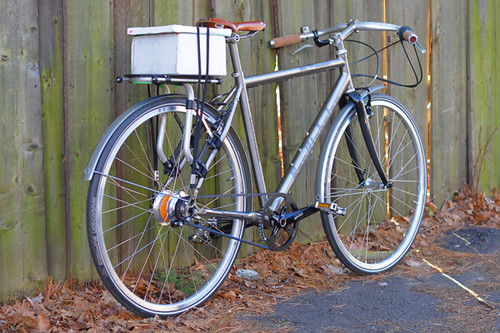
Later we installed a Freeload rack on the bike, so that I could transport packages and my laptop pannier. Aside from one ride done for the sole purpose of testing the bike on hills and over longer distances, I mostly rode the Van Nicholas for transportation, since that was the context in which I was testing it. Its proportions work well for this purpose. The long (456mm) chainstays allow for optimal pannier clearance; the relaxed head tube angle and long top tube prevent toe overlap with the front wheel. I wore my chunkiest winter boots to test ride the bike and there was not even a chance of toe overlap, which was great.


Van Nicholas Test Ride

The handlebars, despite being somewhat swept back, are set very low and you can see that my position on the bike is rather aggressively leaned over. Ideally I would prefer handlebars that are not necessarily higher but more swept back. In other ways the bicycle fit me very well and at 5'7" I was happy with the 54cm frame size. The handling felt familiar and predictable. Not like a classic Dutch bike exactly, but like something I've ridden in the past. Maybe like a Ti version of my Rivendell, were it set up as an upright bike. For transportation cycling I like this type of handling very much.
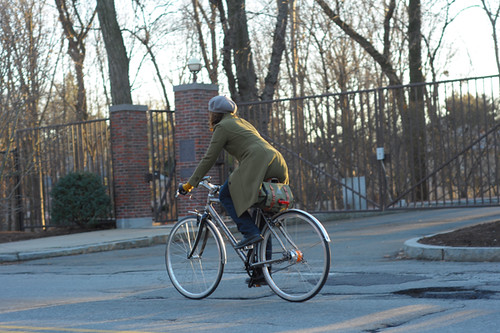


Van Nicholas Test Ride
But my favourite part of the Van Nicholas ride quality was how it felt over rough roads. If you look at the lower righthand corner of the picture above, you will notice there is a ditch in my line of travel. Unfortunately, many roads in the area where we live look like this, and often I end up riding right over those ditches and potholes, because to avoid them would be to zig-zag incessantly. The Van Nicholas was fine with this type of road surface, despite being fitted with tires only 32mm wide (the frame's maximum tire clearance is 2.35", so it is possible to fit much wider tires). I could ride through a ditch like the one you see here and feel only a distant echo without the bone-shaking feeling. As I've written before, I've noticed this same detached "echo" feeling with several titanium bikes so far, so I don't think it would be out of line to speculate that the titanium plays a role here.
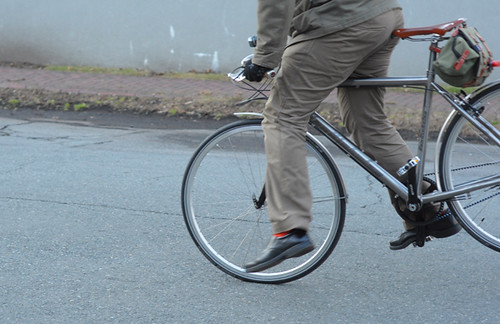


Van Nicholas Test Ride
On a critical note, the v-brakes were insanely strong and difficult to modulate. I was not brave enough to demonstrate this, but here the Co-Habitant shows what happens when squeezing the front brake with moderate force. We would have to mess with the brake to adjust it in a way that would prevent this, but decided to leave it alone and instead I simply used the rear brake only.
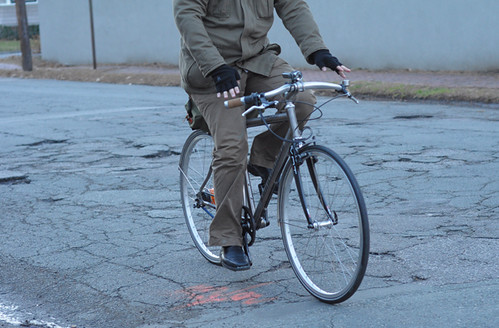


Van Nicholas Test Ride
Test riding the bikebriefly, the Co-Habitant also noted that he was unable to comfortably ride it hands-free (I would not know, as I do not normally ride hands-free anyhow). The frame was a couple of sizes too small for him, but I doubt this played a role. It could be that the weight of the Rohloff hub and the saddlebag made the front end too light for hands-off riding.
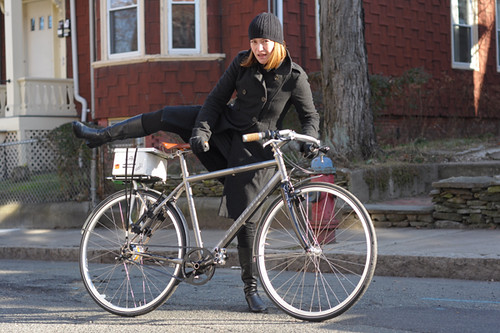


Van Nicholas, Art Supplies
Me, I was very pleased with the handling and the ride quality of the Van Nicholas Amazon and would have been tempted to covet it for my own if it were not for the diamond frame. Try as I might, I am just not comfortable riding diamond frames for transportation in my everyday clothing. Yes I can do it, but I prefer not to. My long coat or skirt inevitably get caught on something as I swing my leg over to mount or dismount the bike, and I am too clumsy to handle this on a regular basis. So despite the great ride quality, the amazingly versatile Rohloffhub gearing, and the silent and maintenance-free belt drive, I ultimately feel more comfortable on my own bike. I should note that Van Nicholas does make a ladies version of the Amazon, but I find the MTB step-through frame design unbearably ugly. Looks are not everything, but the welded titanium and the carbon fork already stretch the limits of my open-mindedness and I am only human. If they managed to make a more attractive step-through or mixte option however (like this please!), I would be in trouble and would desire this bicycle very badly. Offering a dynamo lighting package would also be a huge plus on a bicycle like this - whether it is used for touring or transportation.


Test Riding Van Nicholas Amazon
The Van Nicholas Amazon is a unique bicycle in that it is durable enough for year-round, all-weather transportation and comfortable on bad roads, while also being sufficiently light and versatile to handle serious hill grades over long distances. Something like this cannot be achieved without the Rohloff hub and the lightweight Ti frame, which makes its high cost inevitable. But for those who can afford it and for whom the diamond frame is not an issue, the Amazon is worth looking into.


Van Nicholasbicycles areavailable with both stock and custom options, and the full specs, geometry and other details of the Amazon are available here. More of my pictures can be viewed here. Many thanks to Van Nicholasand EU Cycling Imports for the opportunity to try this bicycle.