Saturday, October 29, 2011

Wordles Wednesday

No, that isn't a typo. And no, don't worry, this won't be a feature every Wednesday ;-)

Last week when footnoteMaven passed around the Wordle virus to the genea-blogosphere with her post Let Me Get A Wordle In Edgewise, I didn't have time to play. She did a follow-up with Do Not! I Repeat - DO NOT - Read This Post! With links to other genea-Wordles and some other fun stuff.

In school, and the Navy, I was nearly the last in line for everything (surname Wiseman, right). And have a tendency to be a bit late for meetings and appointments. Not on purpose, though it might seem so. Anyway, as the saying goes "Better Late Than Never" here are my contributions to the genea-Wordle-world. One is for the surnames in my Mom's lines, and the other is for my Dad's lines. The size of the name is dependent upon how many ancestors have been entered in my database with that name. As always, click on the images to see a larger version.


What Maps Don't Say About Roads


Processing some pictures from my Northern Ireland trip last year, I remember how different the roads there are from the roads around here. I do not mean just the landscape, but features of the roads themselves. The patterns they follow, the ways in which they wind, the presence or absence of shoulders, even the texture of the asphalt/ tarmac and its feel under a bicycle's tires. Before I headed over to Ireland, I used maps to plan out my routes and was pretty sure I knew what to expect. But the types of roads I encountered had not been in my experiential vocabulary. The maps couldnot prepare me for the feel of them.


Is it a stretch to compare roads to types of music? The rhythm of the elevation changes in Northern Ireland is jazz-like, whereas here in New England USA it feels more like classical music. How can you describe jazz to someone who is only familiar with classical? They would have to hear it for themselves.


This is more than about topography.Do roads have style? Can a road be elegant, sophisticated, nuanced? Or perhaps it's a matter of physical presence, of chemistry and rapport between road and rider. Cycling on a road about which you've read on the internet can feel like meeting a person and finding them different from their online profile.


With new roads there will always be an element of surprise, a recalibration of the senses.There are things that maps don't tell us, no matter how good we may be at reading them.

Friday, October 28, 2011

Birds & Squirrels

The Cedar Waxwings are back!!! I just saw a flock of them in my leafless River Birch (Betula nigra) by the creek. I hope they find the Yaupon Holly that's just outside my office window again this year. It was an amazing sight with all of those birds covering the tree. And loud!

It was this time last year that a Waxwing got intoxicated and passed out on my porch. I loved her.

Later today, when I went outside to see if they were still around, I saw that the squirrel is back into my bird food.In his defense, one of my feeders is just an old harrowing disk from a tractor that is nailed to the railing. The cardinals and some of the larger birds seem to prefer this to the feeder.

But dammit, bird seed is expensive and I'm not interested in feeding greedy squirrels!

So I went outside and dumped ground red pepper all over the seed again to keep him out of it.I did this for the first time last week and it works great. I watched from the window as the squirrel began to gorge on seeds (I'm pretty sure I was wringing my hands with anticipation as I did this). The heat from the pepper hit him all at once and he straightened up like he had been hit by lightning. Then he let out a yelp and scurried away in a zigzag pattern....it was great.

Now I know you are thinking I am mean. But really it's no worse than eating some spicy buffalo wings to you or me.

As for the birds, they don't even notice. They don't have the neural receptors that recognize the heat from peppers. In fact, birds have co-evolved with peppers to eat the fruit and spread the seed! And if you don't want to use up your kitchen spices, you can always buy seed that is pre-coated with red pepper.

It's nicer than a pellet gun, right?

Stay warm!
Kari

Thursday, October 27, 2011

The Destroyer


This is a photo that you've seen before, although never composed the way you see here. I've shared two previous versions of this image, both of which were vertical crops. This version shows the original composition, cropped only slightly to get rid of some dead space on both sides of the image. I've always loved this shot because of the power and intensity of the lightning, but I was never completely happy with the vertical crops as they cut off part of the island. I love this one because it shows the whole island as well as more of the water. This is Pete's Island in Grand Portage Bay, and is the view that we see from the beach right in front of our house.

Birthday Trip


We decided to take a driveup to our favorite place yesterday, the Jemez Mountains. It was to be part of my birthday present. We stopped at several places we frequently stop at. It had rained the day before and everything seemed fresh and clean with the smell of pine, juniper, and wet dirt.


We stopped at the Forest Service Office where this huge cottonwood tree is, and bought our yearly permit to cut firewood.


We were interested in seeing the area where the fire had gone through in June on Thompson Ridge where we had heard it had jumped the paved road that goes between Jemez Springs and Los Alamos, New Mexico. We saw these gates and signs at most of the places where you can get off the road. One sign said Closed to Public Use with a sign beside of it that read Please Close the Gate. I know the yellow sign had been there before but it looked funny.


We could see where the fire had burned most of the trees on the hilltops but left a lot of the small grassy areas. This pretty little ranch was lucky, as it came almost to their door.


You can see the burnt trees on this ridge.


But we did see lots more wildflowers than we expected.


Wednesday, October 26, 2011

Speaking of Saddles

Saddle Fit at Cycle Loft
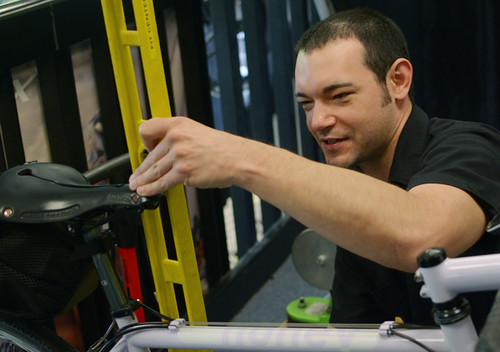
Earlier this week I was visiting Cycle Loft - a local bicycle shop known, among other things, for its extensive fit studio.I will be test riding a few of their bikes this summer, and the staff suggested I undergo a fitting session beforehand. As we were getting started, the fitter - Joel - caught sight of the Selle Anatomica I was riding. He asked whether I wanted to use my own saddle, given how particular it was, or try something new.


Today there are lots of high quality, well thought-out saddle designs on the market, in a variety of materials. The trick is to find one that fits our particular anatomy, position and riding style. For the past two years I've been going back and forth between a Berthoud touring saddle and a Selle Anatomica on my roadbikes. These saddles are as close as I've been able to get to being truly comfortable over long distances. But neither is perfect. SoI decided to keep an open mind and see what the fitter recommended.


Saddle Fit at Cycle Loft
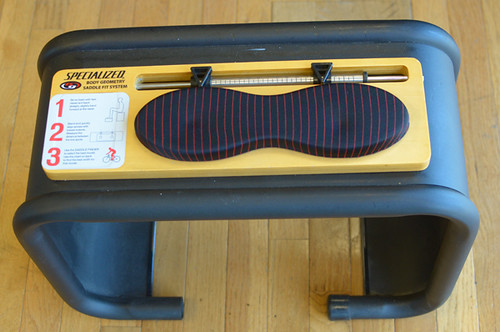
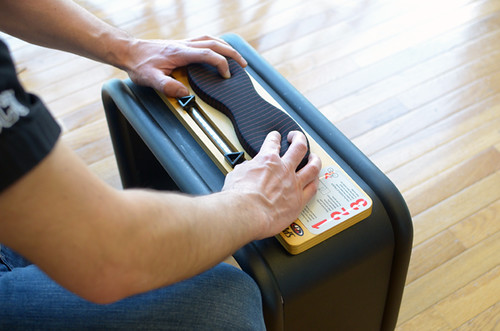
To start with, Joel measured my sit bones. This is something I've never had done "professionally" before, so it was pretty exciting. Cycle Loft uses the Specialized "Body Fit" method, which, as I understand it, is comparatively un-intrusive (no pelvic fondling, etc.). But there is a nifty device involved. A stool was brought out with a butt-shaped pillow, upon which I sat as instructed. When I stood up, my sit bones left two clear indentations, which Joel swiftly measured.


Saddle Fit at Cycle Loft
The figure was 135mm - considerably narrower than what I thought my sit bone width was based on my DIY measurements (the figure I'd come up with was more like 150mm). But we repeated the process just to make sure and got the same number again - so looks like 135mm it is.


Joel explained that a saddle should be wider than the sit bone width itself. How much wider depends partly on the rider's position and partly on the saddle's shape. As far as the rider's position, the more leaned forward you are, the narrower area of support is needed. That much I'd known. As far as saddle shape, Joel showed me a selection or road/racing saddles and pointed out that on some the sitting surface was flat across, while on others it was rounded, like an arc. For all my careful scrutiny of saddle shapes, this was not a distinction I'd explicitly been aware of before, so I was excited to learn something new. For any given rider, on a rounded saddle the width needs to be greater than on a flat saddle.


According to the fit chart, the saddle width recommended for my sit bones was 155mm minimum. My Berthoud saddle (which is flat) measures 160mm across, and my Selle Anatomica (which is rounded) measures 170mm across. My comfort with both makes sense according to this fit method.
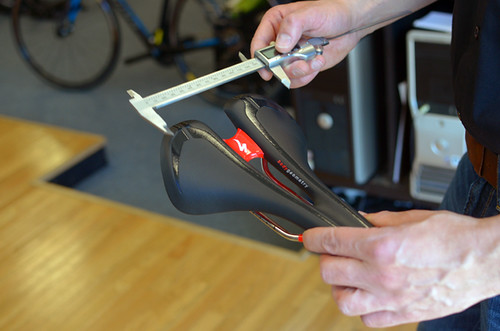


Saddle Fit at Cycle Loft
Next, Joel asked what I liked and disliked about the saddles I normally use. I explained that my saddles are fairly wide across the rear, yet have narrow, racing-style noses. The wide rear and narrow nose combination works for me, because this waymy butt feels fully supported but I don't get thigh-rub. Other saddles I've tried tend to be either too narrow or too wide all around, which doesn't work. I also like the feel of suspended leather, compared to other surfaces I've tried.


As far as what I don't like, that is a little trickier to explain. The Berthoud feels a bit too hard, whereas the Selle Anatomica has a bit too much give. And with each, I occasionally - at random times, it seems - feel pressure or pinching in the middle of my "soft tissue." It happens rarely now compared to the problems I used to have, but it does still happen occasionally. We discussed all this in detail, as well as the other saddles I've tried. I described my dislike of gel (I sink into it and feel horrible pressure), my inability to ride Terry saddles (the slots are somehow in the wrong place), and finding the edges of many racing saddles "too sharp" as I pedal.


Saddle Fit at Cycle Loft
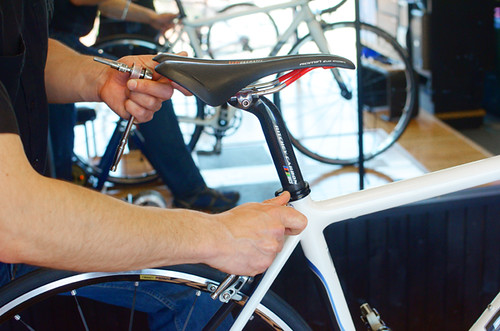
After taking all of this in, Joel suggested I try the Romin Evo saddle by Specialized (interesting write-up about it here). It had everything I seemed to need: a rounded wide rear (168mm across), a narrow nose, and a firm, but not rock-hard, surface. A channel down the middle and a curved nose were designed to avoid contact with exactly the pressure-prone spots I'd identified. It is not a woman-specific saddle, but then neither are my own. A synthetic saddle made by a big-name manufacturer, it was not what I would normally gravitate toward, but I'd said I would be open minded, and so I would.


The Romin Evo is now fitted on the demo bikeI'm riding. I could not feel it under me on the initial 30 mile ride, but I will withhold judgment until after the follow-up, 100K ride.


But whether this particular saddle wins me over is beside the point. What I appreciated the most was the generally informative conversation with the fitter - who I felt was neutral and knowledgeable when it came to various styles, materials, aesthetics and brands of saddles. I would like to keep learning myself, and at some point to post a comprehensive guide that might be of help to those at a loss for where to start.

Thursday, October 20, 2011

Echoes of Bikes Past: Yamaguchi Mixte

Yamaguchi Swoopy Mixte

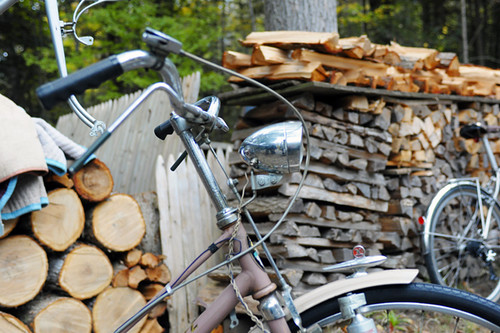
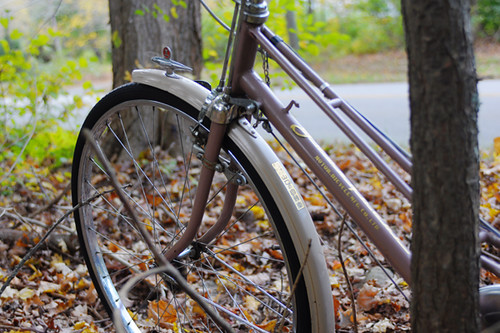
At a gathering of vintage bicycle enthusiasts last week, I spotted this unusual machine and made my way toward it through the sea of French constructeurs. "Aha!" said the owner, "I brought this one especially for you to look at." Yamaguchi Bicycles, Japan. Year, model, and history unknown. Not collectable. Not worth much. Not of interest to many. But what attracted me was its surprisingly elegant combination of design elements not usually seen on the same bike: a mixte frame, roadster geometry, 26" wheels, rod brakes, full chaincase. The colour - straddling the border between beige and mauve - reinforced the theme of blending.


Yamaguchi Swoopy Mixte

Despite its obscure pedigree, the Yamaguchi was a hit with the vintage collectors; there was just something about the way everything harmonised. It also "looked light" despite weighing over 50lb.


Shimano Trigger Shifter, Yamaguchi Bike

From a historical perspective, an interesting feature of the bike is the very early Shimano 3-speed trigger shifter. I have never seen one of these before, and could not find examples online allowing me to establish the date of manufacture.


Yamaguchi Swoopy Mixte

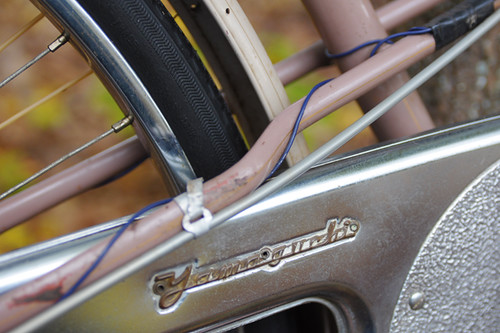
As far as frame construction, it is neat how they kinked the right lateral stay so that it would clear the massive chaincase, then routed the shifter cable and dynamo wiring along that stay.


Yamaguchi Swoopy Mixte

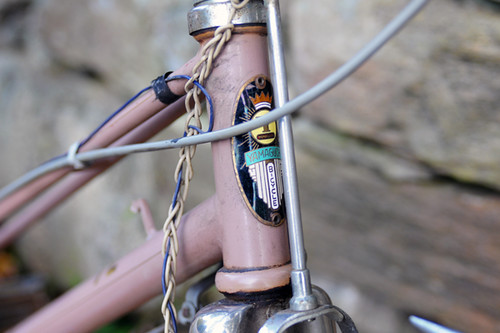
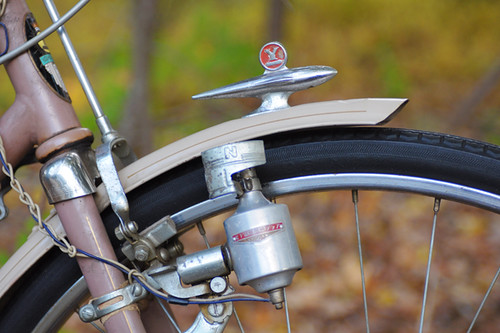
Another interesting thing is how thoroughly branded this bicycle is: Every part of the frame, many of the components, and even the bolts used sport the Yamaguchi name.


Yamaguchi Swoopy Mixte

Yamaguchi fender ornament.


Yamaguchi Swoopy Mixte

Yamaguchi cranks, including dust caps.


Yamaguchi Swoopy Mixte

Yamaguchi saddle.


Yamaguchi Swoopy Mixte

Noticing a decal that mentioned motorcycles, I incorporated that into my search and found mention of a company that went out of business in the late 1950s. This could be them. Later a reader posted a link to a Japanese blog showing some photos of Yamaguchi "Gold" roadsters, which is the only other significant mention of the brand I've encountered so far.


Yamaguchi Swoopy Mixte

Over the decades, bicycle manufacturers all over the world have come and gone. Some of them have left a mark in history and others disappeared without a trace. The Yamaguchi roadster-mixte is in the latter category, which makes its elaborate branding and unusual design all the more intriguing. Did the manufacturer have plans for this bike to become popular, or was it merely a promotional item for their motorcycles? How many of these were produced? How did this one make its way to the US? These things we may never know.


Yamaguchi Swoopy Mixte

Recently a friend and I were talking about all the new bicycle brands popping up on the market today, and speculating which of them will last. History suggests that most will not. But maybe now - with all the forum chatter and other electronic traces of things - we will be left with more detailed records of the brands that disappear. Stories of failure are just as historically significant as stories of success, and it's a pity these stories tend to get lost. Trying to reconstruct them is one reason I like finding obscure vintage bikes.

Monday, October 17, 2011

Escalante River Hike


We were a little tired after our hike back up the hill from Upper Calf Creek Falls, so we decided to stop in the nearby town of Boulder for a snack. As luck would have it, we found a nice little store that sold bagels and smoothies. This was the perfect refreshment after our morning hike! After that we headed a few miles down the Burr Trail to Long Canyon, which I thought might be perfect for a short bike ride. Indeed it was, and we had a blast cruising down the canyon on our cross bikes. Our final adventure for the day was a hike upstream along the Escalante River to Escanlante Natural Bridge and Arch. This hike had a LOT of vegetation along the way, included some beautiful giant cottonwood trees and tons of sage. The trail also crossed the Escalante River several times, which was fun and refreshing each time wehad to cross :-)


After about 2.5 miles we came to Escalante Natural Bridge, which was fascinating to comprehend but really not all that photogenic, since the bridge blended into the background cliff and was not standing out against the sky like some other natural bridges. We contemplated the bridge for a while, then continued on up the trail to the arch. The arch was awesome, certainly unlike the other arches we've seen on this trip. This one was not very big, but it was extremely high up on top of a cliff. The lines in the rock running down the cliff were mesmerizing, and the bottom of the cliff was lined with beautiful cottonwood trees. After another full day of outdoor adventures, we were ready for a good meal so we headed back to the Escalante Outfitters and this time tried their calzones, which were just as goodas the pizza we had last night! This has been such an awesome trip already, I wonder what cool sights and experiences tomorrow will bring?

Sunday, October 16, 2011

Color


Talking of the depressingly drap desert colors we have now makes me want to try and hurry spring along. We had a couple of days of 55 and 60 degree weather that always makes me want to get out and start the gardening. In my back yard, away from the horses where they can't eat them, I always grow lots of easy to care for flowers and a few tomatoes each summer. This photo is of our wild four-o-clock. I have put so many mundane photos on with no bright colors lately, I though it was time to do so. These are native here and, although hard to transplant, if you can get one going it will take the place. They are usually only about a foot tall but will spread out and cover as much as 12 square feet in a summer. Then they die back in the fall and you can't even be sure where the plant was after you get rid of the dead vine and leaves. All summer, from late June until the first hard freeze, each evening, as the sun desends toward the west at about four-o-clock, (that is why it is named that) the plant opens its hundreds of purple flowers and purfumes the air with a wonderful sent.

Thursday, October 13, 2011

Cal Poly Poppies


Cal Poly Poppies, originally uploaded by ParsecTraveller.

The California poppies are in full bloom on top of the Cal Poly "P" ridge. The "P" is a large monument-like letter engraved in the hillside above the Cal Poly campus. The ridge above the "P" is covered in wildflowers right now.

Wednesday, October 12, 2011

Jemez Creek

Took the dogs and when to Jemez Creek for a walk the other day.
There are several rest areas along the road that have acess to the creek for hiking and fishing. There are nice paths for walking. On this day we noticed the water in the creek was really low allowing us to see a lot of rocks we can't normally see. We also saw a few trees that some beaver had been cutting down for food or for damn building but no sign of a damn any where here like we see higher up in the mountains.

Native plant pairing

I saw this combination at a nursery I was scouting last week (Fair View Nursery). Although the pairing was unintentional, it looks great.

The dark rosy flush on the Dwarf Yaupon Hollies is accentuated by the pink plumes on the Sweet Grass.

This works.

Tuesday, October 11, 2011

Photographing ice at Cutface Creek Wayside


This morning I met up with my friend Bryan Hansel (http://www.bryanhansel.com) near Grand Marais to photograph the sunrise. The shoreline we visited was littered with these large "mountains" of ice, pushed up by wave action from Lake Superior. The temperature was even cold enough to have some nice sea smoke out on the lake. Along with the fascinating ice, we found several otter "slides" in the snow along the shoreline. Otter slides are trails made in the snow by the otters as they slide down slopes on their bellies. It sure was a fun morning!

Monday, October 10, 2011

One More Time :: The Piedras Blancas Elephant Seals

Wednesday, May 1st - - A drive along the central Coast of California is not complete without a stop to see the Elephant Seals at Piedras Blancas, a few miles north of San Simeon. It is just plain fun to watch them interacting, getting annoyed with each other, and playing. If it is a warm day and the breeze is coming in off the ocean you may not want to stay long (the smell can be a bit overwhelming at times) but it is definitely worth a visit.


Carol has some cute pictures of the seals that she took in April of this year. And here are some photos from my visit in April ... There was far more activity and movement amongst the seals today than on past visits.