 I got this shot of a flycatcher sitting on the same plant stand to catch the cool air as the mockingbirds I told about in the previous post.
Tuesday, November 29, 2011
Flycatcher
I got this shot of a flycatcher sitting on the same plant stand to catch the cool air as the mockingbirds I told about in the previous post.
Monday, November 28, 2011
Autumn at Grand Portage State Park

(Above: High Falls, Grand Portage State Park)
Today's adventure brought me to one of my favorite hikes, the Middle Falls Trail at Grand Portage State Park. With several hundred feet of elevation change each way along the trail and a very rugged trail surface with lots of rocks and tree roots, the Middle Falls Trail is not for everyone. For those that do make the trek, however, its a very rewarding hike.

(Above: Awesome Aspens on the Middle Falls Trail)
Autumn is my favorite time of year to hike this trail. There is a nice variety of color as you progress through the various elevations along the course of the trail. Also, due to its rugged nature and its remote location at the northeast end of Minnesota's north shore, the trail sees relatively little traffic.

(Above: Middle Falls)
(Below: Golden fall colors glow behind the Pigeon River at Middle Falls)

(Below: Looking upstream at Middle Falls)

(Below: "Patterns in wood" - This tree had fallen and blocked the trail, and had been cut by a chainsaw crew. This cool pattern in the wood was revealed after being cut by the chainsaw.)

(Below: Trapped at Middle Falls)

Saturday, November 26, 2011
- Off to a snowy start
 Near record amounts of snow fell at Paradise in December and early January. The weather station there recorded over 360 inches (over 30 feet) of the white stuff so far this fall and winter. At that rate, the mountain is on track to break the previous snowfall record (93 feet in 1972)... The breakneck pace of snowfall has blanketed the entire Cascade range and has also caused a significant amount of avalanche distress and accidents. The thick unstable snowpack brought a series of severe avalanche cycles that have claimed nine lives in the region. Almost another record, yet very grim, for avalanche fatalities.
  At Paradise on Mount Rainier, a snowshoer was caught in a snow-slide on December 18th. It took 3 and 1/2 days to find 22 year old Kirk Reiser. Though the accident occurred within 3/4 miles of the parking lot, a tremendous amount of continued snowfall made the recovery hazardous and arduous. To find him, we called upon Mountain Rescue and Crystal Mountain Ski Patrol to help. They showed up with many rescuers, search dogs and bombs (to mitigate the hazard). Left: Crystal Mountain Ski Patroller Chris Morin tossing a bomb, photo by Stefan Lofgren.
 It's been over 20 years since someone has been caught and killed in a "winter" related avalanche on the Paradise side of the mountain. Climbers have certainly been caught, but those incidents happened in the spring and fall at higher elevations. The last four avalanche fatalities were in June (3) and October (1), not your traditional "avalanche season." Left: Mountain Rescue volunteers working a probe-line, photo by Stefan Lofgren.
Anyone who leaves the parking lot for a day of fun in the snow should definitely pay attention and adhere to the avalanche forecast. You'll also need to know how to evaluate the hazard and make route finding decisions that avoid hazardous areas. Another key is to carry the necessary backcountry rescue equipment (a beacon, a shovel, and a probe per person) and know how to use them efficiently during an emergency. Remember, rescue equipment is a last resort, avoiding an accident is the goal. Perhaps the best advice is to take a class and learn about snow safety. If you haven't done so, check out some of the avalanche courses offered in the area. If it's been a few years since you've had a course, take an update/refresher. A good place to start is the Level 1 AIARE or the Recreational Level 1 course from the Canadian Avalanche Association.
 Over the last week, we've enjoyed mostly clear and cold weather (as attested by Chris Olson's image to the left). This allowed 3 climbers an opportunity to summit via the Gibraltar Ledges route on Jan 23rd!! During that weather window, numerous snowshoers and skiers made their way to Camp Muir. Most were reporting firm, hard snow, no one else summited (that we know of)... That said, the snow has again started to fall in Longmire and at Paradise (another 2 feet reported). Once again, things are very soft and hazardous. As a safety heads up: the emergency public radio at Camp Muir is not working (more later on when it gets fixed). As for the snow/ski conditions, check out our ski reports from Lead Climbing Ranger Chris Olson. As always, I appreciate any field reports route updates, if you send them, we'll share them...
 And speaking of updates, we have a new writer on the website that you'll be meeting later this week. But to give you a quick heads up, get ready for famed writer and blogger: Rebecca Agiewich. Rebecca is a Rainier enthusiast, skier, and for the benefit of this website, a writer. She has signed on to help me with route reports and other updates so that YOU wont have to wait (sometimes 8 weeks) for the local scoop on Rainier traffic and events as I wade through NPS policy and budgets... Look for her pithy and fun posts to come. She'll spin her own Rainier press and provide added entertainment and information.
Above image is of Park Ranger Stefan Lofgren assessing the snowpack, by Mike Gauthier.
Sunday, November 20, 2011
A Lovely Touring Bike... For You?
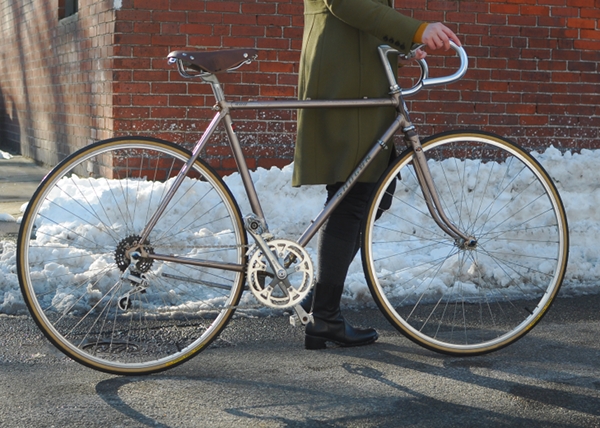
When I mentioned my "roadbike for women who fear roadbikes" project earlier, I didn't make this clear as I was still figuring out the details - but it is now very much official: I will be giving this bicycle away for free to an interested recipient in the spring.

To recap: Back in November, I picked up a vintage Shogun bike in which I saw a lot of potential, due to its comfortable frame geometry. The Co-Habitant and I are overhauling the bicycle from the frame up and fitting it with nice, comfy components. The goal is to turn it into a touring bike that will hopefully address some issues that fledgling female cyclists tend to have with roadbikes. I was not able to handle a roadbike until (after much trial and error) I discovered that a comfortable frame plus the right components were key. That experience changed my perspective and made me very happy, and I would like to help make that happen for someone else.
I am able to fit this bicycle with extremely nice components and give it away for free, thanks to the generosity of several donors. The main donors for this project are Velo Orange and Cambridge Bicycle, whose contributions will be described below. I have also been offered a monetary donation by a reader "Cedar" to cover the costs of the frame and wheelset I had purchased. Additional contributions of components were made by: Justine Valinotti of Midlife Cycling, reader "Spindizzy," reader "G.E.," reader "neighbourtease," and "somervillain" of Boston Retro Wheelmen. The Co-habitant and I are contributing our time and labor, as well as a few of our own things.
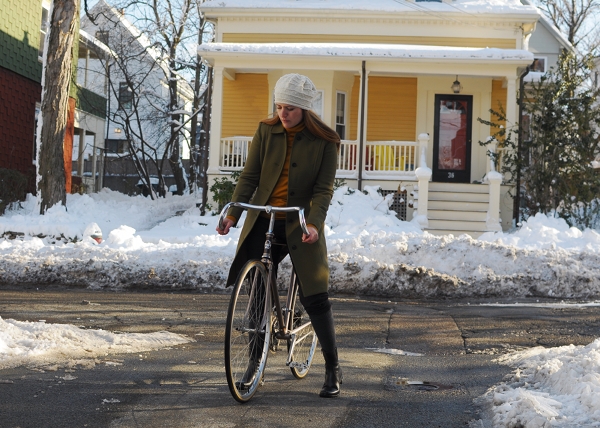
The frame and fork are cro-moly, and the seat tube angle is a comfortable 72.5 degrees. The frame has "touring geometry" and eyelets for fenders and racks. The bicycle as shown in the pictures here has been stripped of most of its original components, fitted with an updated touring wheelset, a Nitto stem, Nitto Randonneur handlebars, and a Velo Orange saddle. The drivetrain shown is original, but it will soon be replaced.

The size of the frame is 52cm, as measured from the center of the bottom bracket to the center of the intersection with the top tube (or 54cm if measuredto the top of the seat tube). I am 5'7" and the size is just right for me - with plenty of top tube clearance, but not too much. If you are 5'5" - 5'8" it should fit you as well. Outside of that range, I would need to know your inseam measurement or pubic bone height to give you a better idea. Since there is only one bike, the size will naturally exclude many of you from participating in the give-away, and I am sorry about that.
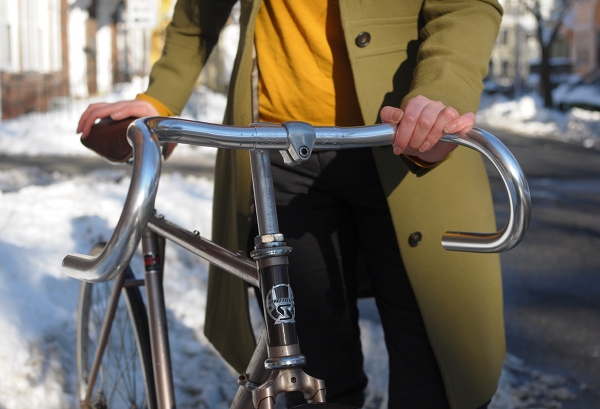
The frame colour of the bicycle is an ethereal mixture of mauve and champagne. It's a neutral colour, but vibrant, with some shimmer to it; the pictures here portray it accurately. The headtube panel is a deep, dark chocolate-plum. The Shogun insignia on the downtube is sage green.
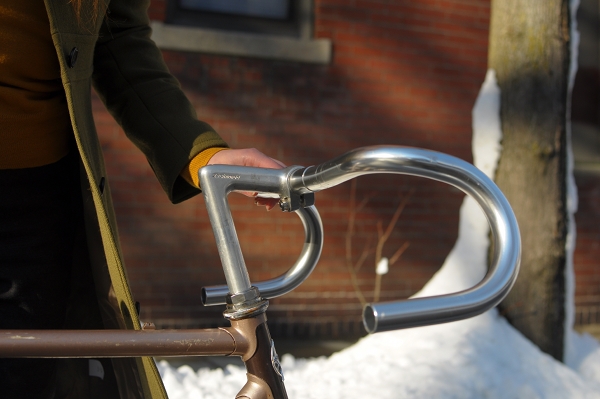
The Nitto Technomic stem and Randonneur handlebars are from my own parts stash (the handlebars are new, the stem gently used). I am not sure yet whether the final bicycle will have the Randonneur bars or the Noodles - I am planning to do a comparison test.
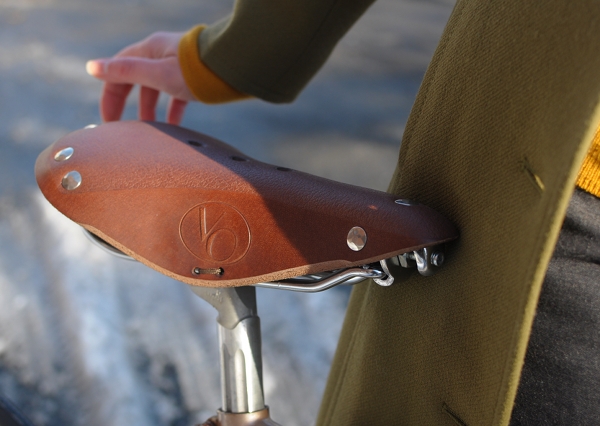
The saddle is a "Model 3" touring saddle from Velo Orange, which I will test out and review once the roads are clear of snow. The person who gets the bike in the end will have a choice between this saddle, and one of my own Brooks B17S saddles (which I no longer use).
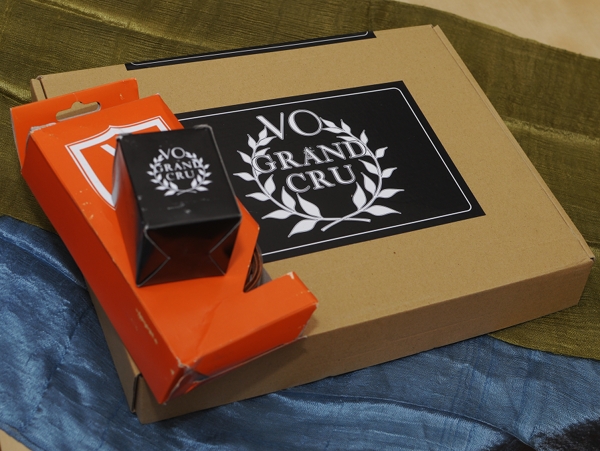
In addition to the saddle, Velo Orangewas kind enough to donate: a headset, a crankset, fenders, and leather handlebar tape. The items were ones I requested specifically for this bike.
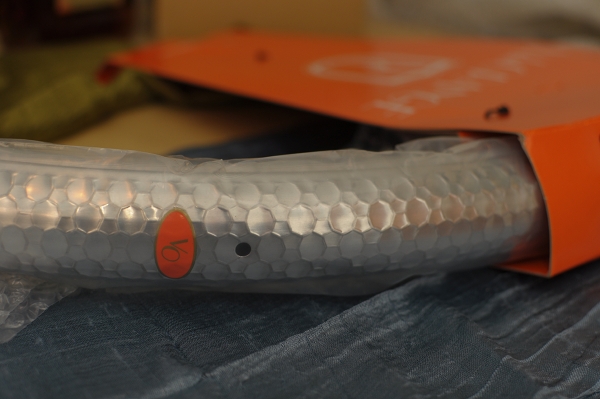
I don't want to remove the hammered fenders from the packaging until it's time to install them, but they look beautiful. The hammered pattern has a "honey comb" look to it that I visually prefer over the Honjo version - though this is, of course, a matter of taste.
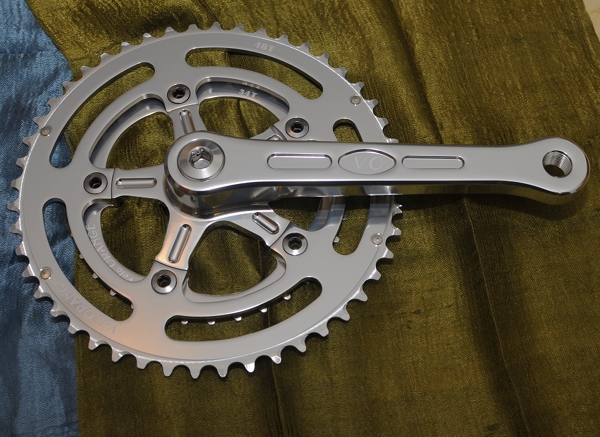
The "Grand Cru" crankset is classic and beautifully made, modeled on vintage TA. Before VO released this model, it was very difficult to find a crankset in a classic style.
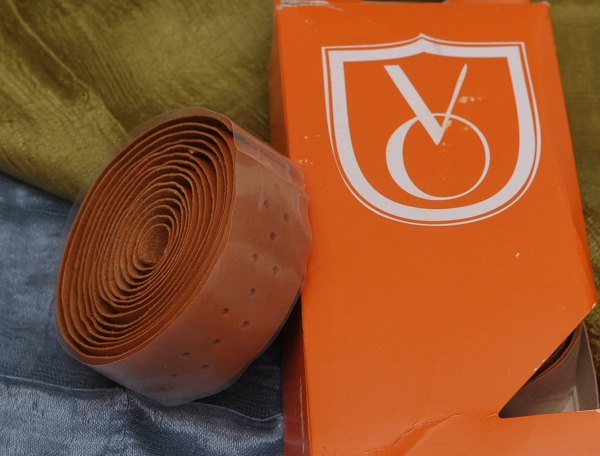
I haven't put leather tape on any of my own drop bars, as I consider it too expensive - but if will be fabulous to try it out before giving the bike away!

I have not yet picked up the components donated by Cambridge Bicycle, but they will include: brakes, short-reach brake levers, derailleur, cables, housing, and MKS touring pedals. I will feature these in a separate post.
For others interested in getting involved in this project, I am still in need of the following components for the basic build:
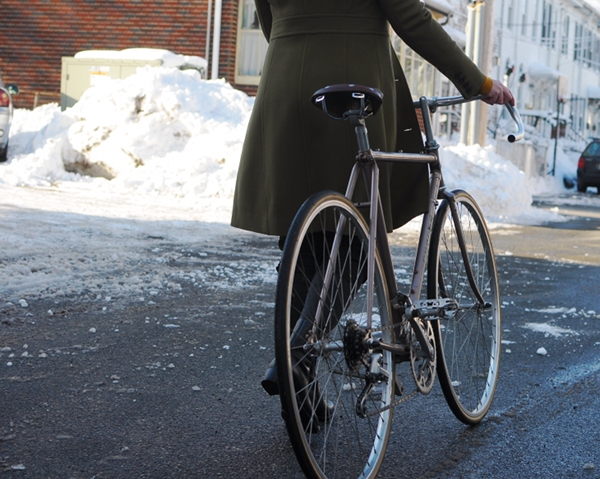
I am not sure yet what form the give-away of this bicycle will take. I hate to call it a "contest," but there will obviously have to be some sort of selection process, as there is only one bicycle. Either way, the formal rules will likely not be announced until early Spring. In the meantime, I would love to hear what you think about the whole idea. A refurbished vintage bike is not a typical give-away item and I am not even certain whether anybody will want it! Do you like the colour? The look so far? And I am especially interested in hearing from women who would like to try a road bike with drop bars, but have not had much luck thus far. What has been your experience? What do you find intimidating or difficult about the process? Similarly, if you already ride a roadbike, but find it uncomfortable or sub-par, I am interested in why.
I am enjoying putting together this bicycle immensely, and I thank once again those whose donations have made this project possible!
Saturday, November 19, 2011
Wiseman Siblings
 The three oldest children of Charles and Elsie (Shuder) Wiseman: Perry Martin Comfort Wiseman (1906-1968), Leslie Wilson "Dick" Wiseman (1910-1978), and Eva Leah Wiseman (1908-1967).
The youngest of their eight children was my father, born in 1924.
Contributed to the 11th Edition of Smile For The Camera :: brothers & sisters.
Friday, November 18, 2011
Pleasanton Family History Expo
By all accounts, the recent Family History Expo in Pleasanton, California was a success. I'll add my kudos to all of the reports with one exception...
The speakers were good. The topics presented were varied and interesting. Visiting with geneabloggers previously met was wonderful. The exception? In plain and simple terms, the venue was awful. Two classrooms in each building separated by fabric curtains certainly did not enhance the learning experience. To give her credit, Holly Hanson (president of Family History Expos) apologized for the classroom environment in her end of the Expo presentation, saying that the Expo will return to the area next year but in different and hopefully better facilities. That's good news for everyone! All in all, the Expo was well worth the time and money.
The first session I attended was with Arlene Eackle. And even though I have few ancestors in the south (a couple in Maryland, Virginia, Kentucky), I learned a great deal about locating the “right” ancestor through property records.
At 11:30 I learned what was new in RootsMagic4 with Bruce Buzbee. RootsMagic has some interesting features. I'm almost convinced that I should switch from Legacy! Almost.
The lines for getting lunch were quite long and I missed the 1:30 session with Lisa Alzo that I had planned on attending. Her talk was on Websites You Might Be Missing - a review of some cool tools and useful web sites for genealogists. I'll be able to get some of that information from the Syllabus but I'm sure more information was given in the lecture.
At three o'clock I sat in on Tim Cox's presentation on Hard Drive Organization and learned about how he files his genealogy documents and images. I'm always looking at how other people do that since I have several thousand documents and photos that I scanned before leaving home last September and have yet to organize them. I want to devise a system that will not need to be changed sometime in the future! Probably an impossible dream.
The final classroom session for the day was with Jean Wilcox Hibben on Shaking the Myth: Proving/Disproving Family Legends. Jean has devised a method of evaluating evidence by asking a series of questions to help determine if the legend could be true. It was fascinating to “step through” one of her family legends using this process.
The first day wasn't quite over when the last session finished. I, along with most of the geneabloggers and quite a few other people, attended the live Genealogy Gems Podcast with Lisa Louise Cooke. Her guests were Craig Manson and Sheri Fenley. They discussed writing for the online magazine Shades of the Departed which was created by footnoteMaven. Both Craig and Sheri were fantastic guests, and the dessert bar was pretty good too!
 Lisa Louise Cooke and Craig Manson
Day two of the Expo, I was a slacker. It was noon before I made my way to where the Expo was being held. I went in to a session at 1:30 but left after 10 minutes. I couldn't hear the speaker due to the noise from the neighboring session... I went to a 3:00 session but left soon after it started because the subject wasn't what I thought it would be. At 4:30 Holly Hanson gave the final presentation on breaking down brick walls on those troublesome ancestors providing several inspiring examples. And then, it was over... a few days respite and I'm back on the road!
The speakers were good. The topics presented were varied and interesting. Visiting with geneabloggers previously met was wonderful. The exception? In plain and simple terms, the venue was awful. Two classrooms in each building separated by fabric curtains certainly did not enhance the learning experience. To give her credit, Holly Hanson (president of Family History Expos) apologized for the classroom environment in her end of the Expo presentation, saying that the Expo will return to the area next year but in different and hopefully better facilities. That's good news for everyone! All in all, the Expo was well worth the time and money.
The first session I attended was with Arlene Eackle. And even though I have few ancestors in the south (a couple in Maryland, Virginia, Kentucky), I learned a great deal about locating the “right” ancestor through property records.
At 11:30 I learned what was new in RootsMagic4 with Bruce Buzbee. RootsMagic has some interesting features. I'm almost convinced that I should switch from Legacy! Almost.
The lines for getting lunch were quite long and I missed the 1:30 session with Lisa Alzo that I had planned on attending. Her talk was on Websites You Might Be Missing - a review of some cool tools and useful web sites for genealogists. I'll be able to get some of that information from the Syllabus but I'm sure more information was given in the lecture.
At three o'clock I sat in on Tim Cox's presentation on Hard Drive Organization and learned about how he files his genealogy documents and images. I'm always looking at how other people do that since I have several thousand documents and photos that I scanned before leaving home last September and have yet to organize them. I want to devise a system that will not need to be changed sometime in the future! Probably an impossible dream.
The final classroom session for the day was with Jean Wilcox Hibben on Shaking the Myth: Proving/Disproving Family Legends. Jean has devised a method of evaluating evidence by asking a series of questions to help determine if the legend could be true. It was fascinating to “step through” one of her family legends using this process.
The first day wasn't quite over when the last session finished. I, along with most of the geneabloggers and quite a few other people, attended the live Genealogy Gems Podcast with Lisa Louise Cooke. Her guests were Craig Manson and Sheri Fenley. They discussed writing for the online magazine Shades of the Departed which was created by footnoteMaven. Both Craig and Sheri were fantastic guests, and the dessert bar was pretty good too!
Lisa Louise Cooke and Craig MansonDay two of the Expo, I was a slacker. It was noon before I made my way to where the Expo was being held. I went in to a session at 1:30 but left after 10 minutes. I couldn't hear the speaker due to the noise from the neighboring session... I went to a 3:00 session but left soon after it started because the subject wasn't what I thought it would be. At 4:30 Holly Hanson gave the final presentation on breaking down brick walls on those troublesome ancestors providing several inspiring examples. And then, it was over... a few days respite and I'm back on the road!
Tuesday, November 15, 2011
Traveling by Bike
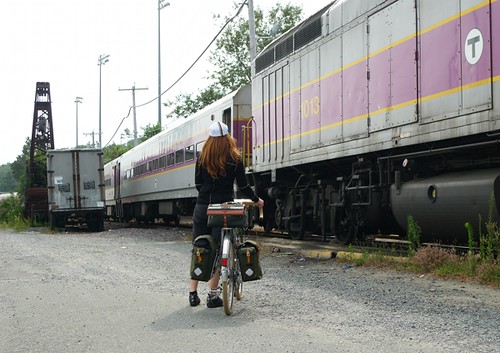 As you may have noticed, we are staying on the coast for a little while - our annual working vacation. This is something we've been doing at the end of every summer for the past six years. When we lived further North, we used to go to a place in Maine, and after moving to Boston we began staying on Cape Cod. I've been writing about that for the past two summers, and it's funny how over time our trips became increasingly bicycle-oriented. Two years agowe went by car as usual, but for the first time took bikes and cycled around a bit during our stay. Last summer we arrived by car again, but got around entirely by bicycle once there and attempted some high mileage day-trips. This summer we no longer have a car and really did not want to rent one just for the trip. So after discovering that Cape Ann was accessible by commuter rail, we decided to come here instead and do the whole trip on bikes. Another reason for choosing Cape Ann, is that it is a popular starting point for long rides up the coast of Northern New England. There are no decent routes north directly out of Boston, and what cyclists often do is take the commuter rail up here before proceeding north. So that was the plan: To arrive on our bicycles, to get around by bike, and to cycle up the coast as far and as often as possible in the course of our stay.
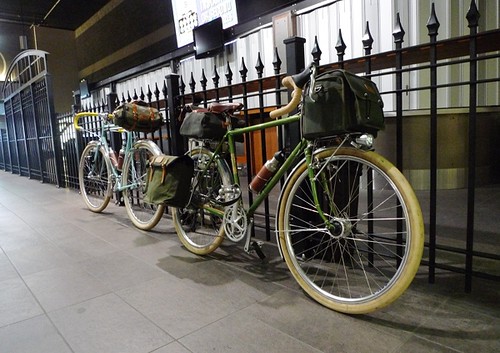 Our main challenge was figuring out how to transport our belongings. This is not a bicycle-specific trip, so we needed more than a change of cycling clothing and rain gear. We are living here for two weeks and doing all the same things we do at home - including work-related stuff. We needed our regular clothing and footwear, personal hygiene products, bedding, towels, laptops, a variety of electronic devises, some necessary books and documents, and our camera equipment - in addition to the cycling clothing, tool kits and raingear. And all of that we fit into the luggage you see here.
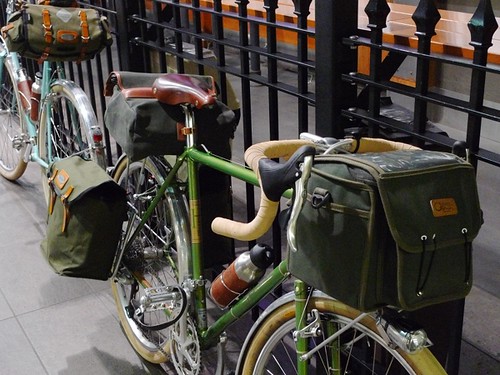 For a number of logistical reasons, we decided the most practical course of action would be to turn one person into the pack mule - and since I already had a front rack and a large handlebar bag on my bike, it made sense that this would be me. I had planned to eventually get a touring-specific rear rack for my Rivendell anyway, and so that is what I did. Between the two of us, we packed a total of five bags for the trip - four on my bike and one on the Co-Habitant's.
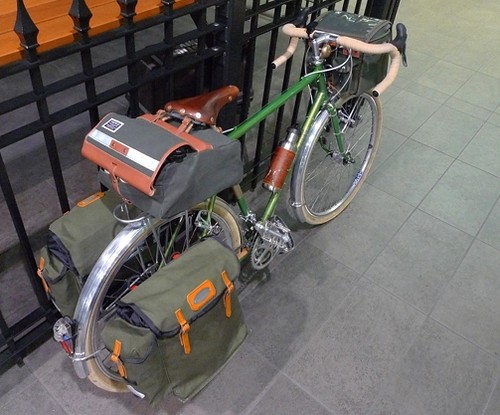 The rear rack on my bike is a Nitto Campee with removable lowrider panels, to which we attached a set of Carradice panniers, while using the rack's platform to support a Sackville SaddleSack. These bags plus the Carradicesaddlebag on the Co-Habitant's Surly contained our clothing, bedding and laptops. My Ostrich handlebar bag contained camera equipment, electronics and various other miscellaneous items. Everything was packed very tightly, and I estimate that my bicycle weighed around 100 lb when all was said and done.
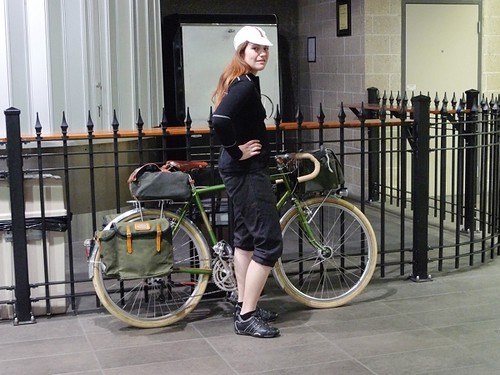 The ride to the train station from our house is 4 miles through some of the busiest parts of the city. I have never ridden with my bike loaded up like this before, and the prospect of trying it for the first time in Boston traffic was nerve-wrecking. Overall, the bicycle handled fine. Once it got going, I could not feel the weight at all, and the heavy handlebar bag did not affect steering. But at very slow speeds - especially when starting and stopping - there was a fishtailing effect in the rear that took some getting used to. Also, with so much weight on the bike, the brakes were less effective than usual, which I had to keep in mind when stopping on a downhill. The frame itself had an interesting feel to it - as if it was "yielding" to the weight (mildly flexing?). The resulting ride quality was in some ways nicer than with the bicycle unloaded. Having survived this ride in traffic, loaded touring on the open road does not seem in the least daunting. Going slower than usual is, of course, a given - but the reduction in speed was not as drastic as I thought it might be. Even cycling uphill (which I got to experience once we arrived to Cape Ann and rode from the train station to the place we are staying!) was not as difficult as I expected. Thanks to a helpful reader after my description of our previous commuter rail experience, we were able to board the elusive bike train, which made the trip more pleasant still.
 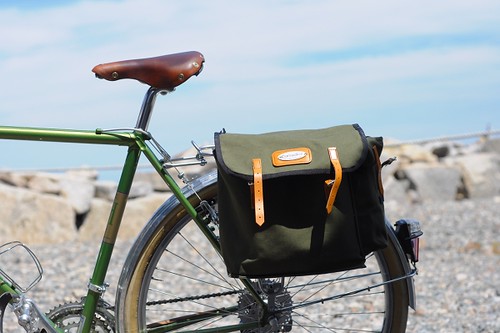 Once we arrived and settled in, we removed the lowrider panels from the rear rack, transforming my bike from a full-on pack-mule into a lighter ridethat could still carry food and equipment when necessary. I will write more about this particular rear rack in a separate post; it is pretty neat and versatile.
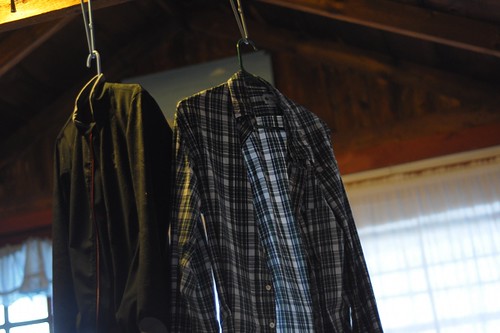 The place where we are staying is somewhere between a cabin and a shack on the architectural spectrum and is the size of a small garage. It is situated on a rocky cliff overlooking the ocean, and there is a beach down the road. Despite the stormy weather, we love being here - just the two of us and our bikes. Yesterday the sun finally came out and we did a 50 mile "warm-up" ride, hoping for more soon. And it feels great that we were able to drag all of our stuff up here without needing a car. It was important to us that this did not feel like a compromise compared to the previous times we've gone away, and it most definitely does not. We were able to fit everything we need into our bicycle bags, and not having to deal with a car here feels extremely relaxing. I highly recommend giving traveling by bicycle a try!
Ohio Research :: Joslin in Delaware County
In September .. I spent several days in Ohio. I didn't do hardly any new research, rather went mostly to cemeteries to obtain better photographs of my ancestor's gravesites, most which I had visited way back in 1986.
The first research stop in Ohio was on September 16th in Delaware (in Delaware County), to see what could be found on the Joslin family that I didn't already have. I really didn't think there would be anything new since my last visit in the late 1980s. At that time I had scoured the library and the courthouse. Cemetery records (yes). Land Records (yes). Estate Records (none). Way too early for death records. No church records.
I made it to the library shortly after they opened at 9 am. It didn't take long to look through their small collection of books. Nothing new, at least not related to the Joslins. But they did have microfilms of the newspapers, even those from the early 1800's. There were two items that had been abstracted and published previously (by Carol Willsey Bell in 1980 and Mary V. Reed in 1992) but I had never written to get the actual copies from the newspapers.
Printouts from the microfilms were terrible. Then I remembered a tip from Jasia about using your camera to photograph the microfilm reader screen. The results aren't great, but they are much better than the printed copies.
The first article was a notice by James Joslin in the Delaware Patron of Thursday July 13, 1826. The abstracts by Bell and Reed were slightly different but basically stated “Wife Abigail left my bed and board at Liberty township, will pay no debts.”
The actual article is a bit more verbose but does not really provide any additional information. From the Delaware Patron [Delaware County, Ohio] July 13, 1826: Abigail would have been pregnant with her second child at the time. Their first child, Lysander (my 3rd great-grandfather), would have been 14 months old. I still haven't found a marriage record for James and Abigail (Goodrich) Joslin but apparently their separation wasn't too long. They would have four more children, but then James disappears after the 1850 census, so perhaps, all was not well between them.
The other article that was published in abstracts refers to the death of Ruth Dyer Joslin. Both abstracts stated that Mrs. Ruth Joslin died on 27th ult, age 59 years. But the abstract by Bell (correctly) stated that she was the wife of Jonas while the abstract by Reed said she was the wife of Johns Joslin.
The article, from the Ohio State Gazette and Delaware County Journal:
Obituary. Died - - In Liberty township on the 27th ult, Mrs. Ruth Joslin, aged 59 years, wife of Mr. Jonas Joslin.
 The Delaware County Historical Society and the Genealogical Society have a combined Research Room that was open from 2-4 pm on the day I was there so I spent a pleasant two hours with them.
The Joslin Family cemetery had been destroyed when developers began constructing homes on the old farm. A few years ago, Jean Oldham Heuman had found the gravemarker for Ruth (Dyer) Joslin and donated it to the Historical Society. However, it is virtually impossible to get a good picture of the stone. It stands in the entryway of the museum along with several other stones. The light is poor and the space is dark. I tried with available light and with flash. Neither way really captured the inscription to my satisfaction.
 On the right is the gravemarker for Ruth (Dyer) Joslin.
 This is the best image I could capture of Ruth's gravemarker. It has been enhanced a bit with a little manipulation of the contrast and brightness. The inscription reads:
Ruth wife of Jonas
Joslin died Aug.
27, 1830 aged 59
Years
Most of the records held by the society were much too late for my family. Jonas is presumed to have passed away between 1850 and 1860 (he is in the 1850 census but not in 1860) and my James and Abigail had moved to Whitley County, Indiana by 1838.
The society did have the papers submitted by Mrs. Oldham and another lady for Jonas Sr. and Jonas Jr. for First Families of Delaware County. I looked through them but found nothing that I didn't already have that pertained to Jonas Sr. They did have a copy of the booklet that Mrs. Oldham had published on the two Jonas' and they allowed me to scan it to pdf rather than make a copy of it (Jean had told me she didn't think she had any more copies). At 25 cents a page, I was grateful that they allowed me to scan it.
Even though I found nothing new in Delaware County, it was still a worthwhile stop on my journey as I was able to obtain copies of previously abstracted records and get a complete copy of Mrs. Oldham's manuscript.
The first research stop in Ohio was on September 16th in Delaware (in Delaware County), to see what could be found on the Joslin family that I didn't already have. I really didn't think there would be anything new since my last visit in the late 1980s. At that time I had scoured the library and the courthouse. Cemetery records (yes). Land Records (yes). Estate Records (none). Way too early for death records. No church records.
I made it to the library shortly after they opened at 9 am. It didn't take long to look through their small collection of books. Nothing new, at least not related to the Joslins. But they did have microfilms of the newspapers, even those from the early 1800's. There were two items that had been abstracted and published previously (by Carol Willsey Bell in 1980 and Mary V. Reed in 1992) but I had never written to get the actual copies from the newspapers.
Printouts from the microfilms were terrible. Then I remembered a tip from Jasia about using your camera to photograph the microfilm reader screen. The results aren't great, but they are much better than the printed copies.
The first article was a notice by James Joslin in the Delaware Patron of Thursday July 13, 1826. The abstracts by Bell and Reed were slightly different but basically stated “Wife Abigail left my bed and board at Liberty township, will pay no debts.”
The actual article is a bit more verbose but does not really provide any additional information. From the Delaware Patron [Delaware County, Ohio] July 13, 1826:
Caution. Whereas my wife Abigail Joslin, has left my bed and board without just cause, therefore all persons are hereby, forewarned not to harbor or trust the said Abigail on my account as I am determined to pay no debts of her contracting after this date.
James Joslin.
Liberty, June 30th, 1826
320-3w
Abigail would have been pregnant with her second child at the time. Their first child, Lysander (my 3rd great-grandfather), would have been 14 months old. I still haven't found a marriage record for James and Abigail (Goodrich) Joslin but apparently their separation wasn't too long. They would have four more children, but then James disappears after the 1850 census, so perhaps, all was not well between them.The other article that was published in abstracts refers to the death of Ruth Dyer Joslin. Both abstracts stated that Mrs. Ruth Joslin died on 27th ult, age 59 years. But the abstract by Bell (correctly) stated that she was the wife of Jonas while the abstract by Reed said she was the wife of Johns Joslin.
The article, from the Ohio State Gazette and Delaware County Journal:
Obituary. Died - - In Liberty township on the 27th ult, Mrs. Ruth Joslin, aged 59 years, wife of Mr. Jonas Joslin.
The Delaware County Historical Society and the Genealogical Society have a combined Research Room that was open from 2-4 pm on the day I was there so I spent a pleasant two hours with them.The Joslin Family cemetery had been destroyed when developers began constructing homes on the old farm. A few years ago, Jean Oldham Heuman had found the gravemarker for Ruth (Dyer) Joslin and donated it to the Historical Society. However, it is virtually impossible to get a good picture of the stone. It stands in the entryway of the museum along with several other stones. The light is poor and the space is dark. I tried with available light and with flash. Neither way really captured the inscription to my satisfaction.
On the right is the gravemarker for Ruth (Dyer) Joslin.This is the best image I could capture of Ruth's gravemarker. It has been enhanced a bit with a little manipulation of the contrast and brightness. The inscription reads:Ruth wife of Jonas
Joslin died Aug.
27, 1830 aged 59
Years
Most of the records held by the society were much too late for my family. Jonas is presumed to have passed away between 1850 and 1860 (he is in the 1850 census but not in 1860) and my James and Abigail had moved to Whitley County, Indiana by 1838.
The society did have the papers submitted by Mrs. Oldham and another lady for Jonas Sr. and Jonas Jr. for First Families of Delaware County. I looked through them but found nothing that I didn't already have that pertained to Jonas Sr. They did have a copy of the booklet that Mrs. Oldham had published on the two Jonas' and they allowed me to scan it to pdf rather than make a copy of it (Jean had told me she didn't think she had any more copies). At 25 cents a page, I was grateful that they allowed me to scan it.
Even though I found nothing new in Delaware County, it was still a worthwhile stop on my journey as I was able to obtain copies of previously abstracted records and get a complete copy of Mrs. Oldham's manuscript.
Glacier National Park
It was mid-morning on Monday (July 26th) when I arrived at Glacier National Park. Since I didn't have reservations, the first order of business was to find an open campsite! Rather than stay at Apgar on the west side I decided to take a chance on Avalanche Campground, which is just before where the Going to the Sun Highway starts its climb to Logan Pass. Luck was with me once again and I got one of the last five sites still available!
 Lake McDonald on the west side of Glacier National Park. It was a hazy day with mist rising from the lake. This is from about half-way down the lake looking to the northeast, before you get to Avalanche Campground.
About four years ago Glacier National Park began running shuttle buses on the Going to the Sun Road. They aren't mandatory, but enough people use them to take some of the stress off of the parking areas, which are limited. In fact, the shuttles that I road were filled to capacity with people waiting for the next one. The do run frequently but with construction on the “Sun” road, the schedules are all out of whack.
As soon as I got settled into my campsite, I walked to the shuttle stop and took it to Logan Pass where there is a Visitor Center and trails. The trail I took that afternoon was to Hidden Lake. It is 1.5 miles to the overlook along boardwalk and snow...
 Note to Steve: Our shoes are made for walking, but not for walking in icy snow! I was slip-sliding all the way...
 The view to the northeast. Part of the Going to the Sun road is visible in the center of the picture.
 This is looking to the southeast.
 There were several small groups of Mountain Goats that frequented the trail area. They didn't seem to be afraid of people.
 The destination: Hidden Lake, looking south.
 Bearhat Mountain towers over Hidden Lake and environs.
 A bit of Hidden Lake and Bearhat Mountain on the left. Lake McDonald in visible in the distance in the center of the photograph. The trail from the overlook continues another 1.5 miles to the lake shore. Due to time constraints (having to catch the last shuttle back to the campground) I didn't go all the way down.
 The snow-covered trail on the way back to the Visitors Center.
Lake McDonald on the west side of Glacier National Park. It was a hazy day with mist rising from the lake. This is from about half-way down the lake looking to the northeast, before you get to Avalanche Campground.About four years ago Glacier National Park began running shuttle buses on the Going to the Sun Road. They aren't mandatory, but enough people use them to take some of the stress off of the parking areas, which are limited. In fact, the shuttles that I road were filled to capacity with people waiting for the next one. The do run frequently but with construction on the “Sun” road, the schedules are all out of whack.
As soon as I got settled into my campsite, I walked to the shuttle stop and took it to Logan Pass where there is a Visitor Center and trails. The trail I took that afternoon was to Hidden Lake. It is 1.5 miles to the overlook along boardwalk and snow...
Note to Steve: Our shoes are made for walking, but not for walking in icy snow! I was slip-sliding all the way...The view to the northeast. Part of the Going to the Sun road is visible in the center of the picture.This is looking to the southeast.There were several small groups of Mountain Goats that frequented the trail area. They didn't seem to be afraid of people.The destination: Hidden Lake, looking south.Bearhat Mountain towers over Hidden Lake and environs.A bit of Hidden Lake and Bearhat Mountain on the left. Lake McDonald in visible in the distance in the center of the photograph. The trail from the overlook continues another 1.5 miles to the lake shore. Due to time constraints (having to catch the last shuttle back to the campground) I didn't go all the way down.The snow-covered trail on the way back to the Visitors Center.
Friday, November 11, 2011
Underneath the Pavement
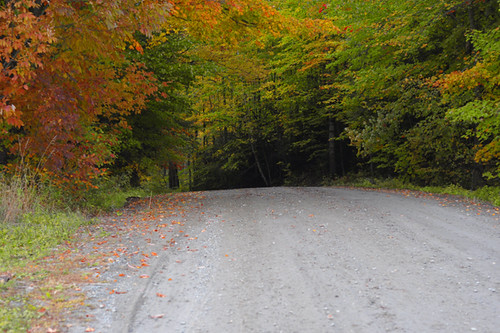
Though it's been a week since the Vermont Fall Classic, I still cannot post a report. My heart is too full; this is a ride that requires some emotional rest and distance before it can be put into words. But privately some of us have been discussing it, rehashing it, testing the accuracy of our own memories by comparing them against the memories of others'. And one topic that's come up is the quality of the dirt. A few of us noticed that it was differed from our local dirt, and different from the dirt we rode in previous events. At the D2R2 in Massachusetts and Southern Vermont, the unpaved roads were a dark brown earthy colour that turned muddy when wet. At the Kearsarge Classic in New Hampshire, the terrain was rocky. The dirt roads in Northern Vermont were a light grayish-tan, almost clay-like in consistency, dusty and tightly packed except for a thin top layer that was soft from the rains of previous days. When it began to rain again, this top layer turned liquid, but not muddy exactly. It was thinner than mud, less viscous. I was certain it was some type of clay. Others thought it was more sand-like. A rider who often cycles in upstate New York then described the dirt roads there, which are reddish clay and leave a pink residue over everything. Fascinated by these nuances, we admitted that we never gave them much thought until now.
All of this makes me realise just how unfamiliar so many of us are with the actual soil we live on. Paved roads have defined and homogenised our landscape for so long, that we hardly consider what lies beneath. Do most of us even know what our local streets would look like unpaved? The streets in the next town over? Can most of us determine what a particular type of soil is by looking at it or feeling it? I was in touch with these things when I lived in the countryside, had a garden, walked in the woods, but living in the city has distanced me from that awareness. Now cycling on dirt through different parts of New England has reminded me just how important it is. I'd like to learn more about our region's terrain, about what lies underneath the pavement. I don't ever want to lose that connection again.
On the Road to Memphis
Leave Nashville and continue on to Memphis stopping at Shiloh National Military Park


Completed in 1994 the double arched bridge that spans Birdsong Hollow received the Presidential Award for Design Excellance. It rises 155 ft above the valley and eliminates the need for spandrel columns.

Arrive in Memphis to rain but head down to Beale Street


The rain picks up so we pick up and get on one of the Trolleys for a quick tour of the town


Next Stop Arkansas!
Completed in 1994 the double arched bridge that spans Birdsong Hollow received the Presidential Award for Design Excellance. It rises 155 ft above the valley and eliminates the need for spandrel columns.
Arrive in Memphis to rain but head down to Beale Street
The rain picks up so we pick up and get on one of the Trolleys for a quick tour of the town
Next Stop Arkansas!
Subscribe to:
Comments (Atom)