Cotton is a major crop in southern New Mexico. But the drought didn't do the cotton crop any good this year. 1st photo is of cotton still on the plants that were dead at this time of the year. Most of the fields had already been harvested.
Stop worrying so much. Worry will not strip tomorrow of its burdens, it will strip today of its joy.
Monday, April 30, 2012
Cotton
Cotton is a major crop in southern New Mexico. But the drought didn't do the cotton crop any good this year. 1st photo is of cotton still on the plants that were dead at this time of the year. Most of the fields had already been harvested.
Saturday, April 28, 2012
La Sportiva Baruntse

As you mature there are times you just have to over look the stark beauty and amazing good looks of the crazy party girl that is really a raving mad, succubus just waiting to seduce you and then eat your liver while you watch and are still alive. It is bleak.....
The choice you learn to appreciate is the sweet young thing that knows how to be nice. treat you with respect and make your life better not just more exciting. And most importantly leave you wanting more after every rendezvous.
Weird way to start a boot review, hu? There aren't many things in climbing that can bring about such an emotional response from me....but boots....preferably good boots..will do that. Bad boots on the other hand my make a Succubus look good at the end of a long day out...liver or no liver.
Baruntse, the mountain, is best known as a "easier" 7000m trekking peak close to Everett in Nepal.
The La Sportiva Baruntse how ever, is an exceptional technical climbing, and very warm, double boot. You have to wonder just how many climbers are going to miss out on the Baruntse thinking is is the "little brother" not up to the same tasks as the more expensive Spantik simply because of foolish name branding and marketing?

From La Sportiva Italy:
"A thermal boot with removable bootie, ideal for winter mountaineering or working outdoors in cold conditions."
That sound like a technical climbing boot to you? Of course not!
Here is what La Sportiva USA has to say on the Baruntse:
"A sturdy, durable double boot for high altitude mountaineering
When the conditions are cold and high the Baruntse offers a hospitable climate to keep your feet warm and dry. Ideal for use on 6-7000 meter peaks or in harsh winter conditions where you don’t want to think about your feet. The thermo-formable inner boot sports the patented speed lacing system and couples with the highly insulated multi-layered PE outerboot for dependable warmth and a PU coating to keep moisture and cold outside and heat inside the boot.
WEIGHT: 44.7 oz/ 1267 g LAST: Nuptse CONSTRUCTION: Inner Boot: Slip Lasted Outer Boot: Board Lasted OUTER BOOT: Transparent PU Tech anti-abrasion film with high insulation expandied PE/ High density expanded PE insulating netting/ Synthetic mico-fiber/ High abrasion resistant Cordura®/ Giugiaro lacing hardware INNER BOOT: Anti-abrasion Cordura®/ Thermo-moldable 7mm high density insulating EVA INSOLE: 6 mm isulating Ibi-Thermo + PE insulating barrier and aluminum insulation MIDSOLE: 8-9 mm TPU/SBR Air Cushion SOLE: Vibram® Montagna"
But let me back up a bit. If you don't know of the La Sportiva Nepal Top or the newer Nepal Evo Extreme you should. I'll tell you why in a minute. What I really should be doing is adding all sorts of cool climbing photos to this blog post to make my point on how good the Baruntse really is. But I can't. Why not you ask? If these boots are so cool? Well to be honest I was having way too much fun actually climbing in them to bother with taking pictures this winter. And I used them a lot...no shit... that is a true story.

Back to the Nepals for a minute. If you like the Nepals you'll love this warmer version of them...and how they climb. Damn near every Chamonix Guide climbs in the Nepal Evo or Top.....hard to argue with success. The Nepal climbs exceptionally well , fits most feet even better and is durable enough you'll be forced to keep them around for a resole or two.
The Baruntse is just a warmer Nepal with all its advantages......that alone should get you to try this boot on. End of story.
Well not quite 'cuz this is a boot I really love. First time out in them I soled a 600' WI3.
Not all that hard for me back in the day. But hadn't been out in a while and had never been on the climb before and knew nothing about it. I was just along for the "ride". Did I mention i was taking pictures? I was taking pictures. But never noticed the boots....ever.
Which says a lot for the boot. My next outing in the same boot was a 100m WI5+. With a rope this time and a long pillar, Again never noticed the boot. I could pass some of that off as me being preoccupied on both climbs...scared shitless maybe, but I wasn't...preoccupied that is...may be scared a bit. But I would have noticed the boots that didn't perform at least as well as expected. The Baruntse climbed so well in both cases that I was able to take advantage, and notice, the extra support in the rigid sole, the even flex on the ankle cuff both forward, front pointing and side ways in French technique and even the extra warmth. What I didn't notice is the extra bulk or weight of a decent double boot.
It is no wonder, as the Baruntse is only 4oz heavier than a pair of Spantiks in my 45 size.
I can easily lace the outer shell as tight as required to support my narrow ankles/heels. Tight enough that I get ZERO heel left. Which is simply amazing and almost unheard of for me outside a custom boot. I like the really simple inner boot, that it was heat formable with printed directions that actually worked. And that it fits! And it does really fit well. Best of all I like that that the rigid soled and mid soles were very easy to fit every pair of crampons I own to the Baruntse...perfectly. Really...perfectly....every pair I own! They have a more normal width heel and less rocker front and back than the Spantik both of which makes a huge difference on the positive side when fitting crampons.
It is the one boot I own...or have for some time... that I don't want something drastically changed or improved on. Sure I would like them lighter and smaller...but they are warm enough and light enough and not too big in volume. All of which is saying a lot about this boot. I'd take these back to Denali in a second with no over boots and expect to summit even on a cold day in May with warm feet. I know they will make miles of hard Alaskan , 60 degree ice, easier. I know I can climb any grade of technical ice I can get up with the Baruntses on my feet. And enjoy it.
So screw the advertising and the usual questions of "why didn't you buy the Spantik" ....
If you are up to it, the Baruntse will take you BIG before going home. And that will be done with the least amount of effort. Which is all that is required.
Wednesday, April 25, 2012
Guadalupe Mountains
Wednesday, April 6th - - Continuing north on Texas Highway 54 about 60 miles from the town of Van Horn, you run smack dab into the south face of the Guadalupe Mountains!

This was still about 15 miles south. The mountain rises dramatically from the desert floor. The peak in the center is El Capitan, which has an elevation of 8,085 feet. Guadalupe Peak, the highest peak in Texas at 8,749 feet, is directly behind El Capitan. (As always, double-click on an image to view a larger version! It's worth the "extra" clicks!!)

US Highways 62 and 180 intersect with route 54 just south of the mountain. I traveled a short distance west on 62/180 to take the above photo.

Turning back to the east, highway 62/180 heads into the mountains. (This was taken as I was driving down the highway – not a recommended practice by the way - hence a bit of glare in the center of the picture.)

El Capitan as seen from Guadalupe Pass, which is at 5,420 feet.

The view from my site at Pine Springs Campground in Guadalupe Mountains National Park. Not quite as imposing as El Capitan but impressive nevertheless.
I had been told by one of the campers at Monahans Sandhills that even if I did no hiking, it was worth the drive to Guadalupe just to see the Mountains. I totally agree with that assessment.
I had also been informed that it was extremely windy at Guadalupe. In fact, that is the primary reason I didn't go there last year. And, yes, it was quite windy. The van was buffeted all night long as the wind howled through the mountains. They have some nice trails too (some even designated as easy), but I didn't do any hiking – too windy and the left leg is still bothering me.

This was still about 15 miles south. The mountain rises dramatically from the desert floor. The peak in the center is El Capitan, which has an elevation of 8,085 feet. Guadalupe Peak, the highest peak in Texas at 8,749 feet, is directly behind El Capitan. (As always, double-click on an image to view a larger version! It's worth the "extra" clicks!!)

US Highways 62 and 180 intersect with route 54 just south of the mountain. I traveled a short distance west on 62/180 to take the above photo.

Turning back to the east, highway 62/180 heads into the mountains. (This was taken as I was driving down the highway – not a recommended practice by the way - hence a bit of glare in the center of the picture.)

El Capitan as seen from Guadalupe Pass, which is at 5,420 feet.

The view from my site at Pine Springs Campground in Guadalupe Mountains National Park. Not quite as imposing as El Capitan but impressive nevertheless.
I had been told by one of the campers at Monahans Sandhills that even if I did no hiking, it was worth the drive to Guadalupe just to see the Mountains. I totally agree with that assessment.
I had also been informed that it was extremely windy at Guadalupe. In fact, that is the primary reason I didn't go there last year. And, yes, it was quite windy. The van was buffeted all night long as the wind howled through the mountains. They have some nice trails too (some even designated as easy), but I didn't do any hiking – too windy and the left leg is still bothering me.
Tuesday, April 24, 2012
Polar Rotation

My friend Roger (http://www.rogernordstromphoto.blogspot.com/) was just here for a weekend visit and we spent some time together photographing the stars on friday and saturday nights. Roger has been interested in learning more techniques for shooting stars, and since I shoot a fair amount of night-time images, he wanted to pick my brain a bit.
We are both armed with Canon 5D Mark II full-frame cameras, which means we have cameras that are capable of producing some stunning night images. While we didn't have the best skies for shooting stars (there were more clouds than I would have liked), we still came away with some fun images.
Sunday, April 22, 2012
An Update...
After having arrived at my friends place in Louisiana last Friday evening, I've been off the road for a few days. I'll be here for a couple more days but am planning to leave on Sunday. Even though it has been cold here (highs in the 40s and lows in the 20s) I'm thankful that I'm not further north and that I don't have to endure the snow and colder weather! And even more thankful for friends that provide a place to stay out of the weather!
I've been taking advantage of the “down time” to work on a little project... I've decided to “dismantle” my website. It has been more than two years since I've added anything new so I think it is time to let it go. The Whitley County pages are going to be moved to the website of the Genealogical Society of Whitley County (which is now at its new location on the web) and some of the family data will eventually be moved here to this blog. Yesterday, I finished modifications to the Whitley County pages and got them sent off to their webmaster.
Now I've got to consider how and when family information will be posted to the blog. There is my Grandmother's autobiography, a series of 30+ letters written to the Berlin family in the 1860s and 70s, and a lot of obituaries that I've transcribed. Those things will keep me busy for a while ;-)
But mostly, I'm just takin' it easy.... and thinking of warmer days...
I've been taking advantage of the “down time” to work on a little project... I've decided to “dismantle” my website. It has been more than two years since I've added anything new so I think it is time to let it go. The Whitley County pages are going to be moved to the website of the Genealogical Society of Whitley County (which is now at its new location on the web) and some of the family data will eventually be moved here to this blog. Yesterday, I finished modifications to the Whitley County pages and got them sent off to their webmaster.
Now I've got to consider how and when family information will be posted to the blog. There is my Grandmother's autobiography, a series of 30+ letters written to the Berlin family in the 1860s and 70s, and a lot of obituaries that I've transcribed. Those things will keep me busy for a while ;-)
But mostly, I'm just takin' it easy.... and thinking of warmer days...
Saturday, April 21, 2012
Low Trail Madness

While I've wished for this to happen, I doubted that it actually would: Low trail, 650B bicycles entering into standard production. But the day has arrived, and it arrived with an email from Soma Fabrications. An e-buddy of mine over there informs me that they will soon release a "Grand Randonneur" model, co-designed with Boulder Bicycles/Rene Herse."Is this public knowledge?" I asked, wiping the spray of coffee off my keyboard. Not really, was the reply, but I was welcome to make it such. "Just note that it’s still unofficial, and some of the details may change before production." Noted. Oh, and do I want to test-ride the prototype once it's ready? As if they had to ask.
The Soma announcement came on the heels of Rawland's release of the Stag: a model similar to the Nordavinden, only with slightly different specs. The pre-order pricetag is $625 including a free set of Pacenti PL23 rims. I imagine Soma will try to get its pricepoint in the same range. Adding the $500 Velo Orange Polyvalentto the mix, that gives us 3 manufacturers offering standard production low trail 650B framesets, made in Taiwan, for well under $1,000.
For those who prefer a US-made bike, there are several pre-fab models available in the $1,500 range, including the Box Dog Pelican, the Boulder Randonneur, and most recently the Rambler from Ocean Air Cycles.If you've ever wanted to try a bike like this without the wait, uncertainty and pricetag of going full custom, there are options.
But speaking of custom, more and more framebuilders are testing the waters with low trail 650B designs and some of the names may surprise you. As I write this, I am eying a fresh-off-the-boat prototype frameset from Mercian Cycles in England that was built to my spec. (For the record, they are skeptical of the low trail design, so if the bike doesn't ride well I take full responsibility.) Equally surprising is that Seven Cyclesare willing to give it a go, in titanium of course. Jokingly I asked them about it a little while ago, and the reply was "Let's talk."
So what's so special about low trail? In a sense, nothing, and that's sort of the point. Some of us simply believe it to be a "normal" geometry just like any other that happens to be useful in some contexts and beneficial for some riders. This does not mean that it's special or better, but only that we feel it ought to exist as a viable option. Personally, I've come to appreciate the feel of low trail on city bikes, as well as on fat tire bikes ridden on dirt; the combination of how responsive and at the same time intuitive these bikes feel intrigues me. But of course not everyone agrees. The husband tolerates low trail on his Brompton, because he finds the bike handy, but dislikes it on roadbikes. And framebuilder Mike Flanigan - tempted to try the Rawland after I raved about its handling - just smiled and shook his head after his ride: "Nope, still don't like low trail" - though he's made a few for customers, and continues to do so.
Is low trail design a fad that will seem silly in hindsight, or an enduring trend that is here to stay? We'll just have to wait and see.
Friday, April 20, 2012
Yosemite Falls
Monday, April 30th - -

The morning light contrasts sharply with that of late afternoon. The row of trees on the far bank of the river are the same trees that were in yesterday's photo.

Upper Yosemite Falls.

Upper and Lower Yosemite Falls.
Even though the campgrounds were full, there didn't seem to be many people out and about. Traffic was light and it was easy finding a place to park so that I could simply walk around the meadows in the valley and soak up the views.
On a previous visit in July .. I was able to visit Glacier Point (the road was still closed this time) and got soaked at Bridalveil Falls. This time I decided to walk to the base of Lower Yosemite Falls. The trail was nearly deserted, it was very quiet and peaceful - except for the roar of the water which got louder with every step along the path.

There was a hint of a rainbow at the bottom of the falls.

Out on the middle of the footbridge, the mist from the falls was the strongest as was the blowing wind. I got wet, but nothing like at Bridalveil Falls.

A dramatic view of both falls, which is somewhat deceiving as it looks as though the Upper fall is immediately above the Lower fall. But looking at the third photo above, you can see that there is a considerable offset between the two waterfalls. As always, double-click on the photos to view a larger version, then click again to get the full size.
In addition to the road to Glacier Point being closed, Tioga Road (Highway 120 through the park) was also closed so a visit to Tuolumne Meadows was out of the question. As much as I would have liked to do the hike that takes you to the top of Yosemite Falls, I didn't think my legs could handle the rugged, wet trail. Instead, I simply walked around the valley, had a picnic lunch next to the river, and enjoyed a wonderful, leisurely day.

The morning light contrasts sharply with that of late afternoon. The row of trees on the far bank of the river are the same trees that were in yesterday's photo.

Upper Yosemite Falls.

Upper and Lower Yosemite Falls.
Even though the campgrounds were full, there didn't seem to be many people out and about. Traffic was light and it was easy finding a place to park so that I could simply walk around the meadows in the valley and soak up the views.
On a previous visit in July .. I was able to visit Glacier Point (the road was still closed this time) and got soaked at Bridalveil Falls. This time I decided to walk to the base of Lower Yosemite Falls. The trail was nearly deserted, it was very quiet and peaceful - except for the roar of the water which got louder with every step along the path.

There was a hint of a rainbow at the bottom of the falls.

Out on the middle of the footbridge, the mist from the falls was the strongest as was the blowing wind. I got wet, but nothing like at Bridalveil Falls.

A dramatic view of both falls, which is somewhat deceiving as it looks as though the Upper fall is immediately above the Lower fall. But looking at the third photo above, you can see that there is a considerable offset between the two waterfalls. As always, double-click on the photos to view a larger version, then click again to get the full size.
In addition to the road to Glacier Point being closed, Tioga Road (Highway 120 through the park) was also closed so a visit to Tuolumne Meadows was out of the question. As much as I would have liked to do the hike that takes you to the top of Yosemite Falls, I didn't think my legs could handle the rugged, wet trail. Instead, I simply walked around the valley, had a picnic lunch next to the river, and enjoyed a wonderful, leisurely day.
Thursday, April 19, 2012
Fox Family

We finally saw the foxes! Jessica and I went to watch the den early this morning. After 3 previous unsuccessful attempts at seeing the foxes at various other times of the day, I was confident that being there first thing in the morning would give us the best chance. This time of year that means getting up pretty early. We left the house at 5:00 AM so we could be at the den in time for sunrise. We arrived at 5:40 and right away before we had even stopped the truck Jessica noticed one of the kits peeking out of the den. She only saw him for an instant. We waited maybe 5 minutes then he came out again and this time walked around a little bit. This was before either of the adults had come around. After 2 or 3 minutes the kit went back into the den and there was no activity for quite a while.

About 30 to 40 minutes later dad showed up with a piece of meat. We couldn't tell what sort of animal the meat was from, since it was just a hunk of flesh, but when he showed up two kits came running out of the den to grab the food. We only saw 2 kits, so that makes this a small litter unless there had already been others that didn't survive. For the next 45 minutes both kits were in and out of the den, chasing each other and playing. 4 times dad brought in pieces of food for them. The last time he came in with food, it was a huge rabbit. It still had all 4 legs attached, but it looked like the rump had been chewed off. The more aggressive of the two kits chased the other one away from the rabbit, then proceeded to tug at the meat and try almost unsuccessfully to drag the rabbit into the den by himself. At first he couldn't budge it but after several tugs managed to pull it inside the den. Once the rabbit and both kits were back in the den, dad took off for another round of hunting. We ended up with about a 45 minute show of fox activity. It sure was a fun way to start the day!
Wednesday, April 18, 2012
Gardens & garden books
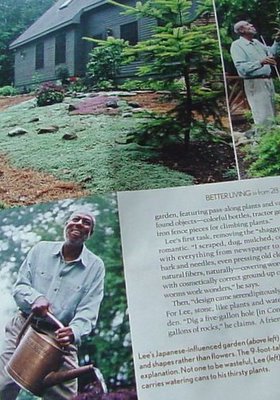
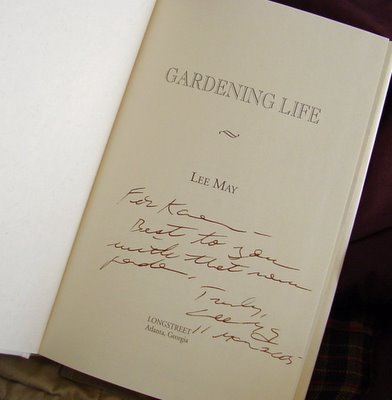
In March last year I wrote about attending the Alabama Master Gardener conference, where Lee May was the keynote speaker. (Don't ever pass up the chance to hear him speak - he's wonderful!)

What a nice surprise to open the February .. issue of Better Homes and Gardens magazine, to find a feature article with several pages of pictures of his gardens. (Mine's a subscription, but I believe it is still on newsstands - go buy one to see the other pics.)

I probably should not admit that both of the lovely books he autographed for me are still sitting on my "to read" shelf. I have not found a lot of time for reading in the past year.
Of course that does not stop me from buying more books.

(As an aside, I believe bookstores that perpetrate placing impossible-to-remove stickers on book jackets should be punished. Severely.)
As far as I know, Lee May doesn't blog... but Amy Stewart does!
Hopefully both my garden-book reading and our actual garden will fare better this year than last.
We've come to the conclusion that we must install raised beds if we're going to be able to grow anything at all. Our beautiful vegetable garden spot apparently lacks any sort of drainage whatsoever. So when it rains heavily, like it has for the past two years, the veggies tend to sit in water for quite a while.

Hubby resisted the raised bed idea for a while, because it means no more driving around on the tractor in the garden. But I think it's inevitable.
Now, will we have the time and the energy to devote to this project? Stay tuned...

What a nice surprise to open the February .. issue of Better Homes and Gardens magazine, to find a feature article with several pages of pictures of his gardens. (Mine's a subscription, but I believe it is still on newsstands - go buy one to see the other pics.)

I probably should not admit that both of the lovely books he autographed for me are still sitting on my "to read" shelf. I have not found a lot of time for reading in the past year.
Of course that does not stop me from buying more books.

(As an aside, I believe bookstores that perpetrate placing impossible-to-remove stickers on book jackets should be punished. Severely.)
As far as I know, Lee May doesn't blog... but Amy Stewart does!
Hopefully both my garden-book reading and our actual garden will fare better this year than last.
We've come to the conclusion that we must install raised beds if we're going to be able to grow anything at all. Our beautiful vegetable garden spot apparently lacks any sort of drainage whatsoever. So when it rains heavily, like it has for the past two years, the veggies tend to sit in water for quite a while.

Hubby resisted the raised bed idea for a while, because it means no more driving around on the tractor in the garden. But I think it's inevitable.
Now, will we have the time and the energy to devote to this project? Stay tuned...
Pinstriping Lugs on Your Bicycle
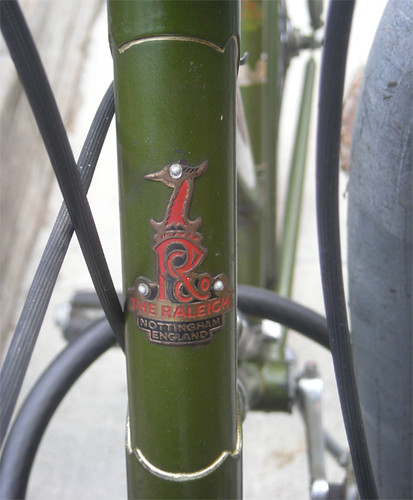
You may have noticed that on some bicycles, the edges of the lugs are attractively outlined in gold or in a contrasting colour. This treatment is called "pinstriping" and is done by hand after the bicycle's frame is painted. I like the look very much and decided to try it on my Raleigh Lady's Sport, in preparation for a more serious project. I was nervous, but it turned out to be easier than I expected. If you want to give it a try yourself, here is how:
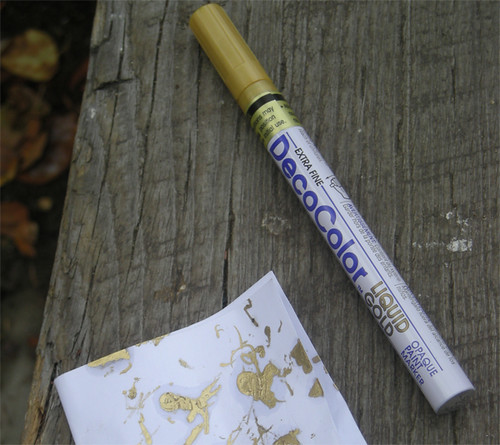
To go the truly professional route, you will need enamel paint and a pinstriping brush in the smallest size available. Having said that, I do not think these tools are necessary unless you are an experienced professional and are pinstriping a $3,000 frame with super-intricate lugwork. The enamel method can be difficult and messy, plus enamel paint contains led. Instead, I recommend a paint pen. Even professionals use these for simple projects. Several manufacturers make quality paint pens that are suitable for pinstriping bicycle frames, including Sharpie and DecoColor. Make sure the paint pen is oil-based. The label should explicitly state that it will leave permanent marks on metal surfaces. The size should be "extra fine". The price is usually in the $2.00 - $4.00 USD range.
The paint pen needs to be started by pressing down on the nib and pumping it several times - something best done on a piece of paper. When the paint flows through the pen slowly and evenly, you can begin.
Before starting the process, it is a good idea to clean the edges around the lugs and wipe them dry. Otherwise, your paint pen may get clogged with dust and grime. Once the area is prepared, simply begin to trace around the lugs with the paint pen, at a slow and even pace.
If the pen skips over a spot, go back and carefully re-trace that spot. If your hand shakes and you make an uneven line, or if the paint smears, wipe it off quickly with your fingertip or fingernail before it dries.
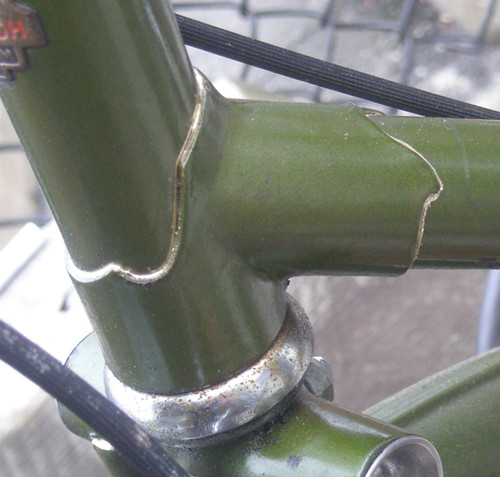
Once the paint dries, the marks you have made will be water resistant. If you notice a mistake after that happens, you can still get rid of it by carefully scraping the paint marks off with an exacto knife or a razor blade.
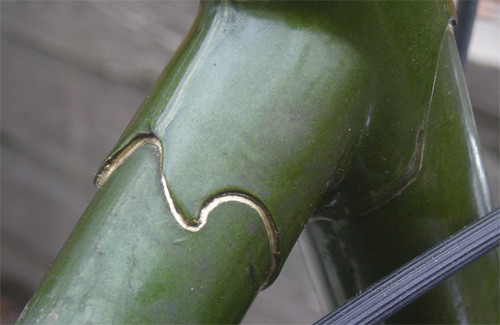
One issue you might encounter with rougher lugwork, is jagged edges. The lugs on my Raleigh Lady's Sports are quite crudely finished, and as you can see above, it can be difficult to make smooth outlines when the edge itself is crooked. But don't worry about that too much; these little details aren't noticeable unless you really examine the lugs up close. And I can assure you that the pinstriping on standard production vintage bikes is just as messy: Whoever outlined the lugs on my Motobecane at the factory did a sloppier job than my DIY.
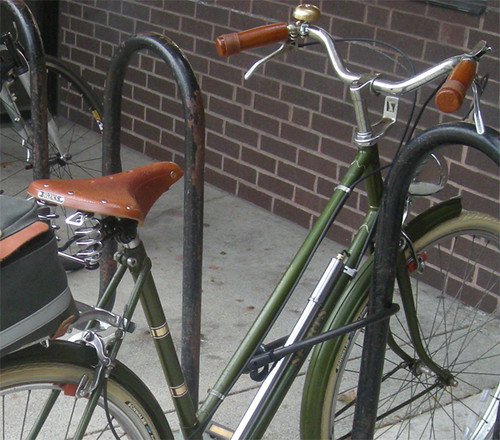
So really, don't be afraid to go for it. If you have an old bicycle you'd like to spruce up, pick up a paint pen and give it some nice lug accents.
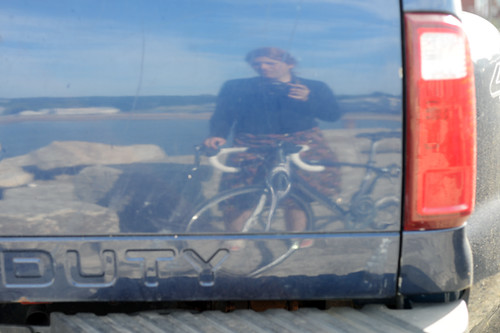
Driving As a Cyclist

Until last week I had not been behind the wheel of a car since 2007. ButI knew this day would come - the day I would want to drive again.
Over my years as a driver, the cars I've owned have always had automatic transmission - I never learned how to drive manual. When I mention this to an Irish friend, he shakes his head and roars with laughter. "Automatic!"He says it as if the word itself, used in relation to cars, is amusing in its absurdity."Automatic?! Okay, so you never learned to drive properly in the first place. Well come on - I'll learn ya!"
And just like that, I am in the driver's seat. I feel ready for this, looking forward not only to being behind the wheel after such a long time, but specifically to trying the manual gear-shifting. And the funny thing is - this enthusiasm comesfrombeing a cyclist, not in spite of it.

The 8 mile stretch of Benone Beach is like an unpaved extension of the road. Cautiously I maneuver the rickety Saab along the sand, my left hand on the gear shift knob, my senses heightened, trying to listen to the engine's sounds and feel the give in the clutch.
Things do not go as badly as I thought they might. I am not stalling out. I press the correct pedals. My hand is getting used to the positions of the gears, so that I can shift without looking. Operating the gear box makes sense, having gotten used to the concept and feel of gears on the bike. When the gear is too high, the car makes a straining noise - not unlike a cyclist grinding along at a painfully low cadence. When the gear is too low, the car feels as if it is spinning out, unable to pick up speed efficiently. It is not a perfect analogy by any means, but it is just enough to make sense. And I can feel that with some practice this will become intuitive.
I think of driving now differently than I did 5 years ago. Cycling is a very physical activity, and it has made me more viscerally aware of the mechanics involved in operating a vehicle. I think of driving as a serious skill, rather than a perfunctory action. When in the passenger's seatI now find myself more aware of the driver's technique and degree of control under different road surface conditions and speeds.Having worked so hard to learn how to handle my bike on winding mountain roads, I appreciate the handling skills involved in operating all vehicles - be they motorcycles, tractors or cars.Some of the people I know here are extremely skilled drivers, and I must admit that riding with them is exciting. I am impressed with the smoothness and precision with which they operate their complicated, heavy 4-wheel motorised vehicles. And if I do drive myself, I aspire to aim for the same degree of proficiency.
Monday, April 16, 2012
Exit Thursdays Gritscone ..
With our fearless leader Sammy out of town, we still had three people ready to go. Like previous weeks, we were to meet at the Park and Ride at 5pm. I arrived with Amy already waiting in the lot. After a few moments, she got a call from Greg stating he was stuck at work. She talked to her friend Dave to see if he was coming and he stated he would be arriving later after picking up his buddy.
Amy and I headed out with the intent of choosing an area en route and then relaying that information to Dave and Greg. We decided to go to the Gritscone since we did not have a guidebook. We knew the routes there and that they could easily be top-roped.
When we got there, we set about climbing the 5.7 route (So Funny I Forgot to Rope Up) on the far right to warm up. Amy and I both led it and then went to the left side to climb the 5.6 and 5.7 over there. I led the 5.7 (Snaffle Baffler) and Amy followed. She then led Lucky Arms (5.6) and I followed. By this time Dave and his friend arrived. They started with Chica Rapida (5.10a) and worked their way through the harder routes.
Amy climbing 99Grit
Amy and I went right again and did the same, although through lower grades. We both led Pete's Possum Palace (5.7) and then I led 99 Grit (5.9) and Amy followed. To finish the evening, I led Chica Rapida where I had to hang a bit on the third bolt to figure out the following moves. Amy followed the route and we called it a night.
Cleaning the anchors on Chica Rapida
It was nice to get out again on Thursday evening. It was interesting to get back to the Gritscone. I had climbed there only once before, and that was when I first started to lead. So I got to do a whole bunch of routes that I hadn't done previously and remembered why it isn't so fun to climb at the Grtiscone. Lots of dirty, mossy, pine needled holds. Being in the trees, it also does not lend itself to climbing in the evenings as it is already a darker place. While I lead 5.9 and 5.10 in other locations, last night marked the first time where I have led a 5.9 or 5.10 at Exit 38. I finally think I am overcoming the difficulties I have with climbing there.
Amy and I headed out with the intent of choosing an area en route and then relaying that information to Dave and Greg. We decided to go to the Gritscone since we did not have a guidebook. We knew the routes there and that they could easily be top-roped.
When we got there, we set about climbing the 5.7 route (So Funny I Forgot to Rope Up) on the far right to warm up. Amy and I both led it and then went to the left side to climb the 5.6 and 5.7 over there. I led the 5.7 (Snaffle Baffler) and Amy followed. She then led Lucky Arms (5.6) and I followed. By this time Dave and his friend arrived. They started with Chica Rapida (5.10a) and worked their way through the harder routes.
Amy and I went right again and did the same, although through lower grades. We both led Pete's Possum Palace (5.7) and then I led 99 Grit (5.9) and Amy followed. To finish the evening, I led Chica Rapida where I had to hang a bit on the third bolt to figure out the following moves. Amy followed the route and we called it a night.
It was nice to get out again on Thursday evening. It was interesting to get back to the Gritscone. I had climbed there only once before, and that was when I first started to lead. So I got to do a whole bunch of routes that I hadn't done previously and remembered why it isn't so fun to climb at the Grtiscone. Lots of dirty, mossy, pine needled holds. Being in the trees, it also does not lend itself to climbing in the evenings as it is already a darker place. While I lead 5.9 and 5.10 in other locations, last night marked the first time where I have led a 5.9 or 5.10 at Exit 38. I finally think I am overcoming the difficulties I have with climbing there.
Friday, April 13, 2012
Pictured Rocks National Lakeshore
Thursday, August 4th - - Unless you want to travel on back-country dirt roads, the route to Pictured Rocks National Lakeshore takes you south, then west, and then back north to County Highway 58, which follows the shoreline of Lake Superior for a few miles then takes you back inland. The drive reminded me of the route through Canada last August on the Alaska Highway – curves and hills midst a tree-lined road, with nothing in sight except more trees!
One of the first stops within the National Lakeshore is Au Sable Point where there is a very nice, but not very photogenic cascading waterfall. Too much contrast with bright sunshine and heavy shade. If I was into HDR (High Dynamic Range) Photography, this would have been a good place to experiment with it.
A short distance down the road was a place called Log Slide Overlook. A flyer picked up at the waterfall trail said of the Log Slide: “The 1,000 foot trail to the viewing platform from the picnic area is worth the walk. Newspaper accounts tell of logs sent down the dry log chute generating enough friction to cause the chute to catch fire. Today the chute is gone, but the lumberjack stories still linger as you gaze out over the Grand Sable Banks and Dunes.”

A short walk on a very well manicured path leads you to a small sand dune, about 25 feet high. This is the view from the top, overlooking Lake Superior. What you can't see is that beyond that opening is a 500 foot drop to the water's edge!
Perhaps “drop” is a bit dramatic, but a nearby sign states that the distance from the top of the dune to the lakeshore is 500 feet with 200 feet being nearly vertical. It also states that it takes only a few minutes to get to the bottom but can take an hour or more to climb back up!

The view looking to the east toward Grand Marais.

This is the view looking down toward the lakeshore, 500 feet below.

And this is the same view showing some rather energetic and youthful people near the bottom of the dunes. Provides a bit of perspective, doesn't it?
Needless to say (but I'll say it anyway), I did not even attempt this feat. I was pretty sure the old legs would give out on the way down and if they didn't the heart and lungs would get quite a workout on the way back up!
One of the first stops within the National Lakeshore is Au Sable Point where there is a very nice, but not very photogenic cascading waterfall. Too much contrast with bright sunshine and heavy shade. If I was into HDR (High Dynamic Range) Photography, this would have been a good place to experiment with it.
A short distance down the road was a place called Log Slide Overlook. A flyer picked up at the waterfall trail said of the Log Slide: “The 1,000 foot trail to the viewing platform from the picnic area is worth the walk. Newspaper accounts tell of logs sent down the dry log chute generating enough friction to cause the chute to catch fire. Today the chute is gone, but the lumberjack stories still linger as you gaze out over the Grand Sable Banks and Dunes.”

A short walk on a very well manicured path leads you to a small sand dune, about 25 feet high. This is the view from the top, overlooking Lake Superior. What you can't see is that beyond that opening is a 500 foot drop to the water's edge!
Perhaps “drop” is a bit dramatic, but a nearby sign states that the distance from the top of the dune to the lakeshore is 500 feet with 200 feet being nearly vertical. It also states that it takes only a few minutes to get to the bottom but can take an hour or more to climb back up!

The view looking to the east toward Grand Marais.

This is the view looking down toward the lakeshore, 500 feet below.

And this is the same view showing some rather energetic and youthful people near the bottom of the dunes. Provides a bit of perspective, doesn't it?
Needless to say (but I'll say it anyway), I did not even attempt this feat. I was pretty sure the old legs would give out on the way down and if they didn't the heart and lungs would get quite a workout on the way back up!
Laughing Lizard Cafe
The Laughing Lizard Cafe in Jemez Springs, NM has been there for over thirty year that I know of. But I think it has changed hands several times. It sits right on the main road almost in the middle of town. We have eaten there a few times and it was excelent food. They have a few rooms for rent but I've never heard anything about them.
Thursday, April 12, 2012
Wordless Wednesday :: Pot of Geraniums
Pot of Geraniums. Columbia City, Indiana. September 11, ...Copyright © .. by Rebeckah R. Wiseman.
Friday, April 6, 2012
Lovely summer day on Lucille Island

Today Lake Superior displayed an incredibly calm mood that is rarely seen. I couldn't pass up the opportunity the lake was presenting, so I headed out in my boat and spent the day photographing and exploring the islands that are near my home. In the afternoon some really nice clouds started to show up. Adding a polarizer filter to my lens really helped to accent the clouds as well as cut the glare from the water, so the shallow rocks and reefs could really show up in the images. It was an incredible day to be on the water!
Thursday, April 5, 2012
Remembering Joe Puryear
Last Wednesday, October 27th we received tragic news that friend and former climbing ranger Joe Puryear lost his life while climbing Labuche Kang, a remote peak in Tibet. His partner on the climb was David Gottlieb, a current climbing ranger.
This loss has deeply affected everyone in our community. Joe was an incredible person and he will be greatly missed. Our thoughts are with Joe's family and with David, as he continues to deal with this situation in Tibet.
To read more about Joe's incredible life and climbing adventures please visit his website.
This loss has deeply affected everyone in our community. Joe was an incredible person and he will be greatly missed. Our thoughts are with Joe's family and with David, as he continues to deal with this situation in Tibet.
To read more about Joe's incredible life and climbing adventures please visit his website.
Subscribe to:
Comments (Atom)