This is on the road to Jemez Springs. A few weeks ago there was a rockslide from this ridge. You can see the lighter color where the rocks slide down the ridge. There is the house on the left and another hid in the trees at the bottom of the ridge. I took photos from a parking lot across the road where a small store is. That must have been a lot of noise and very scarey for those living there. On the left side of the photo on the second layer of rock ledge there was a small slide about 20 years ago. We noticed it when we drove up one day and the scar was still fresh then.
I do not remember this large fountain being in the Patio Market the last time I was here but it looks like it has been here forever. Inside of it somewhere was a pump that kept the water constantly circulating so that it looked like the bucket was always spilling water out.
Sunday, September 19th - - It was a delightful day that was spent with one of my favs – Miriam Midkiff of Ancestories :: The Stories of my Ancestors. Miriam has already written about our day but I just wanted to add that it was my pleasure to be able to spend some time with her - to get to know her a little better and to meet her son and husband. Her son, being a teenager, didn't have much to say but her husband and I had several engaging conversations while Miriam was off doing something else. The pot roast was delicious. It was very nice to have a home-cooked meal for a change!
Miriam Robbins Midkiff and Becky Wiseman. Photo taken September 19, .. by her husband. Even though I knew that Miriam and I probably wouldn't get together until Sunday, I arrived in Spokane about mid-day Friday. I had decided that this would be a good opportunity to have a couple of “down” days. I had to tend to some errands – get the oil changed in the van, laundry, grocery shopping – you know, things that “normal” people do on a regular basis ;-)
I also took advantage of having electricity at the RV park to work on the photos from August on the netbook. I don't normally stay at commercial RV parks (or resorts, as this one was called) because they usually resemble parking lots. But for some reason the state of Washington closed the campgrounds in some of its State Parks in mid-September so I had no alternative. This particular RV resort was actually kind of nice. There were some trees and bushes in between each parking space, which provided some degree of privacy. A rarity in an RV park! They also had wifi available but I kept getting kicked off the network after about 15 minutes online. Luckily there was a McDonalds across the street...and their wifi worked great.
My stop-over in Spokane was a nice break in my journey. Several tasks were accomplished and I got to spend some time with a friend. Thank you, Miriam! And I look forward to our next visit, someday!
Had a pretty cool experience at work today, there was a Snapping Turtle that walked right across the main sidewalk in front of our visitor center, then through the woods and down to the Pigeon River. We were guessing that she had probably come up away from the river in order to lay her eggs in the soil somewhere near the visitor center.
Columbia City Post, Whitley County, Indiana Tuesday ~ September 2, 1952
Thursday, September 4, will be the 60th wedding anniversary of Mr. and Mrs. Henry Phend of this city. The event was observed Sunday while the daughter, Mrs. Bernice Holderman of San Gabriel, Calif., could be home to have a part in the family observance. The eight children of Mr. and Mrs. Phend were all present for the event.
On Thursday evening the Evangelical United Brethren church will give a dinner at 6:30 o'clock in honor of Mr. and Mrs. Phend and members of their family. Mr. and Mrs. Phend have long been closely associated with the local church and Mr. Phend has long served as a member of the Board of Trustees.
Seventy-five people attended the dinner at noon which was served on the lawn. In the afternoon 150 guests called between 2 and 5 o'clock. The large anniversary cake, in white and decorated in gold and pink, formed the decorative note of the serving table.
Mrs. Phend, bride of 60 years ago, was attired in a white print marked with a purple design and on her left shoulder was pinned an orchid with a purple throat.
A Packard electric organ provided music and vocal music was furnished by Mr. and Mrs. LaMar Phend of Osceola, who have their own program on the radio entitled "Strolling Down Memory Lane." The couple were heard at the Republican Convention in Chicago.
Four generations were in attendance at the Platinum anniversary of Mr. and Mrs. Phend, who were showered with gifts of every description. A wrist watch, something Mrs. Phend has always wanted, was a gift from one of her children. Other gifts from the children included a pop-up toaster, an electric blanket and there were gifts of money. The Phend home was aglow with flowers that had been brought in by friends.
According to Mr. and Mrs. Phend it was raining on their wedding day. The couple was united in marriage, at the hotel in Nappanee owned by Mrs. Phend's aunt, by the Rev. O. L. Richart, a minister of the Evangelical United Brethren church. Two of the guests at their wedding 60 years ago were present at the anniversary observance Sunday. They were Ed Phend and Mrs. Clara Phend, cousins of Mr. Phend, both of Nappanee. Movies were taken during the day.
Since 1898 Mr. and Mrs. Phend have resided in Columbia City where Mr. Phend has long been known as a building contractor and where this summer he has served as an inspector on the Mary Raber School where classes were organized today for the first time.
All of the Phend children were in attendance at the wedding anniversary observance of their parents, also some of the grandchildren and great-grandchildren.Guests attended the event from Nappanee, Elkhart, South Bend, Fort Wayne, Goshen, Monticello, Larwill and Pierceton. The daughter, Bernice Phend Holderman of San Gabriel, Calif., left today for her home on the Golden State Limited out of Chicago, after a month's visit here.
Henry and Susie with their children: Rolland Victor "Vic" (my grandfather), Cecil, Russell, Paul, Bernice, Virgil, Gerald, and Don Phend. September 2, 1952.
Henry and Susie Phend with their great grandchildren, September 2, 1952. That's me on the left side, sitting on the ground. My brothers, Doug and Jack, are between me and Susie. Doug was 5, I was 4, and Jack was 3 years old. I wish I could say that I remember Henry and Susie, but I don't. I would have been 8 years old when Susie died and 10 when Henry died. Two years after this picture was taken Susie went into a Nursing Home after suffering a stroke and remained there until her death on April 29, 1956. In January 1956, Henry fell and broke his hip. He too was put into a Nursing Home where he resided until his death on July 10, 1958.
The Phend and Fisher family reunion met at the Weiss grove. A splendid dinner was enjoyed by all.
Officers for the ensuing year as follows. William Phend. Pres. Jacob Phend Tres. Ivy Wehrly Sec'y
Births since June 27, 1914 as follows. Emerson Rhodes Aug. 19 Warren Edwin Pletcher Jan. 30 Mary Alice Phend May 3 Ward Miller May 11 Blanche Evelyn May 4 Mary Elizebeth Manuel
The Phend-Fisher families gathered for a reunion in Elkhart County, Indiana almost annually from 1909 until 1943. Usually held at Nappanee, the events of the day were recorded in an old ledger book. Spelling has been retained as it was in the original though some punctuation and paragraph breaks have been added. To view all articles in this series click on the "Phend-Fisher Reunion Ledger" label at the bottom of this post.
As you may already know from the photo I posted last night, the sunset yesterday was nothing short of mind-blowing. The ice formations combined with the awesome clouds and colors in the sky made for a scene that I will never forget. After making several wide-angle images of the scene, I switched to my 100-400mm lens and made a few abstract images by isolating different areas of the ice. This area that you see here was different from the rest. Most of the ice was jutting up at all different angles, but in this area the ice was all laying more or less flat. Each piece was reflecting a bit of the sky. It was one of the coolest things I've ever seen in all my life of living along the shores of Lake Superior.
Happy Birthday! Thank you for everything that you are doing. It is appreciated very much. If it wasn't for you, I very likely wouldn't be on this journey. I love you. Aunt Becky. (Photos were taken in November 1976.)
Although there are plenty of complaints about the lack of bicycle parkinghere, my impression is that the greater Boston area is better than many places in this respect. There are bicycle racks all over shopping districts, outside post offices, libraries and prominent places of business, next to transit stations, throughout college campuses. But I notice that cyclists do not always choose to use the racks, preferring to lock their bicycles to alternative structures instead. There will sometimes be a rack that is almost entirely empty, and nearby there will be some bicycles locked to trees and sign poles.
The other day I saw a group of cyclists locking up their bikes outside a cafe - each one of them ignoring the racks and going for random other structures. I commented about it, and we had an interesting conversation. Here are some of the reasons they gave for not using the racks provided:
. Transportation bicycles with big tires, fenders and headlights don't fit some types of racks.
. The "tethering post" types of racks that are installed along sidewalks are often placed too closely to the road, and careless drivers can damage bicycles with their cars when parallel parking.
. Theseracks can also stand too closely to pedestrian lines of travel, and people bump into the parked bicycles when walking past them, sometimes knocking them over.
. Others lock their bicycles too closely to yours, scuffing or scratching it, or even knocking it over in the process.
. Bicycle racks attract thieves, since that is where they look for bicycles and where it is easy to get multiple bicycles at a time.
Some of these points reflect my own experiences. There are racks I cannot use, because my bike won't fit except locked to the very edge (a spot that is usually already taken by another bike with the same problem). And while this has not happened to me, I have seen cars hit bicycles locked to those individual racks they place along the edge of sidewalks. Pedestrians brushing against my bike and others' bikes scuffing it is less of a concern, because I don't baby my transportation bikes. And I had not given much thought to the possibility that bike racks could attract thieves.
While not all of these issues are solvable, they are worth addressing when installing bicycle racks. It's a shame when resources are spent to create racks that cyclists find unusable.
Those who love lugged steel bicycles arrive to that preference in one of several ways. Often they grew up with lugged steel. The look or concept of it either holds sentimental value or represents quality. Perhaps their dream bike - the one they'd see in the bike shop window every day on their way home from school- had distinct lugwork. Or else lugs are incorporated into a "they don't make'm like they used to" narrative. On the other hand, a person entirely new to bicycles might simply decide they like lugs - either for aesthetic reasons or perceived functional ones.
With me it was definitely the latter. I was born in 1979. The bikes of my youth looked like this. And as far as shop windows... Well, come to think of it, I don't even remember any bike shops around when I was growing up; bikes came from department stores.
I am trying to remember how I even learned what lugs were. I certainly did not know about them when I first got into cycling as an adult. Neither did I have an ingrained preference as far as frame material. Before I bought my first grownup bike, I rode a rentedaluminum hybridin Austria - which, frankly, I thought looked kind of nice. But it rode a little harshly, and when I mentioned this to the man at the rental place he advised that I buy steel - giving me a long, expert-sounding lecture about the benefits of steel over aluminum. This was among the things that sent me in that direction.
Fast forward a bit, and I remember standing at the Belmont Wheelworks bike shop, looking at a collection of hand-cut Peter Mooney lugs through the glass counterpane. Peter Mooney was the first custom framebuilder whose bicycles I saw in person, as well as the first builder whom I would meet face to face. I knew that the filigreed objects he made were those sleeve things I'd seen on some bicycles' joints. "Those are beautiful," I said. "Yeah, Peter makes his own lugs," replied the person at the counter. And I think that's how I learned what they were called.
So I went home and looked it up online. Until that point, the artist in me thought the sleeve things looked beautiful, but I had assumed they were entirely decorative - much like embellishments on furniture and porch railings. Now reading about them, I understood that they served as frame joints and were inherent to the frame's construction. I also found many articles and posts expressing the opinion that this lugged construction was "better" (stronger, more receptive to repair, requiring more skillful execution) than other kinds. This was even before I stumbled upon Rivendell(although it set the stage for Rivendell's appeal); this was coming from individual framebuilders and from vintage bike collectors, of whom I soon came to know a few personally. The argument seemed logical enough: Modern bikes, like everything else that's made now, were fragile and disposable. The traditional method was meant to last.And what made me particularly receptive to this argument was visiting bike shops and trying the different city bikes that were available at the time. The bikes that felt uncomfortable or seemed poorly made, happened to be welded.
This is all simplified of course. But it's not an inaccurate summary of how my preference for lugged steel came about. It wasn't a perspective I brought with me to the blog. But it developedpretty quickly within the first year of it.
Interestingly enough, the first stages of its unraveling had to do with aesthetics. I liked looking at bikes and spent a lot of time doing it, studying frames from different eras and different builders. I also live in an area where handbuilt lugged steel bikes are plentiful, which gave me in-person access to a lot of the custom work. One thing I began to notice, was that lugs and their various relations (fork crowns, reinforcer plates, dropout sockets, and the like) gave bicycle frames a certain aesthetic uniformity. Most framebuilders do not make their own lugs but purchase pre-fabricated sets, and there aren't many of those to choose from. And while some builders modify existing lugs to the point that the originals are not recognisable, most do not. Because of its visual distinctness, lugwork has a strong influence over a bicycle frame's aesthetic. And the more frames I looked at, the more I started to feel that the same generic details were dominating many framebuilds' work. I began to question what it was that I was actually appreciating: the creativity, the craftsmanship, or the pleasing shape of a $1 reinforcer plate? With fillet brazed and TIG welded frames I may not have cared for the look of the joints, but had to admit that the work seemed less constricted by pre-fabricated parts.
Around the same time that my thoughts started to flow in this direction, I began to encounter an increasing number of modern, well-made bikes that were not lugged and, in some cases, not steel. Demoingthe aluminum Urbana bike had a big effect on me. This excellent machine was nothing like the half-heartedly made bikes I'd grown weary of seeing in bike shops, despite using similar construction methods.The same could be said of the Paper BikeandPilenI tried soon thereafter, not to mention custom welded bikes by ANT, Geekhouse and Seven. The association I'd formed between construction methods and quality had been erroneous. The flimsy bikes I disliked were such because they were made and assembled poorly, not because they were welded.I still preferred the look of lugs, particularly unique lugs. But my appreciation for the other methods of frame construction grew.
The growth continued as I developed closer relationships with a handful of local builders and began to better understand their methods. With this, my sense of aesthetics shifted. When looking at a bicycle frame's joint, I now see it as an embodiment of the work and creativity that making it involved, of the opportunities and limitations that were created by the chosen method of construction. This does not so much overshadow the look, as it gives meaning to the look. And meaning informs our subjective judgments of beauty.
Having now tried my own hand at building a bicycle frame, my thoughts on lugs have gone through yet another iteration. When asked what I think of them, what comes to mind is that I appreciate them making brazing easier. I don't appreciate how time consuming they are to work with and the limitations they place on frame geometry. That reasoning is entirely devoid of aesthetic sentiment, which worries me a bit. I don't want to stop "seeing." And I don't think that I will; more likely I am just a little tired now, and still overwhelmed from having gone through the process so intensely and quickly.
I remember how, after welding two bits of steel together myself, I tried to pry them apart a couple of minutes later. The strength of the connection took me by surprise. It felt like fusion (which, of course, it was), whereas a similar joint, when brazed, felt more like it held together with very strong glue. This doesn't necessarily mean anything, I know. But I would like to learn more, and I would like to learn it firsthand.
Indifferent is a negative word, so I would not say I am now indifferent to lugs.I like lugs, particularly unique ones.One of my crazy dreams is to design and cast a lugset of my own some day. Until then... I sort of like it all, lugs included.
Last week Jasmine started barking like a crazy dog again. "There's an alien reptile here! Right here! Right here! Right here!"
This time I had to tie her up at a safe distance, since the turtle was jumping at her. Jumping and snapping. I've never seen a turtle move so fast.
If this is the standard for snapping turtle behavior, there really must have been something wrong with April's slow-moving visitor.
The new guy was a little smaller, decked out in about an inch of mud, and feeling very lively.
How to get a fiesty turtle out of a dog's range?
I'd heard stories of snappers grabbing a stick and holding on til sundown. He'd grab it all right, but would let go the moment I tried to lift him up. Didn't take too well to being herded with the stick either. (Got to see him jump at warp speed again though.) I eventually scooped him up with a long-handled shovel and relocated him to the other side of the fence. Heavy little sucker.
I found a site with pictures showing the difference between common snapping turtles (Chelydra serpentina) and alligator snapping turtles (Macroclemys temmincki). They show our visitor to be the former.
Maurice Hale Brubaker (known as Hale) was the youngest son of Malissa Joslin and William Brubaker. He taught at least one term at the Crow's Corner school in Smith Township, Whitley County, Indiana when he was 18 years old. This was still at a time when college degrees were not required for teaching. Hale's life was cut short when just 6 years later he died of pneumonia while attending Law School at Columbia University in New York. His death had a traumatic affect on the family. It was a shock to his parents but particularly his father who died a little over a year later.
The brief "biography" of Hale was written by his mother: "Hale died in N Y Dec 14 1910 aged 24y 6m & 27da he was in Columbia University a Law Student would have finished in May 1911 he was born in Troy TP Whitley Co graduated in common School when 13 & in high School 17 Taught School in Smith TP. was an active member in the First Baptist church & Sunday School after all God took him called him higher where he is at rest Mother"
Grade V: Ethel Herron, Jennie Gilbert, Rilla Boggs, Edward Gordon, John Fulk, Charles Gilbert, Jesse Rowland, Earnest McNeal, Herbert McNeal, Cyrus Griffith, Joshua Griffith
Grade III: Lottie Herron, Virgie Griffith, Frank Garrison, Howard Gilbert
Grade I: Opal Boggs, Millie Garrison, and a few more that were in the damaged portion
Chris Denny pretty much hits on all the high points of the new Arcteryx Aphix Hoodie in the video above. But you need to listen closely to what Chrisis saying and pay attention to the detailing he points out in the video to get the best impression from that 1 minute Arcteryx ad.
I am the first to tell you, I LOVE this new jacket. That doesn't happen often. I see a lot of expensive clothing. Few pieces really impress me or will I ever climb/ski in very much. The Aphix has impressed me. And I will be doing both climbing and skiing in this jacket. Not a common feat for any jackets I own.But I am also the first to tell you that the Aphix isNOT an Atom LT.I don't down hill ski in an Atom LT. It is not warm enough. I do use a Patagonia Nano Pullover skiing often enough though. Not being an Atom LTis both good and bad from my perspective depending on how you plan on usingthe Aphix.
There is no doubt the Aphix was specifically designed for something. You need to figure out where you canuse it best and if it was actually designed for you. Weird as that might sound. Unlike the Atom LT which just about anyone can appreciate right from the get-go. The uneducated (more like anyonepaying retail) might well hesitate on the Aphix for a few reasons.
This is what Arcteryz says on the hang tang if you bother to read it. "Intended use: a very warm mid layer for active use on frigid days."
Other tags say, "made in Bangladesh" and "this article contians NEW MATERIAL ONLY"."DWR treated for stand alone use." Seriously. Made in aMiddle East sweat shop by some really poor folk may be, but no recycled Primealoft Eco, milk bottles or pillows here!
"Lightweight insulated hoodie that can be used as a stand alone piece or as a cold weather mid layer. Inset panels of stretch fabric under the arms stop just above the hip for extended range of motion without compromising warmth. Stitched insulation is radiant Coreloft™ that traps heat. Well suited to cold dry conditions. Dropped hem positions jacket for maximum core protection; collar and hand pockets are insulated. Proficient at warmth and weather resistance."
From Arcteryx:
Technical Features
Breathable
Insulated
Compressible and packable
Wind resistant
Design
Stretchy side panels
Patterning
Articulated patterning for unrestricted mobility
Gusseted underarms
Hood Configuration
Insulated hood
Zippers & Fly Configuration
Webbing zipper pulls
Full front zip with insulated wind flap
Metal zipper pull on main zip
Cuff & Sleeves Configuration
Stretchy cuffs (ya, not really)
Hem Configuration
Drop back hem
Adjustable hem drawcord
Pocket Configuration
Internal chest pocket
Two hand pockets with zippers
But the REAL question is, "What specifically was the Aphix designed for?"
Arcteryx sez:
Style:
Mid-Layer-Sweaters Cold Weather
Funny how Arcteryx has finally adopted the term "sweater".
But I do see how the Aphix would be a good ski sweater.
Slim fit with alonger body and arms. All seem to be perfect for under a shell.
Atom LT Hoody compared to a Aphix Hoody?
Atom LT, Men's Large 416g / 14.5oz
Aphix, Men's Large 540g / 18.5oz
In a nutshell Dane sez:
* Aphix is longer (body and arms) than Atom
* Aphix is a slightly trimmer fit than Atom
* Aphix is more breathable than the Atom
* Aphix is NOT as stretchy as the Atom
* Aphix is 80g Coreloft, the Atom LT is 60g Coreloft
More from Arcteryx:
"At the heart of the Arc'teryx Men's Aphix Insulated Hoodie lies Coreloft insulation. This jacket compresses down easily so as not to waste valuable pack space, and side stretch panels give you ultimate mobility so you can reach for holds or reach out to plant a pole in deep powder."
Coreloft synthetic insulation is lightweight, and the insulation compresses and regains its loft quickly so you won't have to worry about cold spots after tightly packing this jacket
DWR coating shrugs off light moisture and precipitation so you can depend on this hoodie as a stand-alone jacket or a cold-weather mid-layer
Stretch side panels allow full range of motion at your core and underarms so you can reach or stretch without feeling held back
Cuffs stretch over light gloves in order to seal out the elements (good luck with that as there is no stretch in the cuffs)
Insulated hand pockets (the collar is not lined)
Aphix shell is: 40D nylon, lightweight, wind resistant mini ripstop taffeta
Atom Lt shell is: Luminara™—Stretch nylon ripstop fabric with wind and water resistant, air permeable PU coating and DWR finish.
Atom shell stretches. The Aphix shell does not. It is a big deal in these weight jackets. And the Luminara is likely one reason the Atom Series is so durable. I am not expecting much of a "mini ripstop taffeta". There is a spin on the language, "mini ripstop taffeta " :-) Who exactly in the Arcteryx marketing department came up with that copy after a longlunch? Either way don't expect the taffeta on the Aphix to shrug off the abrasion like the Atom Series of garments do. The Aphix you'll rip holes in undersimilar circumstances when you snag things on the shell. But the taffeta of the Aphix will make it easier to layer over. The slick taffetashell is a definite bonus if you are going to use it that way.
Aphix is 80g Coreloft, the Atom LT is 60g Coreloft
Vents on the Atom LT are made from Polartec® Power Stretch®
Vents on the Aphix are made from Helius™ a lightweight, breathable, stretchy, plain knit textile
Most importantly I think is Helius seems to breath better than Polartec Power stretch. But not becausethe Helius is a more breathable material it is not. Simply because the Helius is a lot thinner.
Likely 1/2 the thickness of the Polartec material used.
All the photos above and beloware of the Aphix Hoodie
The Aphix has 216 square inches of the vent material, from your wrist all the way down your side to just short of belly button level. 36"x 6". The Atom LT uses 156 square inches of vent material, arm pit down to waist level. 24"x 6.5"
The model's pants are the bright blue here.
Imagine the width of the stretch material under the arm on the Aphix from this picture.
There is a BIG difference in the amount of surface area coveredwith a breathable fabric on these two jackets. Fully 1/3 of the length of each arm is a breathable soft knit, Helius™, on the Aphix. The Atom Lt is full insulated 60g Coreloft in the arms.
Same side vents (dark blue material) on the jacket version of the Aphix
What ever the Aphix gained inwarmth with 20g more of Coreloft on the Atom LT it also gained even more in ability to vent/breath by the extra square inches in venting material. I noticed the lack of insulation in the arms during my first use of the Aphix on a mid 30F degreeday. It is easily noticeable just how much better the Aphix breathes than an Atom. If for no other reason that there is a lot more surface area not as well insulated on the Aphix. Great from technical climbing or a skin track...not so good for skiing down hill imo. Unless of course you added a shell.
For warmth? Until you cut the wind with a shell...it is going to be a toss up imo between an Atom LT and a Aphix. Add a shell and no question the Aphix will be warmer.
The Aphix's side panelstretch insulation islikely more wind resistant than the Atom's Power Stretch.But the Aphix material is also likely half the actual thickness of the Power Stretch. In the real world I find the Aphix material breathes better. And you'll feel the out side temperature/wind through it easier. There is more breathable material in the surface area of the Aphix to "breath better". Your arms aren't likely to ever over heat in the Aphix.The "hard finish" of the Helius material also seems to shed snow and rain better than the Power Stretch. But that observation is really a push. That difference is slight.
By comparison the hoods are the same in size andwith no adjustments. They work well enough with helmets. But it could easily be done better. They do make a wonderfully warm and puffy collar though when fully zipped up and the hood down.
Arcteryx makes the hoods all the other makersare judged by. I have to wonder how they can make such terribly fitting stand alone collars on their other jackets? Seriously, what is up with that?
The jacket's bottom hem draw strings are the same. Two, one on either side. Same nicely done wind baffles behind the main zipper on both jackets. The front zipper isn't. The Aphix zipper locks in place any where along the zipper line. The Atom's intentionally does not lock.
Pockets arepretty much the same. Two on the outside that are zippered, with one sided, back of thehand, hand warmer liners. And one internal chest pocket that is zippered. The Aphix has sewn zipper pulls.
Really long sleeves, no stretchy cuff on theAphix. Be sure to catch that typo in the Arcteryx ad if you are buying sight unseen because you'll be disappointed if you did not.Atom Lt has a normal length sleeve and nice stretch cuffs with a snug fit at the cuffon most anything. I like the Aphix cuffs but Arcteryx missed the detailing there imo. If I am wearing glovesthe cuffs just bunch up against the glove, may be not the best seal on a jacket/glove combo, unless you have a shell and Velcro cuffs over the top of both. My answer without a glove is tosimply roll them up. Yes, I roll them up, seems to work OK as hard as that might be to believe. Not the best solution on a expensive, nicely tailoredjacket.If theyhad beenstretchy even that long they would be golden, but they are not stretchy. Not a deal breaker but annoying enough everyone seems to have already noticed. The jacket is good enough though that some are simply having the jacket custom tailored with a new cuff. Costly at best, ugly at worse! No matter your ape index you won't pull these cuffs off your wrists once spread out to full extension.
The jacket 's hem is really long front and back. Below the tail bone in the back. Long enough in the front that I worry about ripping the zipper out skiing. Thankfully the elastic on the hem allows you to move the hem up a bit. But a snap and reinforcement there would have eliminated that worry. I have no doubt the Aphixwas intentionally designed that way. Seems I amobviously missing exactly what this jacket was specifically designed for. Under a shell most likely. And I do really like this jacket. But it will seldom go under a shell when I amusing it. It fits my needs well as a stand alone climbing piece in my "action suit". The over all fit in the body is almost perfect for me. That might have you ignoring thefew unmistakable nitson the design.
It works as a stand alone garment so well in the right conditions climbing. May be even better than the Atom LT. But, thankfully, it is not an full blown Atom SV either. So may be some ofthe Aphix design details are simply lost on me. And likely almost everyone else. Which begs the obvious question?
The long hem does make it really easy to tuck into a harness and keep it there though. I like that. The slim fit on the Aphix is perfect for me. Slimmer than the Atom LTs' cut for sure. The fit is what makes the other small issues, "small" for me. I really like the, hybrid "heavy sweaters" available in combos of 60/80/100g/m synthetic insulation weights with the morebreathable fabricssewn in where appropriate.
Aphix is one of the best yet even all the while being just a tiny bit funky. But then the Atom LT wasn't designed to use as the top of your cold weather "action suit" either. The Aphix might even do the job better. My bet is it will.
If you like what you have read and want to know morecheck out the detailed pictures and reviews on line here and else where:
My guess is Arcteryx will clean this jacket up a bit at some point. They willshorten the body some, fix the cuffs and shorten the sleeves. Not everything I'd want in a jacket that I climb or skiin. I'd like a slightly shorter body, a sturdy snap closure to beef upthe zipper. Atom LT cuffs added to the long sleeves and some lining at the collar for my chin. A slightly bigger hood with some adjustment would be on my wish list. How about moving those pockets up 5 inches or so to clear a harness completely or ditch them all together for Napoleon pockets instead since I am asking?
So before they mess this jacket up...my suggestion is if you like climbing in an Atom LT...check the Aphix out before Arcteryxchanges it drastically or simply ditches it completely.
On the main trail to the very tip-top of the Sandia Mountains is this paved walkway with handrails for safety. It was very windy on the day we were there and the railing and it was necessary for me to hold onto the railing. Others weren't but I needed to.
Sunday, September 18th - - It began 22 years ago as a good-natured spoof between two neighboring ranchers but, according to the Montana Bale Trail website, it has become a nationally recognized celebration and in .. was named as Montana's Tourist Event of the Year. I heard about it on the radio one day but as it was more than a two hour drive, I decided not to go. Then, looking at the map to determine my route to Glacier National Park, I realized I'd be going through the area.
A one-day “festival” of sorts held on the first Sunday after Labor Day, the two towns in the area (Hobson and Windham) have “special” events that day. There were reportedly 50 or so “am-hayzing” displays of hay bale sculptures, most created by local farmers and ranchers, along the trail (a 21 mile long loop on state highways 239 and 541 just south of U.S. Highway 87). Many of the hay bale sculptures remain for days and weeks afterward – lucky for me!
Most of the sculptures were named and generally included the word “hay” or “bale” in one form or another. The detail on many of them was rather incredible and ingenious.
I'm just Smurf'Hay.
Rise of the Planet of the 'Hay'pes.
Some were even more simplistic than this Toots 'hay' Roll.
But a lot of work went into this one. The sign in front of it said “Mudhay Days - May June”
It was one of the more elaborate sculptures.
Wild Bale Hickok was quite impressive though.
From his head...
To his toes boots.
But the one I thought was most impressive was “Hay-wo-Jima”
Proud to say Made in the U.S. Hay.
The wind had taken its toll on the soldiers, with the one on the right being almost blown over, but you get the idea...
It was a fun and interesting way to spend an extra hour or so on the long drive to St. Mary on the north-eastern side of Glacier National Park.


 Miriam Robbins Midkiff and Becky Wiseman. Photo taken September 19, .. by her husband.


 Henry and Susie Phend with their great grandchildren, September 2, 1952. That's me on the left side, sitting on the ground. My brothers, Doug and Jack, are between me and Susie. Doug was 5, I was 4, and Jack was 3 years old. I wish I could say that I remember Henry and Susie, but I don't. I would have been 8 years old when Susie died and 10 when Henry died. Two years after this picture was taken Susie went into a Nursing Home after suffering a stroke and remained there until her death on April 29, 1956. In January 1956, Henry fell and broke his hip. He too was put into a Nursing Home where he resided until his death on July 10, 1958.
  June 26, 1915

 Happy Birthday! Thank you for everything that you are doing. It is appreciated very much. If it wasn't for you, I very likely wouldn't be on this journey. I love you. Aunt Becky. (Photos were taken in November 1976.)
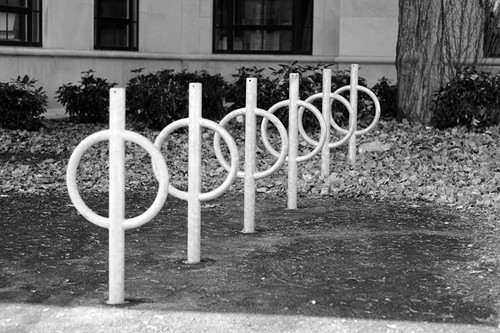 Although there are plenty of complaints about the lack of bicycle parkinghere, my impression is that the greater Boston area is better than many places in this respect. There are bicycle racks all over shopping districts, outside post offices, libraries and prominent places of business, next to transit stations, throughout college campuses. But I notice that cyclists do not always choose to use the racks, preferring to lock their bicycles to alternative structures instead. There will sometimes be a rack that is almost entirely empty, and nearby there will be some bicycles locked to trees and sign poles.
 The other day I saw a group of cyclists locking up their bikes outside a cafe - each one of them ignoring the racks and going for random other structures. I commented about it, and we had an interesting conversation. Here are some of the reasons they gave for not using the racks provided: