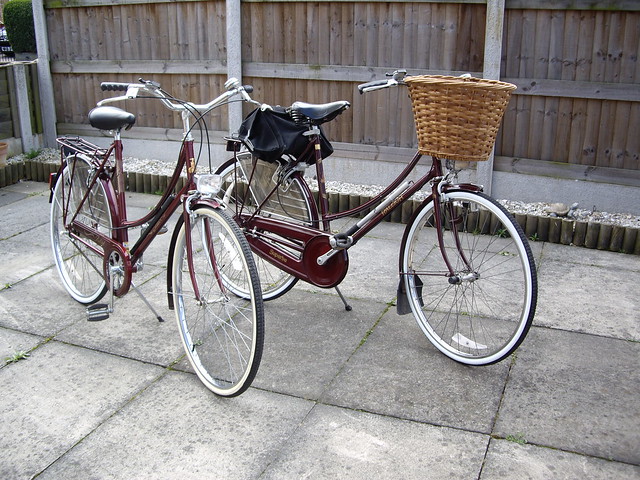
 [image vianiniferrose]
 In addition to the variety of comments posted on this website, I receive lots of questions from readers via email. And if I had to say what the one most frequently asked question is, it would be a variation of this one:
I am looking for a nice bicycle for commuting around town and my budget is $500. I would love to get a new Dutch bike or a Pashley, but I just can't afford it. What would you recommend in my price range?
Now, I do have a page on this website called Budget Options, and a link to it is prominently displayed in the upper lefthand corner. On that page I keep an updated list of manufacturers that sell budget versions of classic bicycles for as little as $150. I also have a page on shopping for vintage bikes. So, in emailing me the above question, the reader is usually looking for more than to be directed to one these pages. They are looking for my opinion: What would
I do with $500? What do I
recommend of all the possible options?
Okay, if you really want to know, I'll tell you. But I can almost guarantee that you won't like it and that you won't follow my recommendation. Do you want to hear it anyway? Well, all right. I would recommend buying a vintage 3-speed and spending the remainder of your budget on modernising it. Here is how I would do it:
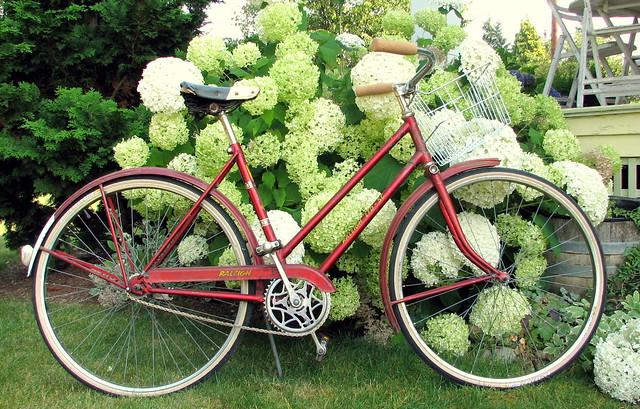 [image via Trisha Brink Design]Step 1:
Buy a vintage
Raleigh Lady Sports in your size and preferred colour. Make sure the frame is in good condition, and that as many components as possible are salvageable. Try to spend under $100 on this purchase, and absolutely no more than $150. It
is possible if you do some research and ask around. Even if there is a shortage of vintage bikes in your area, post a "want to buy" ad on your local C-List and chances are someone will dig one out of their basement or barn. Or join
bikeforums and a kind enthusiastic soul on the
Classic & Vintage subforum will provide you with some local contacts. It
can be done if you are motivated.
Step 2:Buy a modern 26" (ISO 590) wheelset with alloy rims and a 3-speed hub built into the rear wheel (the shifter is usually included). The biggest problem with using vintage 3-speeds for transportation, is that they have caliper brakes and steel rims - a combination that provides inadequate stopping power in wet weather conditions. An alloy wheelset will solve this problem. Several bike shops sell such wheelsets online at reasonable prices:A
Sunwheelset from
Harris Cyclerywill set you back $200. An
Alexwheelset from
Niagra Cycle Workswill set you back $130.Your local bike shop might be able to order a wheelset from a catalogue as well.
Step 3:Buy a set of 26" (ISO 590) tires with puncture protection.
Schwalbe Delta Cruisers in either black or cream are a good choice, because they look classic, make for a very comfortable ride, and cost only $40 for the pair.
Step 4:Assuming that you are not skilled in bicycle repair, maintenance or assembly, bring your vintage bike and all the parts to a trusted local shop. Ask them to replace the wheelset, put on the new tires, and give the bicycle a thorough tune up. They will probably end up replacing the chain and some cables as part of that process as well. It should run you about $100.
Step 5:If the vintage bike you found did not come with a saddle and there is room in your budget, get a
Brooks or a lower-priced
VO leather saddle. If you are tapped out, look for a vintage saddle, or buy a cheap generic one as a temporary fix until you save up the extra money for a new, quality one.
 [image via niniferrose]
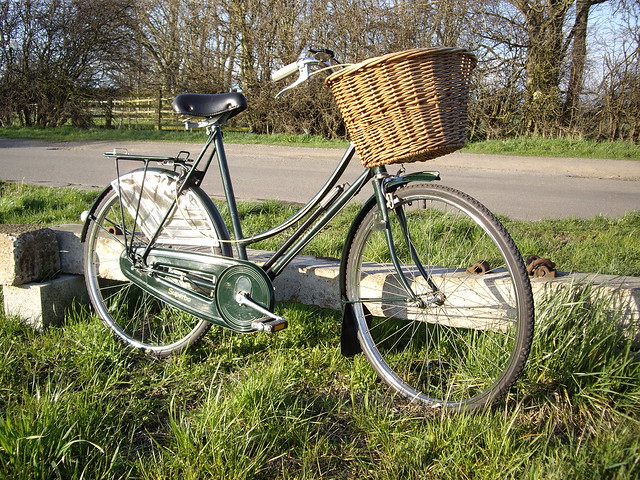
 At the end of this process, you will have a bicycle with all the comfort, durability and charm of a vintage 3-speed, but with modern braking power. It should last pretty much forever and should feel great to ride. Yes, organising the bike will be a small adventure - but again, it can be done if you put your mind to it.
Having said that, I realise that most of my readers will opt out. For one thing, it seems difficult and time-consuming. It also probably seems absurd to spend a total of $500 on a vintage 3-speed, when you could go to the store and get one of thesefor the same price, brand new and shiny. I sincerely understand that.But...
Consider that the second most frequently asked question I get from readers over email is a variation of this one:
Three months ago I bought a [Budget Manufacturer X] bicycle, because my budget was $500. Actually, I ended up spending a bit more than that, because I got the 7-speed version. And Basil panniers. And a Brooks saddle. And cork grips. But anyway, I thought the bicycle looked nice and I liked how it rode when I tested it outside the bike shop. But it's only been 3 months, and now my rear fender is making clunking noises, and my chain has come off twice, and I keep getting flat tires. Also, the bike doesn't feel that great over pot-holes and my hands start to hurt on the handlebars towards the end of my commute from work. My bike shop says that I can update some of the components to fix these problems, but it looks like that's going to cost me another several hundred dollars. I am not sure what to do now. What do you think?
I never know quite how to answer that one, because at that point the person has already maxed out their budget. Any suggestions? And yes, I am perfectly serious that I get these emails. I respect it when people say they are on a tight budget and I would like to be helpful with solutions instead of saying "save up for a better quality bike". But I honestly cannot think of a solution that I truly
believe in other than my vintage 3-speed plan. I have never received an email from anybody complaining about their vintage
Raleigh Sports.

 For perspective, there are people walking on the dune on the right side of this photo.


 Following the Bridge Flake
 Exit Glacier. So close, yet so far away.
 Two miles from the glacier the road was barricaded and a Ranger was directing traffic to the nearby trail parking lot. She said that there had been a tremendous amount of rain the past month over the glacier. It had gotten over 12 inches of rain on each of two different days! The glacier deposits silt in the river and as water comes down it carves new channels to get through that silt.
 The Alaska Railroad runs between the highway and Turnagain Arm.
 To the Southeast.
 And the Southwest.
 And the West.
 Fantastic!
 He's funny. I think. I'm nevercompletely sure.


 Jeff Lowe at the base of Metanoia. Alone, in the winter of 1991 overnine days of climbing he climbed throughbadweather, took a near-fatal fall and suceededin establishing the new route on the Eiger, Metanoia. Photo courtesy of Jon Krakauer
 Jeff at court and everyone including Mark smiling :)

 Friday and Saturday nights were relatively cold for Central Texas - down to 26 degrees F/minus 3.3 C. Before the freeze I hauled 4 potted roses and a few other containers inside the garage where the plumerias wait for spring.
  For the Meyer's Lemon planted next to the garage I tried a method I'd heard about from several sources - one may have been horticulturalist Skip Richter on Central Texas Gardener. In theory, the heat from mini-lights suspended under a sheet or floating row cover may be just enough to keep citrus from being killed by cold, without cooking or overheating the plant.
  A few hours later the sun had warmed the patio so I buzzed out to look at the camellia - the open flowers were frozen, but there's a good chance the buds will be okay. I counted at least 2 dozen buds still unopened. The flowers look interesting - like faded fabric flowers pinned onto a real shrub.
  I didn't like what I saw on the left end of that border - once again a branch on the 'Chindo' viburnum looks bad in spite of the zone 7 hardiness rating. More than half the original plant has died in the two years since it was planted, one limb at a time, always right after a dip into the twenties. This Viburnum awabuki 'Chindo' should have been a functioning member of the Green Screen team by now - maybe it's time to interview new candidates.
  As I passed the patio table I got the idea to first pull off some yellowed or black-spotted leaves, clip off dead twigs and remove dried tree leaves from the surface of the soil.
  Hmmm - with the leaves gone I could see a funny sort of depression in this container - aha! A squirrel planted a pecan about 6-inches down. It had begun to split open, ready to germinate.
 With dozens of seedlings popping up in every border we're not likely to run out of 'Coral Nymph', so the Cape Cod weeder is fetched to tease this one out before it overshadows the intended inhabitant.
  I'm pretty sure these pretty, fresh-looking leaves belong to Ranunculus. Julie of the Human Flower Project wrote a compelling post about these flowers in the buttercup family. Last fall I finally remembered to buy and plant a package of Ranunculus asiaticus.
  On the way back to the patio I stopped to admire more green leaves - they look similar because they're also in the Buttercup/Ranunculacea family - these leaves belong to Anemone coronaria - not the perennial anemones grown by Ki - but Windflower types sold in packages of corms in autumn.
  Back at the table I took a photo of the nuts, feeling that it was a good idea to be the bumblebee today, stopping to groom the roses and admire the tiny red leaf buds. If I'd kept walking the ant-trail with those pots, instead of roses there would soon be a pecan tree growing in one pot and an oak tree in the other. Darn it - the camera shut itself off before I got a good shot - weren't there some batteries in the desk drawer?
  Nope - no camera batteries in the desk drawer, but as long as I'm in the office I'll check email and oh, yeah - maybe google around and see if I can find out where to buy something called a concave cutter. Another gardener told me this bonsai tool would be useful for the kind of shaping I'm doing on the crepe myrtles. Maybe there's a source at the Austin Bonsai Society and ....oh look - here's a dealer in Pflugerville, not close but not a bad drive...and the shop is open now. Philo is interested enough in bonsai to go for a ride - just has to turn a pot of turkey soup down to simmer first.
  We find MBP Bonsai Studio without getting lost - and meet the owner of this charming place. Mike and Candy Hansen have studied bonsai for 35 years, first enjoying it as a hobby, then establishing their first bonsai studio 25 years ago. I buy just one tool, but notice wonderful pots, books and decorative items.
  I also notice Philo examining the array of tools and looking out at the plant nursery. He has "that look" - and I know we'll be back for another visit.
 Embracing the GADS enabled us to find this new tool, oust unwanted trees, meet a fellow gardener, discover an interesting place, and we bumblebees even remembered to buy batteries on the way home. This post, "Embrace the GADS!", was written for my blogspot blog called The Transplantable Rose by Annie in Austin.
