Saturday, September 28, 2013

Second Life: on Cycling and Aging

On My Own Two Wheels, by Malachi O'Doherty

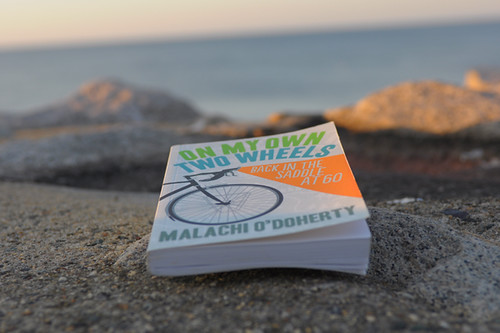
Reading On My Own Two Wheels by Malachi O'Doherty*, I am transported from the North Shore of Massachusetts back to the Antrim coast of Northern Ireland, where I spent some weeks on my bike this past Spring. The Belfast-based author describes many of the same roads I traveled on - the same challenging hills, treacherous weather and glorious scenery - making me long to return there even more than I do already.


But the main theme of the book - whose subtitle is Back in the Saddle at 60 - is that of the author's return to cycling after an absence of three decades, and of the relationship between cycling and aging. Overweight and diagnosed with diabetes at 60, Malachi O'Doherty turned to what had been a favourite pastime of his youth in attempts to regain his health and energy. What follows is a complex and engaging personal account that is part memoir, and part commentary on what it is like to ride again as a changed man in a changed world. It is no longer the 1980s and the author is no longer in his 30s. Confronted with a new breed of bicycles, high-traffic roads, newfangled cycling infrastructure, and a society where cycling is far from a normative behaviour, the author finds himself in a state that is a mixture of wonderment, disappointment, frustration, and delight.


On My Own Two Wheels is a personal narrative. It makes no generalisations, gives no advice, offers up no lessons to the reader. But I suspect the experiences described will be widely relatable. I would estimate that as many as a quarter of this blog's readers are middle aged men and women who had cycled in their youth and have recently gotten back into it, or are attempting to do so. I have met many such cyclists riding for transportation in Boston, and more recently at randonneuring and club ride events. I recall reading that the average age of a Paris-Brest-Paris participant is in their 50s.


There are some specifics in Malachi O'Doherty's story that I find intriguing. One is the way he faces changes that have taken place in the bicycle industry during his time off the bike. Of those who return to riding after decades of absence, many gravitate toward the type of bike that had been popular in their youth - seeking out vintage or classic machines, even taking pains to refurbish them with period-correct components. Some want to ride an exact replica of the bicycle they raced or toured on in their 20s or 30s. Others purchase the kind of bike they had dreamed of, but could never afford back in the day. But the author falls into the category that prefers a clean start and turns to contemporary industry standards. He went to a bike shop, asked for advice, and purchased a modern touring bike - fitted with brifters and clipless pedals in leu of the downtube shifters and toe clips he had used three decades earlier. The new aluminium bike is a size smaller than the steel bike of his youth. It handles differently. Far from feeling at home on the alien machine, O'Doherty nonetheless accepts the new technology and the challenges it presents. I get the sense that for him this is part of the deal: As fondly and nostalgically as he recalls the spirited rides and long touring trips of his 30s, reliving the past is not what he is after; he intends to start a new chapter.


Another choice the author makes early on is to stay away from the racing and club cycling cultures - or any particular bicycle culture, for that matter. He describes his preferred riding style as "tootling," or simply wandering around by bike. And yet, he notices contradictions in himself - competitive impulses and cravings for speed that seem to come out of nowhere and undermine (or enhance? it's not always clear) his experience of the two-wheeled journey. He relates these paradoxes in cycling to paradoxes in life. Perhaps cycling offers a means of understanding himself better.


At the time of writing this post I am 33 years old. What draws a person to the bicycle at the age of 50, 60, 70 and beyond I can only speculate. Some are motivated by health and fitness-related concerns. Others take it up as a hobby after retirement. For others still it seems to be a matter of nostalgia. But regardless of the motive, a not uncommon result is that cycling becomes more than just an interest, but a way of life. A "second life," as one local cyclist in his 70s put it, throwing a slender muscular leg over the top tube of his racing bike and giving me a meaningful wink: "I am in better shape now than I was thirty years ago and my mind is sharper." I believe him. Riding with some exceptionally strong cyclists in their 60s and 70s has made me look forward to that age in a way I hadn't done before. I'd like to be like them when I grow up.


----

*Malachi O'Doherty is an online acquaintance, and I am a great fan of his political books and commentary. A reviewer's copy of On My Own Two Wheels was sent to me by the publisher.

Fred Becky @ 90!


Is lifeall really just perspective and perception?


http://www.youtube.com/watch?v=O9d9Of1NJjs

Friday, September 27, 2013

'Tis Nevermore :: The Nevada Shoe Tree is Gone

In the high desert of Nevada, a large Cottonwood Tree stood for decades alongside a stretch of U.S. 50 near Middlegate, between Fallon and Ely. Known as The Loneliest Highway in America, it is now even more lonely because a local icon has been destroyed.


The Shoe Tree was introduced to you, my readers, in Redefining Shoe Tree. About a week ago I was contacted by a gentleman who wrote a song about the tree being cut down. He wanted to use the photographs from my blog post in a video tribute to the tree. I was truly saddened to hear of the demise of the Shoe Tree.


A Google Search turned up numerous articles about the old tree telling what is known of the incident and a little history of the tree.


A month ago, vandals pulled out their chain saw and cut the Shoe Tree down. No one except the culprits saw the deed being done. As it so happens, the Shoe Tree was on property owned by the Bureau of Land Management so if the culprits are ever found, they will face federal charges. The incident is still under investigation.


There is no understanding acts of vandalism. Nothing will bring the old tree back, but I hope that the culprits are caught and get the punishment they deserve!


The music video tribute by Chris “CW” Bayer has been posted on You Tube: Someone Cut the Shoe Tree Down.


Disclaimer: I have no business or other relationship to or with Chris Bayer. I received no remuneration from him for his use of my photographs. The video is simply a tribute to an icon and will not be for sale.

Tuesday, September 24, 2013

The Cliffs of Shore Acres


On this blustery winter's day with snow falling from the sky I find my thoughts wandering back to our mid-November trip to the Oregon coast and the beautiful weather that we encountered. Yes, it did rain as it so often does on the Oregon coast this time of year. But, we did also have some beautiful weather, as shown here at Shore Acres State Park near Coos Bay. Shore Acres is known for the massive ocean waves that frequently hammer the cliffs shown in this photo. On the day we visited, however, the ocean was about as calm as it gets. We would have loved to hang around into the evening to experience the amazing christmas light display that the park is also known for, but unfortunately we were a little too early in the season for that.

Acadia :: A Leisurely Carriage Ride

We had gone over to Wildwood Stables on Thursday (September 13th) to see about going on one of the carriage tours. The first available opening for "Mr. Rockefeller's Bridge Tour" was for 2:15 on Saturday, so we made our reservations.


Saturday morning dawned with gray skies and scattered showers forecast for the day. We crossed our fingers and hoped that the rain would hold off until after the carriage ride, but no such luck. It started sprinkling as we drove into the parking lot. It drizzled off and on until the beginning of the ride then rained steadily, but not a downpour, for the first hour of the two-hour ride. Rain jackets and ponchos were the apparel for the day!


The carriage tour is a good way to see more of the natural beauty of the park as well as admire the work that went into creating the carriage roads and building the bridges. The driver of the carriage was also the tour guide. We were sitting at the back of the carriage and I sometimes had a hard time hearing what he was saying, especially when he was facing forward rather than looking at his passengers.


It was an interesting ride, with tidbits of information about the construction of the roads and the history of the area.


The colorful underside of one of the bridges.


This bridge is located near the Stanley Brook entrance, on the southern side of the park. We drove underneath it several times on our way to and from the park.


The 'Stanley Brook' entrance bridge from the other side. A hint of fall color is showing as is a bit of blue sky.


The carriage roads are very well maintained.


This Cobblestone Bridge was the first of Mr. Rockefeller's bridges and was built in 1913.


Patiently waiting for the rest of us
to get on board the carriage to continue the tour.


By the time we returned to the stables, the sky had started clearing, the sun had made an appearance, and we were mostly dry!


Monday, September 23, 2013

The Sky is a Happening Place

Castle Rock, Cloudy Beach

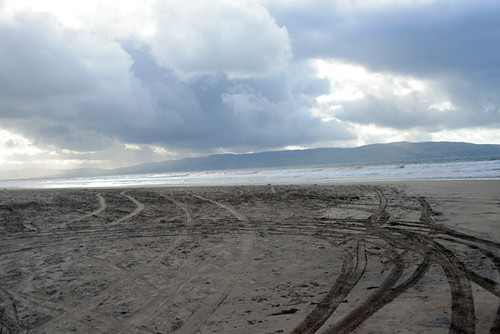
The thing about the weather on the coast of Northern Ireland, is not that it's good, bad, cold or warm, but that it changes rapidly and constantly. "Four seasons in a day," they say here.


But it's more than about changes in temperature and precipitation. The real action is in the sky. There is drama there - a celestial theater that I could stand and watch for hours. The cloud formations, like temperamental actors rushing about the stage, appear to feed off of each other's emotions. Plots thicken. Characters develop. Tempers fly. Action builds up toward crescendos. The end of an act can be explosive, or anti-climactic. Curtains close, then open again for the next act.


Here one cloud approaches another, pressingly, entreatingly. The object of its attention demurs. Like characters in a Chekhov play, they engage in a moody, fateful struggle. Tragically but also coyly, they dance over the peak of the mountain - back and forth, back and forth, until finally they collide - turning into a different creature entirely and swooping down to swallow the mountain whole. A roar of applause.


In my winter clothes I stand on the beach of Castle Rock on a June afternoon and watch all this, my bike propped against the stone wall. There are only two colours: beige and blue. There are only two entities: sky and earth. And in the moment, this seems like all there is, or ever was, or ever will be. It is more than enough.

Sunday, September 22, 2013

Pony Play


Both ponies playing together and talking to one of the other horses, Star.

Friday, September 20, 2013

Pristine, Pink, Breathless

That's what it was like on the mountain this weekend. I made it to Camp Muir Saturday, my first opportunity in over two months. Finally, time to survey the camp and search for possible storm damage (and test the snow conditions on the Muir Snowfield).
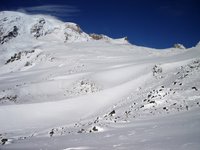
Things looked normal for early December. There was access to the public shelter, but the toilets were drifted in with deep snow. As for obvious signs of rain and wind damage, it seems that only the NPS suffered. We lost two storage boxes. The weather telemetry equipment for the NWAC appears to be working. It's my hope that once the power resumes at Paradise, the weather data will come back up online.

I was a bit surprised that there wasn't more snow cover between 7-11k. Everything looked wind scoured, i.e, lots of exposed rocks along the eastern edge of the Muir Snowfield, Cowlitz Cleaver, Muir Rock, etc. As for the upper mountain, the Nisqually Glacier looked very, very good. And while we're talking, so did the Nisqually Cleaver and Gib Ledges. Plenty of snow and ice in those rocky steep sections

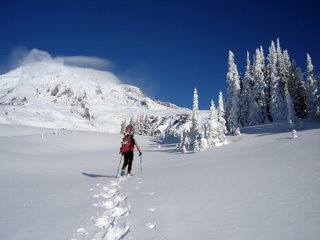
After surveying the camp, it was time to confirm the conditions on the Muir Snowfield. And it was just as I thought it would be: 4,500 feet of untracked packed powder, with a few rocky areas around McClure. As you can see, the mountain turned pink for our descent. Top photo by Ethan McKinley

JUST IN: The Camp Muir and Paradise weather telemetry data are back up. I hope they last! I know that they ran the generator at Paradise today.

Thursday, September 19, 2013

Miss Moose


Today we went up the Gunflint Trail in search of the cow moose with twin calves that seemingly everyone who has driven up the trail in the past month has seen. Unfortunately, we did not see them. I think maybe if the weather had cooperated and it had been nice instead of a torrential downpour we would have been more likely to see them. Oh well, you take what you can get. Luckily we did see another cow moose further up the trail and had the pleasure of watching her eating in a small marsh right next to the road. She hung out in the marsh for a long time and it sure was fun watching her from less than 50 feet away. Every time she dunked her head under water she would root around for some plants then come up and shake her head off. It was quite a comical sight I must say :-)

Sea Palms at Shore Acres State Park


During our recent trip out west we visited Shore Acres State Park, one of the best places along the Oregon coast to watch the ocean waves. As I was photographing the surf breaking over the near-shore rocks I noticed these little ocean shrubs that looked like miniature palm trees. I think they add a bit of whimsy to this photo.

Sunday, September 15, 2013

Hovenweep :: Square Tower Group

I found Hovenweep National Monument to be a fascinating place. Viewing the multi-storied towers perched on the canyon rims and balanced on boulders, I was amazed by the structures and by the people who had built them. Experts at masonry and engineering, the builders used the rock slabs for foundations and the walls of the structures were laid down over the uneven surfaces, rising, in some cases, to heights of several stories.

Why were they built on the rocks? Why were they built in a variety of shapes – squares, ovals, circles, and D-shaped? What was the purpose of the buildings? What happened to their builders?

According to literature from the National Park Service:
The towers of Hovenweep were built by ancestral Puebloans, a sedentary farming culture that occupied the Four Corners area from about A.D. 500 to A.D. 1300. Similarities in architecture, masonry and pottery styles indicate that the inhabitants of Hovenweep were closely associated with groups living at Mesa Verde and other nearby sites.

The ancestral Puebloans prepared their land for cultivation much like farmers do today. They created terraces on hillsides, formed catch basins to hold storm run-off, and built check dams to retain topsoil that would otherwise wash away. Storage granaries under the canyon rims protected harvests of corn, beans and squash for later use.

Many theories attempt to explain the use of the buildings at Hovenweep. The striking towers might have been celestial observatories, defensive structures, storage facilities, civil buildings, homes or any combination of the above. While archeologists have found that most towers were associated with kivas (Puebloan ceremonial structures), their actual function remains a mystery.

By the end of the 13th century, it appears a prolonged drought, possibly combined with resource depletion, factionalism and warfare, forced the inhabitants of Hovenweep to depart. Though the reason is unclear, ancestral Puebloans throughout the area migrated south to the Rio Grande Valley in New Mexico and the Little Colorado River Basin in Arizona. Today's Pueblo, Zuni and Hopi people are descendants of this culture.
The Square Tower Group, located in and around Little Ruin Canyon, which is a short walk from the visitors center, has the largest collection of ancestral Puebloan structures at Hovenweep. The remains of nearly thirty kivas have been discovered as well as a variety of other structures. They think that it is possible that as many as 500 people occupied the Square Tower area between A.D. 1200 and 1300.

The Stronghold House as seen from across the the canyon, from the south side.

These are the same two buildings in the previous photo, taken from a slightly different angle. Using the zoom distorts and compresses the view somewhat.

Two towers, looking northwest.

The same two towers, looking northeast.

Detail showing the stonework.

Hovenweep House, the largest structure in the area, along with several outbuildings. As seen from the south side of the canyon.

Hovenweep House, on the edge of the canyon. Looking to the east.

The Square Tower. Perched on a boulder, at the bottom of the west end of the canyon.

Ruins Canyon, looking east. The two towers are just below the rim of the canyon near the center of the picture. Several other structures dot the landscape, almost blending in with the boulders.

Photographs taken on May 19, ...

Thursday, September 12, 2013

Adios, Big Sky Country

And this is why they call it Big Sky Country!
The Crazy Mountains, dwarfed by the sky and clouds.

You may have noticed that things have been rather quiet here at Kinexxions. I've been busy with the photo project, which I'm happy to say has been completed. In the process I was able to free-up over 55gb of hard drive space on the netbook and have sent an external drive with all of the photos to a friend for safekeeping.

The ladies at the library have been very nice, helpful and friendly. The wifi has been wonderful and it is greatly appreciated. I've spent a couple hours there every day that it has been open.

Sadly, I haven't done as much sightseeing here as I would have liked. Which means that I'll probably have to come back... which wouldn't be a bad thing, it has been VERY NICE here. The weather has been pretty good. Most days there has been sunshine. In the evenings it seems to get a little cloudy. There have been a couple of rainy days, but not an all-day rain. Temperatures have been very pleasant – in the upper 70s and lower 80s with a couple of days in the low 90s.

The van has been emptied and cleaned and a few things were discarded giving me a little space for some of the things I'll need for the next portion of the journey. I'll be leaving here Sunday morning and heading North... through Canada and into Alaska!

Yes, Alaska! A place I've wanted to go to for a very long time... my friends Sue and Fred (the same folks who got me down into the Grand Canyon) notified me less than a month ago that they had added Alaska to their fall trip. I took advantage of their generous offer to join them anywhere along their journey so we're going to meet at Denali National Park for several days then go down to the Kenai Peninsula for a few days. I'll be spending additional time in that area while they head on over to the Inner Passage to Haines, Skagway, and Juneau. I'll be going there too, just not at the same time. And so, this is why I haven't done much sightseeing here in Montana! I've been spending a great deal of time at the library looking up information about activities and making reservations. There is so much to see and do! It is overwhelming.

I'm excited but nervous at the same time. It is a long drive but from what I've read, the roads through Canada and into Alaska are similar to our secondary roads here in the lower 48 so I'm not overly concerned about that aspect of the trip. It is just a very, very long ways away...

Canyonlands National Park :: Needles District

This area of Canyonlands is extremely remote. I saw few people there on the day I spent in the Needles District. Unless you want to do lots of hiking, backpacking or have a four-wheel-drive vehicle, you won't see much here by sticking to the main road. I don't think I even saw any of the tall spires or “needles” that this district is known for, except for those in the distance. I walked several of the short nature trails then found a spot at the nearby BLM campground. That afternoon I watched the blowing sand and read a bit more. It was another lazy, relaxing day for me!

The “famous” needles can be seen on the distant horizon.

Mushroom Cap formations.

I was startled by the intensity of these blue flowers.

And I'm always amazed by the flowers growing in the trail.

I was also fascinated with their paper-thin, wavy texture.

Tuesday, September 10, 2013

Great Blue Heron Rookery


This week we went to visit a Great Blue Heron rookery with 17 active nests. This was my first time seeing a heron rookery and I was fascinated by it. The birds were pretty active, with the adults changing places on the nests quite frequently. It wasn't until late in the evening when we finally noticed some babies in one of the nests. At one time we could see three individual baby heads sticking up out of this nest. It sure was a fun day watching these birds and I can't wait to hopefully go back in a couple of weeks and see the babies when they are bigger!


Above is a photo that shows almost the entire rookery which has 17
nests. If you look closely you can see several of the nests have herons
standing in them. This sure was a beautiful place to watch the sunset!