Sunday, January 12, 2014

They Think You're Eccentric

Neighbourhood
"I don't want to go around in a car all the time. I don't think it's healthy. But if they see you walking on a road out there, they think you're eccentric."


These words were uttered by "Little Edie" Beale, the reclusive cousin of Jacqueline Kennedy, as an explanation for why she finally decided to sell the dilapidated Long Island estate Grey Gardens where she'd been holed up for decades with several dozen cats.The irony of this statement coming from her aside, there is undoubtedly a truth to it.


As a teenager in a New England suburb in the 1990s, I was among the very few students in my high school who did not drive. My boyfriend was another such anomaly. We walked home from school together almost every day and it was just under 3 miles, taking us down the main street that stretched through the center of town and then along a woodsy park road that wound around a lake. I remember these walks vividly, because together with the scenery and the endless deep conversations there was always a degree of dread mixed into it. Everything would be wonderful until someone would drive by and shout something nasty at us. It could be students from the school or it could be adults from town, and the harassment usually varied from random hooting to things like "Whatsamatta kid, too poor to drive your girl to the woods?" On occasion, even a police car would slow down to make sure we weren't up to no good - just because we were walking.


While mostly we were okay with all of this and even found it funny, it would be a lie to pretend it did not get to us on some level. One Valentine's Day we got into an argument, because we wanted to go for ice cream, but both secretly dreaded the idea of walking or riding our bikes there - kind of difficult to maintain a romantic mood while getting harassed. When I think back on this, the absurdity of it overwhelms me. But that's really how it was in our town, at least in the 90s.


In the American suburbs getting around other than in a car is not normal, and I think we underestimate the extent to which this social element is an obstacle to walking and cycling. The majority of people do not wish to be perceived as poor, eccentric, or even "different" as they go out for ice cream on Valentine's Day.

Friday, January 10, 2014

How Do You Choose a Winter Bike?

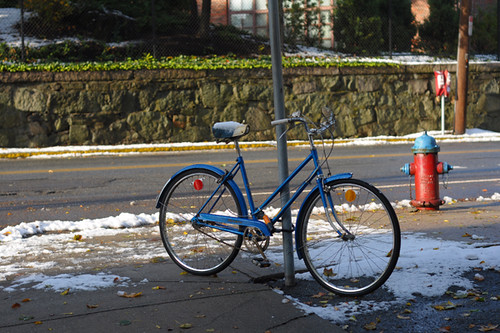
Snow in Somerville/Cambridge, October
With the snow bound to arrive any week now, I am hearing local cyclists talk about "winter bikes" again. Before my first winter of cycling, the very notion surprised me. You're supposed to ride a different bike in the winter than you do during the rest of the year? why?? But then I understood that not everyone's transportation bicycle is a "tank" that is already winter-proof. Some bikes are more suitable for winter conditions than others. And while there is no one bicycle that is universally considered to be the ideal winter bike, there are certain characteristics most cyclists would probably agree are beneficial for winter commuting in snowy climates:


Stability:One reason the number of cyclists decreases so dramatically in the winter, is that cycling on ice and snow is scary. On the right bike, it is much less so. A winter bicycle should handle well on slippery, snowy, muddy and plow-ravaged winter roads. City bicycles and mountain bikes tend to do best in this respect. Those who commute on aggressive bikes during the warmer months may prefer a more relaxed and more upright bike for winter, with wider tires. If there is a great deal of snow where you live, studded tires could be a good idea, or at least knobby tires. Tame, predictable handling becomes much more important than speed in the winter months. Stepover is another factor to consider. A slippery road surface can make it easier to lose one's balance when mounting and dismounting a bike, and even those who normally ride diamond frames might prefer their winter bike to have a step-though frame or a sloping top tube.


Reliability:Related to the above, it is important that the bicycle's crucial functions - in particular, braking power and shifting ability - are not compromised by winter conditions. Rim brakes and derailleur gears can function poorly (or not at all) if clogged with snow or frozen over, which is why many prefer for their winter commuter to haveenclosed hub brakes and hub (or single speed) gearing.


Durability:Understandably, cyclists may not want to expose their nice bikes to freezing temperatures and road salt, for fear that doing so might damage the frame and components. This is why some recommend getting a "beater bike" for the winter. Personally I am uncomfortable with this advice, because a beater bike is unlikely to be reliable (see above). The approach I prefer is to get a bike that is not vulnerable to the elements in the first place. A tough paintjob, stainless and aluminum components where possible, hub gears and a chaincase should get your bike through the winter relatively unscathed with little maintenance.


Visibility: Not only does it get dark much earlier in the winter months, but snowfall can further decrease visibility - making good lighting more crucial than ever.


Presentability:Just because it's winter, does not mean that we are no longer expected to look presentable at work. With road conditions messier than ever, it is important that a winter bicycle be equipped with features that protect the cyclist's clothing: full fenders, and ideally a chaincase or chainguard.


Taken together, these features suggest a number of candidates that could work especially well as winter bikes. If buying new, fully equipped classic city bikes are worth looking into: They already offer hub gears, hub brakes, a full chaincase, a resilient powdercoated frame, stable handling, generous fenders and reasonably wide tires. Recently I wrote about city bikes with mountain bike heritage, which might be particularly appropriate due to their super-stable handling. For those who prefer to put a bike together from scratch, frames with horizontal dropouts (suitable for hub and single speed conversion) and clearances for reasonably wide tires are now easily available from a number of manufacturers: Soma, Surly, Rawland, Rivendell, Salsa and Velo Orange are just a few that come to mind. For extreme conditions there are even all-terrain models that will fit monstrously wide tires, such as the Surly Pugsley and Moonlander, and the Salsa Mukluk. If you prefer to refurbish a used bicycle, an old mountain bike converted to a single speed and fitted with some upright handlebars could work nicely. Same with a vintage 3-speed, fitted with a modern wheelset with hub brakes.


It goes without saying that not everything mentioned here will be applicable to every cyclist who reads this. The kind of winter bike that is ideal for you will depend on everything from the harshness of your winters, to the character of your route, to your bike handling skills, to your bike storage situation, to the amount of time you are willing to devote to bike maintenance, and to the type of clothing you wear when cycling for transportation. Your current bike may already be a winter bike, either as is or with minor modifications. Or you may need to get an additional bike specifically for winter cycling. My own preference gravitates toward classic city bicycles, and those I've owned have made great winter bikes. But I've been increasingly curious to try a mountain bike with knobby tires and see how that compares. What is your idea of a winter bike?

Evacuation and Damage

The Park remains closed until further notice. For updated information, call 360 569 2211 ext 9.
The onslaught of rain continued throughout the night. The Paradise telemetry recorded another 7 inches, bringing the total to 18 inches of precip over the course of the storm... and it's still raining!

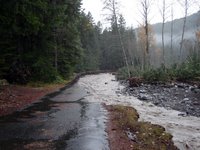
Aside from the rage of the Nisqually River, Longmire is a relatively quiet place. The NPS has closed its offices, and only essential personnel are allowed in through a backroad (which is largely washed out and requires shuttles). See image above, taken near the Eagle Peak Trailhead...
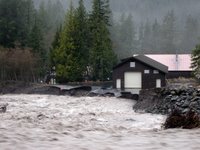
The flooding has seriously damaged or threatened many of the roads (and even a few of the facilities) in the park. This image was also taken from the Longmire backroad below the Community Building. You can see where the road once existed.

Longmire is isolated by washouts and mudflows, so it feels like a safe little island. Well, "safe" unless you're in the Emergency Operations Center (pictured left) which is being undermined by the Nisqually River... Oh, and some of the electrical and water systems are also damaged, but most of the facilities will probably survive the storm.


I'll provide updates when possible. If you plan on visiting this side of the park anytime soon, consider that it's going to take a few days to repair the main road between the Nisqually Entrance and Longmire. I hear that it's completely washed out near Sunshine Point Campground. And speaking of that campground, it's GONE.

Thursday, January 9, 2014

Lassen Volcanic National Park

After leaving Sheri's place on Monday (June 28th), I stopped for two nights at Manzanita Lake Campground on the north side of Lassen Volcanic National Park, several hours drive north of Stockton and about 60 miles east of Redding. It was more or less on the way to my Fourth of July destination.

I was aware that the highway through the park was only open about 10 miles on either end so you couldn't drive all the way through. Also, the Lassen Peak Trail was not yet open. (If this trail is one you might want to do this summer, check their website first. It will be closed periodically during the summer for restoration.) There are plenty of other trails, some quite easy, such as the 1.8 mile loop around Lake Manzanita and the half-mile paved trail in the Devastated Area.

Lassen Peak from the west side of Lake Manzanita on the afternoon of my arrival.

A closer view of Lassen Peak from the west side of Lake Manzanita.

On the morning of my second day at Lassen, a prescribed burn was being done by the Park Service on the northwest side of Lake Manzanita. The wind carried the smoke away from the campground area but the acrid smell of the burning brush permeated the air.

I stopped at the visitors center, which was engulfed in smoke as it was in the direct path of the wind though a safe distance from the burn area, to get a park brochure and some information (it was closed when I arrived the night before). Even though the road through the park was not open, if you wanted to do some driving, you could access all four corners of the park. There were campgrounds on the south side so I could have gone that way and spent the night on that end of the park but it was in the opposite direction I was headed and would have added several more hours onto an already long trip. Instead, I relaxed around the campground and took a few short walks.

Saturday, January 4, 2014

Fuel for the Soul

The first of the iris started coming out of their 'cocoons' late yesterday afternoon and this morning two of them were in full bloom. They are one of my favorite flowers, so delicate and a bit whimsical. Though pretty they have no scent. They are also not the easiest flower to photograph. There are so many aspects to them and the color changes a little depending upon the light.


I cut one Iris and took it inside to get a full view of it. From the petals tip-to-tip the flower is a little over 8" across. Several of the plants are "twins" with two blooms at the top of the stalk. There are 12 plants and most of them have 3 to 4 blooms coming on. Absolutely Gorgeous! flowers to feed the soul...

Aspen Meadows


Another Sunset


Cascade River Aurora


Northern Lights over the Cascade River where it crosses The Grade near Grand Marais, MN. Last night my friend Roger and I were out looking for the Northern Lights and were disappointed by the heavy cloud cover and rainfall that dominated the early part of the evening. Eventually, though, the clouds parted and treated us to some incredible Aurora viewing. A couple of days ago there were a couple of Coronal Mass Ejections that left the sun and were headed straight at Earth. At first spaceweather.com was saying when the CME's hit our atmosphere they did NOT trigger any geomagnetic storms. After the initial impact, however, the arrival of the CME's compressed Earth's magnetic field and lit up Auroras around both poles.


Friday, January 3, 2014

Close Encounters :: Devils Tower

Friday, August 26th - - After spending a couple of hours at the Mammoth Site the trail lead northward once again.


Mother Nature put on a fantastic display of clouds, constantly changing with the wind. Several times I just “had” to pull off onto the side of the road to take a few quick shots. Shortly after this picture was taken, there was hardly a cloud to be seen in the sky!


It was just a few hours drive to my next destination – one that I had wanted to visit for quite some time - Devils Tower National Monument in northeast Wyoming. It's hard to believe that it has been more than 30 years since “Close Encounters of the Third Kind” was released - I've loved the movie and Richard Dreyfus ever since!


A tantalizing southern view of Devils Tower from the drive into the campground.

It was late afternoon when I arrived and the temperature was in the low 90s. I was thankful that the campground was full of trees that provided plenty of shade, and there was a light breeze blowing. After selecting my campsite and grabbing a bite to eat, I drove up to the visitor center, which is near the foot of the Tower.


I had planned on walking the 1.3 mile trail around the base of the Tower the next morning when it would likely be cooler. But I walked a short distance up the trail and just kept going. There were few people on the trail and the only sounds you could hear were of the wind blowing through the trees, a few birds now and then, and those of your own imagination. Far above the top of the Tower there were birds floating on the airstream.


In 1906, President Theodore Roosevelt designated Devils Tower as our first national monument. One of the most popular Native American legends tells of the origin of the Tower:

One day, an Indian tribe was camped beside the river and seven small girls were playing at a distance. The region had a large bear population and a bear began to chase the girls. they ran back toward their village, but the bear was about to catch them. the girls jumped upon a rock about three feet high and began to pray to the rock, “Rock, take pity on us; Rock, save us.”
The Rock heard the pleas of the young girls and began to elongate itself upwards, pushing them higher and higher out of reach of the bear. The bear clawed and jumped at the sides of the rock, and broke its claws and fell to the ground. The bear continued to jump at the rock until the girls were pushed up into the sky, where they are to this day in a group of seven little stars (the Pleiades). The marks of the bear claws are there yet.


Scientists say that the Tower is actually the core of a volcano that has been exposed after millions of years of erosion brought on by the Belle Fourche River as well as the wind and rain. The rocks and boulders around the base of the tower are actually broken pieces of columns that have fallen from the sides. Read more about Devils Tower on Wikipedia.


The light was quickly fading as I finished my hike around Devils Tower. Heavy clouds had moved in and off in the distance I could see flashes of lightning. As I walked across the parking lot to Van Dora I felt a kind of chill even though the temperature was still in the upper 80s. The wind had picked up and a strong breeze was blowing.


Returning to the campsite I watched the lightning flashing through the clouds. It wasn't your “normal” streaks of lightning, rather it caused a kind of glow in and around the clouds that made them stand out in the growing darkness. It rained for about 45 minutes and the front moved through, which cooled the air somewhat. However, it was rather eerie given the location – all we needed was the colored lights to go along with the thunder and lightning!


Saturday, August 27th - - Above, Devils Tower in the early morning light. It rises 865 feet atop the hill upon which it stands.


This sculpture titled “Circle Wind – Circle of Sacred Smoke” by Junkyu Muto stands near the entrance to the campground. Devils Tower is a sacred place to Native Americans.


Probably the most “recognizable” view, from the east side, this was taken as I left the area later in the morning.


Gilman Bridge

these are views from the Gilman Bridge just off the main road going to Jemez Springs. Gilman is an even smaller village. The Jemez Creek flows under the bridge. We stopped to see how well the water was flowing in this time of drought and found it doing ok on this day. I expect it will be really down in a few weeks if we don't get some rain. This water is probably the last of the spring snow melt water.